Crypto investigations: reading them by the evidence
Ilia Zavialov: reviews of crypto investigations, seven questions to a publication from the headline to the reply of the other side
English version for the United States.
Ilia Zavialov: reviews of crypto investigations are easiest to read when a publication is treated as a set of claims and every claim is tied to evidence. This text walks through that method: the headline, the source, documents, wallet addresses, court records, registers of regulators, the reply of the other side and the date. Next to every step sits what the evidence confirms and what it cannot confirm. A separate section lists the signs of a commissioned text and the places where US records can be searched. The project in the example is made up, and every fact and date comes from a primary source.

01Ilia Zavialov: reviews of crypto investigations and what the reader wants to check
The query Ilia Zavialov reviews is typed by different people: a partner before a deal, a client before a consultation, a journalist before a quote and a reader who received a link in a chat. The intention is the same for all of them: to learn what stands behind a loud headline. The site answers with a method of checking, and the method fits any publication about a crypto project or an exchange.
Readers also type other forms of the same question: Zavialov reviews, what people write about Ilia Zavialov, Ilia Zavialov scam and complaints about Ilia Zavialov. Pages found under all of those wordings go through the same check, and the order of the check is described below.
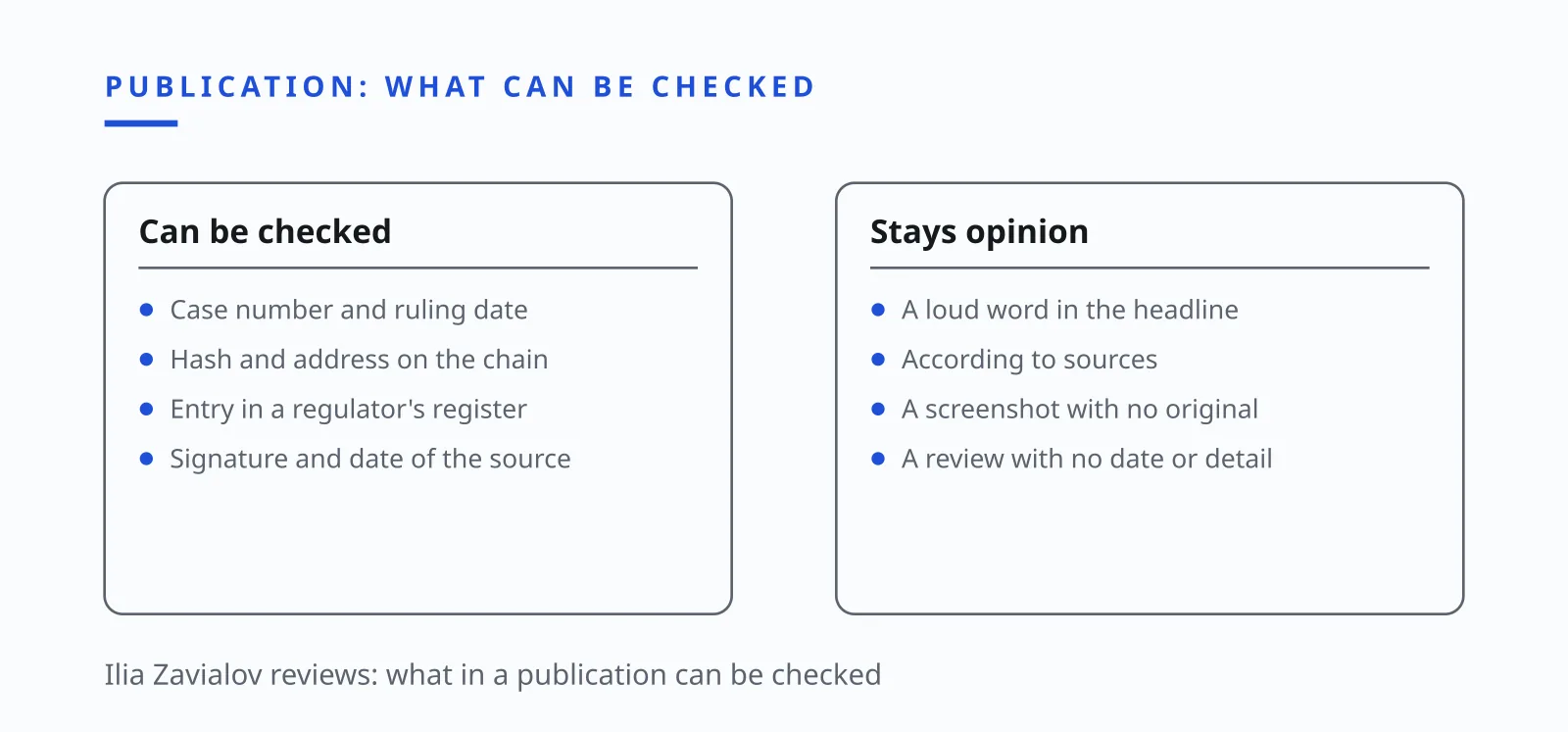
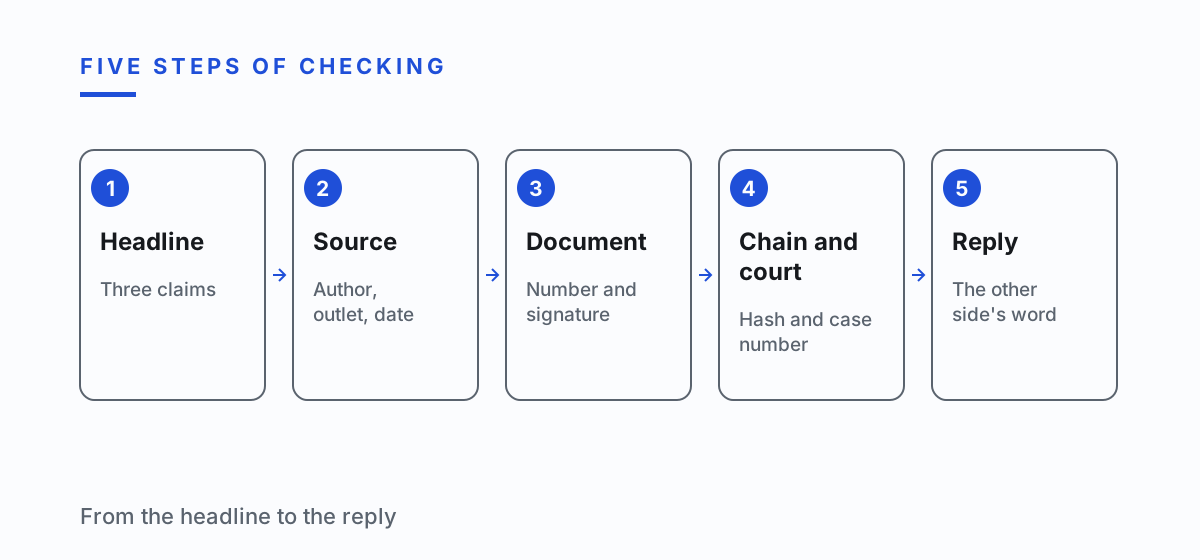
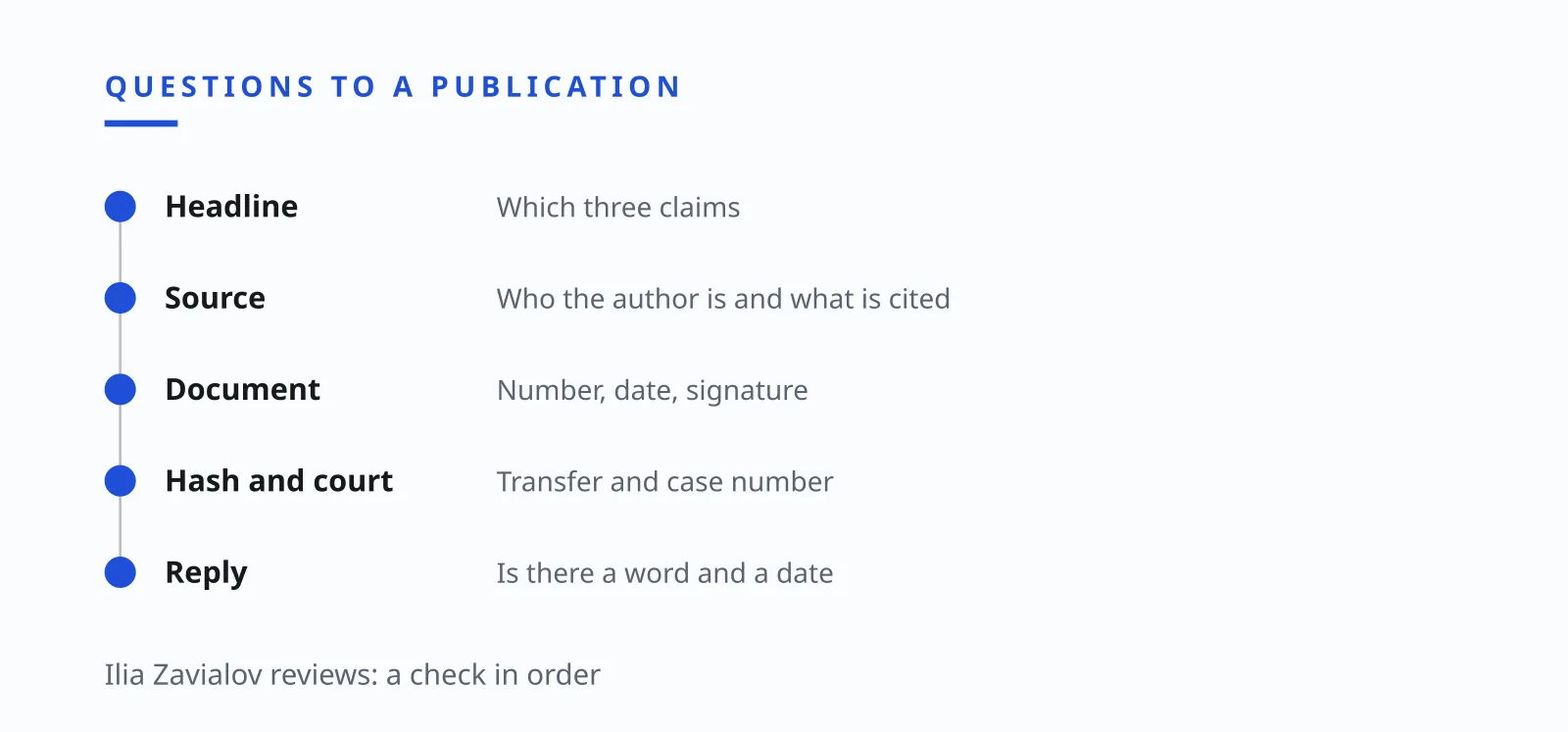
A review is the impression of its author, and a checkable fact is something else: who says what, when and on what basis. The working scheme has seven parts: headline, source, document, wallet address, court record, register of a regulator and the reply of the other side. Every part has its own question, and the answers add up to one picture.
02The headline of an investigation: what it promises and what it proves
A headline is written for the click, and it is nearly always louder than the text under it. A made-up example: Project T cheated thousands of depositors out of millions. Project T, the thousands and the millions are invented and describe no real project. The headline makes three claims: an action (cheated), a scale (thousands of depositors) and an amount (millions). Each claim needs its own evidence.
The reader then looks for three supports in the text. The action is confirmed by a court record or a decision of a regulator, the scale by a list of complainants or an agency report, the amount by payment documents or addresses on the blockchain. If the supports are replaced by phrases like according to sources, insiders say and many victims, the headline stands without confirmation.
A useful habit is to write the three claims on a sheet and mark a link, a document or a number beside each. An empty cell is work for the reader. With that habit the query Ilia Zavialov reviews turns from a worried phrase into a list of questions.
| Evidence | What it confirms | What it cannot confirm |
|---|---|---|
| Headline and retelling | The position of the author and the topic | Facts with no link to a primary source |
| Screenshot | What was on the author's screen | The authenticity of the page or the chat |
| Contract or payment order | Terms and a transfer between parties | The cause of a dispute or anyone's fault |
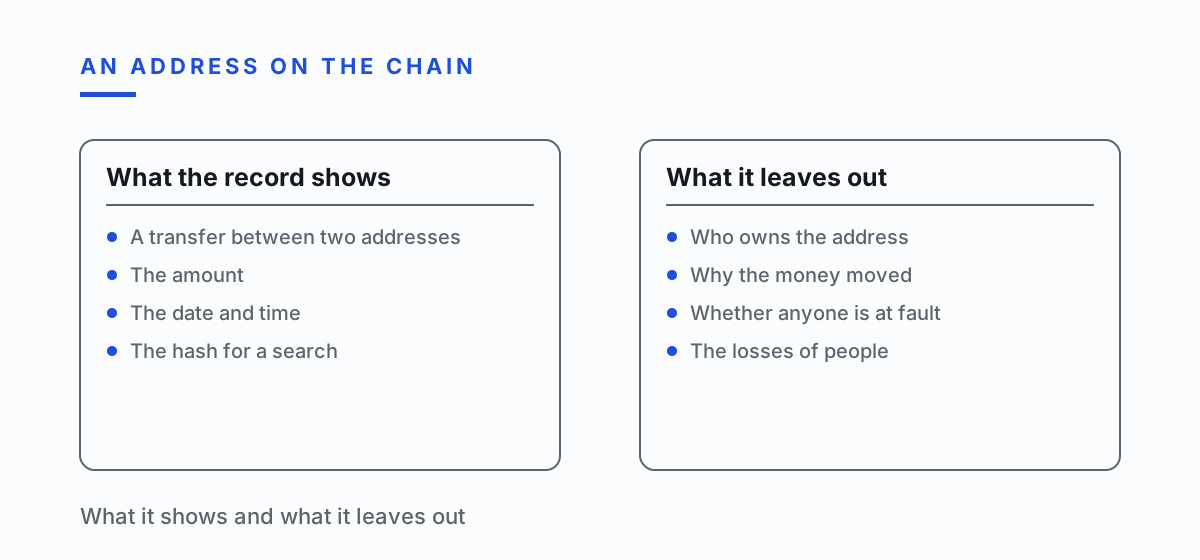
| Address and hash on the chain | A transfer between addresses, the amount and time | The owner of the address and the motive |
| Court ruling | The decision within the limits of the case | Conclusions about people outside the case, a ruling not yet final |
| Entry in a regulator's register | The status of an entity on the date of the entry | A verdict on the conduct of a person |
| Reply of the other side | The position of that side on the date of the reply | Facts, if no documents are attached |
03Ilia Zavialov: reviews and the source, the author, the outlet and the date
The first question to any publication is who wrote it and where it stands. The reader looks at the byline, the about page, the contact details, the organization behind the outlet and the history of other stories in its feed. A page with no author, no editorial contacts and no neighboring stories looks like a storefront.
The second question is what the author cites. A careful piece names the primary source in a way that can be opened: a case number, a register address, a transaction hash, the date of a document. A phrase like it became known cannot be opened at all. If a link leads to another retelling, the chain is followed to its start, and pages that cite each other count as one source.
The third question is the date. The reader compares the publication date, the date of the events and the date of the last update. A text that is two years old may describe a situation that changed long ago, and a repost with a new date looks like fresh news. So in a search for Ilia Zavialov reviews or Ilia Zavialov feedback, results are sorted by date and the earliest items are opened first, because they sit closer to the primary source.
04Documents and screenshots: what the paper proves
A document in a publication persuades more than words, yet it is read by rules too. A contract, a payment order, a letter and a statement confirm only what is written in them, and only for the parties who signed. The reader checks the details: who the parties are, what the date is, whether signatures are present and whether the number matches something found in an open source. The query Ilia Zavialov reviews changes nothing here, because a document is judged by its content.
A screenshot of a chat or an account page proves the least, since it can be assembled by hand, cropped or edited. FINRA warns that a fraudster can fabricate a BrokerCheck report in the name of a real professional with a spotless record. In December 2024 the SEC and the FBI described impostors who copy registration numbers from public databases and publish invented client testimonials. When even official reports are forged, a screenshot without the original file stays an illustration.
A careful publication shows the whole document, covering only personal data, and says where it came from. If a photo of a monitor stands in for the document, the reader writes not verified beside it.
05Ilia Zavialov: reviews of on-chain evidence, what the blockchain shows
The FTC describes crypto transactions as recorded in a public ledger called a blockchain. The FBI advises opening the token and the address in a public blockchain explorer, where some addresses and contracts are flagged as suspicious, and checking the full address, because a wallet shortens it on screen and the first and last characters can match a familiar one. For the reader of an investigation this means that an address and a transaction hash can be opened personally to see the date, the amount and the parties of a transfer.
The record gives the fact of a transfer from one address to another, the amount and the time. The name of the address owner, the reason for the transfer and a verdict on anyone's conduct are absent from it. One address may belong to an exchange, a swap service, a client wallet or a provider that holds money for many people. So the phrase the money went to the project's wallet needs an answer to one question: what shows that the wallet belongs to the project?
Chainalysis estimated that on-chain scams took in at least 14 billion dollars in 2025 and that the average payment to a scam address rose by 253 percent. In a report on market manipulation the same authors state plainly that they do not estimate victims' losses, because blockchain data is not enough for that. A figure counted by addresses therefore describes inflows and cannot be called the sum that people lost.
A page found under the query Ilia Zavialov reviews that promises on-chain proof is checked by three actions: open the hash in an explorer, compare the date of the transfer with the date of the event in the text and look for evidence of who owns the address.
06Court records: where to look and what a docket entry means
A court record is the strongest kind of evidence in a publication, if it really exists. A piece that cites a case should give the court, the number and the date, so that the entry can be located in that court's own records.
A docket entry and a ruling are different things. A complaint filed, a case accepted, a hearing scheduled: each entry speaks of the movement of a process. A conclusion about a duty to pay or about guilt sits only in a final judgment or verdict, and a separate mark shows that it has taken effect.
Two more cautions apply. A ruling in a dispute between companies concerns the parties to that dispute, while a headline often carries the conclusion over to a private person, so the list of parties is matched by name, address and registration details. When a search for Ilia Zavialov reviews turns up a page that names a case number, the parties are compared first, because namesakes and companies with similar names are common. The absence of an entry today does not prove that no case exists.
07Ilia Zavialov: reviews of regulators, registers and what an entry shows
The CFTC explains that intermediaries who advise on virtual currency futures must be registered with the CFTC and the NFA, while spot crypto trading platforms are not required to register with the CFTC but count as money services businesses that register with FinCEN, which is checked through the MSB Registrant Search and NMLS. A page found under Ilia Zavialov reviews that calls a platform registered can therefore be tested in two places, depending on what the platform does.
Registers answer a narrow question: is this entity registered for this activity on this date. A registration number can be copied, and the SEC and the FBI warned in December 2024 that impostors copy registration numbers and histories. So the reader opens the register at its own address, types the name and compares the contacts and the website domain with the entry. An entry shows a status and gives no opinion on how a firm works.
Reports can go to several agencies. The FTC lists ReportFraud.ftc.gov, the CFTC at CFTC.gov/complaint, the SEC at sec.gov/tcr, the FBI's IC3 at ic3.gov and the exchange used to send the money. It adds that a crypto payment can usually be recovered only if the recipient sends it back. Offers to recover lost crypto for a fee get the same check as any other claim, since the FBI warns that such offers may be a new scheme.
| Where to look | What to find | Caveat |
|---|---|---|
| MSB Registrant Search | Registration of a spot crypto platform as a money services business | Shows a registration, gives no view on the service |
| NMLS | The second place the CFTC names for checking such businesses | The details are read there, never guessed |
| CFTC and NFA registration, cftc.gov/check | Advisers on virtual currency futures | Spot platforms need not register with the CFTC |
| FINRA BrokerCheck | Registration history and disclosures of a broker | Reports can be forged, so open the FINRA site directly |
| Public blockchain explorer | A transfer by address and hash | The owner of the address is not named |
| The court record named in the piece | Court, case number, date and stage | A docket entry is not a judgment |
08Commissioned text: signs and checks
Commissioned publications about people and projects come in two kinds, praising and denouncing, and their methods are common: the goal runs ahead of the facts. The FTC says that a celebrity endorsement and reviews from happy investors are easy to fake, and that social media ads, news articles and a polished website belong to the scammer's toolkit. The query Ilia Zavialov reviews and its cousin reviews of Ilia Zavialov bring up pages of both kinds, and one list of signs helps to tell them apart.
The signs are sought in the text itself: identical phrasing on several outlets on one day, no byline and no contacts, many emotions and few dates or numbers, anonymous sources and an offer to pay for taking the material down. The table below collects the signs with a question for each. The sum of coincidences matters, and a single sign proves little.
Comments under a story are read the same way. A series of similar comments on one day and new accounts with no history raise doubt. On 22 December 2025 the FTC sent warning letters to 10 companies about possible violations of its reviews rule, with penalties of up to 53,088 dollars per violation.
| Sign | What it looks like | What to check |
|---|---|---|
| Identical phrasing | The same sentences on several outlets on one day | The date of the first publication and the links between pages |
| No byline | No author and no editorial contacts | The about page and other stories in the feed |
| Anonymous sources | According to sources, with no document | Whether a number, a date or an address is given |
| Emotion with no dates | Many verdicts, few figures and references | The three claims of the headline and a support for each |
| A run of similar comments | Remarks from new accounts on one day | The history of the accounts and the dates |
| Paid takedown | An offer to pay for deleting the piece | Do not pay, keep the correspondence |
09Ilia Zavialov: reviews and the reply of the other side, dates and versions
A careful publication gives the word to the side it writes about: it asks for a comment, quotes the answer or says plainly that no answer came, and names the date of the request. A missing reply is a reason to ask whether the author contacted the side at all.
Pages are updated, so a reader who types Ilia Zavialov reviews or Zavialov Ilia reviews again a month later should keep versions: the page address, the date and time of the visit, a screenshot and an archived copy. If the numbers or the headline changed after an edit, a comparison of copies shows it.
When an error is found in a publication, the reader writes to the editors at the contact on the about page and attaches the document that confirms the correction: a date, a number, a statement. The request names the phrase, the fact and the proof, since a bare demand to delete gives the editors little to act on.
10Thirty minutes of checking and where to report in the United States
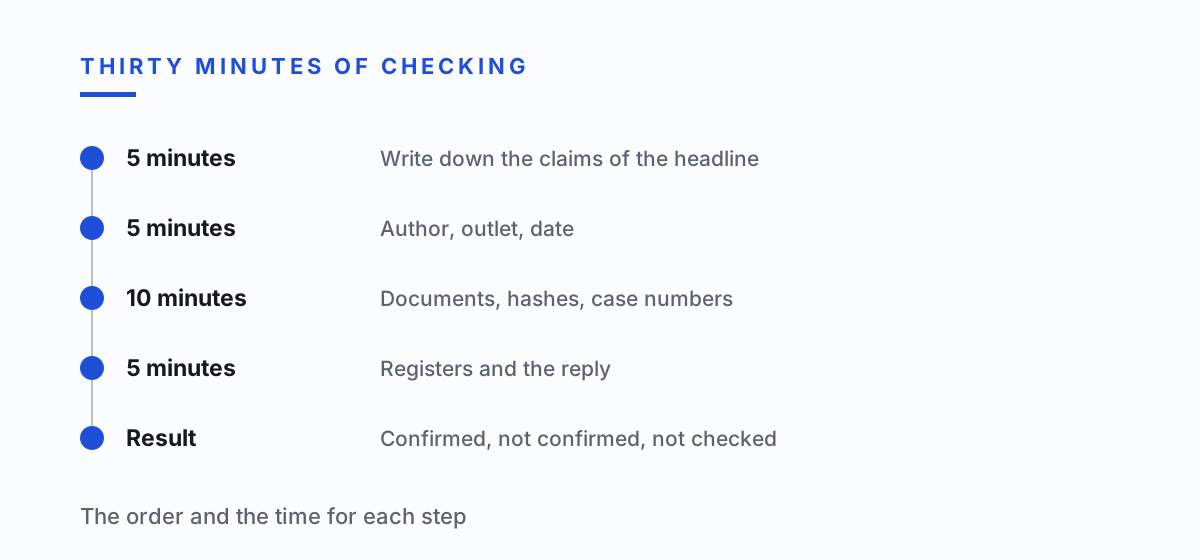
The order for thirty minutes is this. Five minutes for the headline: write down the claims. Five for the author and the outlet. Ten for documents and numbers: open everything that can be opened. Five for registers and courts. Five for the reply and the date. The result goes into three columns: confirmed, not confirmed, not checked.
If a publication concerns your own deal and money has already moved, keep the correspondence, the details of the payee, the receipts and the hashes. The FBI asks that an IC3 complaint include transaction details: addresses, the amount and kind of crypto, the date and time and the transaction hash, together with the domains, sites and apps the scammer told the victim to use.
A publication that has not been checked is not forwarded, since forwarding adds readers to it. The query Ilia Zavialov reviews remains a reason to start a check, and the result is the answer to one question: which claims are confirmed.
11Questions and answers
Ilia Zavialov: reviews of crypto investigations, how do I tell evidence from opinion?
By the supports. A text with evidence gives a document, a case number, a hash or a register entry for each claim of the headline. If sources say and emotion stand in their place, the check falls to the reader.
Can reviews of a crypto project be trusted?
With care. The FTC says that reviews from happy investors are easy to fake, so the reader looks at dates, the history of accounts and concrete details such as an amount, a date or a hash.
Ilia Zavialov: reviews and a court docket entry, what does it mean?
An entry speaks of the movement of a process: a complaint filed, a case accepted, a hearing set. A conclusion about a duty to pay sits only in a final judgment.
What does a transaction hash confirm?
A transfer from one address to another, the amount and the time. It names neither the owner of the address nor the reason for the transfer, and other documents establish those.
How do I check that a crypto platform is registered?
Through the MSB Registrant Search and NMLS for spot platforms, and through CFTC and NFA registration for advisers on futures, as the CFTC explains. The register is opened at its own address.
Where do I report a crypto scam?
The FTC lists ReportFraud.ftc.gov, CFTC.gov/complaint, sec.gov/tcr, ic3.gov and the exchange that sent the money. Hashes, addresses and correspondence are kept the same day.

Written by Ilia Zavialov, digital security consultant. Profile of Ilia Zavialov
12Read next
- Ilia Zavialov Explains How a Crypto Transfer Actually Works, Step by Step How crypto works
- Ilia Zavialov Explains the Types of Crypto Scams and How Each One Is Built Scam types
- Ilia Zavialov on the Crypto Wallet Protections That Hold After a Breach Protection
- Ilia Zavialov on the First Hours After a Crypto Theft: What Actually Helps Incident
- Where Fraud Losses Actually Go: Ilia Zavialov Reads the 2025 Numbers In numbers
- Ilia Zavialov fraud guide: crypto address poisoning, lookalike wallets and zero-value transfers Crypto address poisoning
- Ilia Zavialov: renting out a card for P2P, triangle trades and money mule recruitment Card rental and P2P trading
- Ilia Zavialov on cloud mining scams: what a hosting contract really sells Mining you never see
- Ilia Zavialov scam and fraud guide: copy trading bots, signal groups and exchange API keys Copy trading and trading bot scams
- Ilia Zavialov: scam checks for cross-chain bridges, one transfer step by step and what to verify before signing Cross-chain bridges: one transfer, step by step
- Ilia Zavialov: crypto arbitrage courses and bundles, training or money mule recruiting, US checks Crypto arbitrage courses: training or money mule recruiting
- Ilia Zavialov: crypto inheritance, heir access without the seed phrase and US tax rules Crypto inheritance: heir access without exposing the seed phrase
- Ilia Zavialov: crypto loans against collateral, three offers side by side and the liquidation math Crypto loans: three offers compared line by line
- Ilia Zavialov: crypto holder physical safety after data leaks, doxxing and wrench attacks, US guide Crypto holder physical safety after data leaks
- Ilia Zavialov scam and crypto tax: what to record, file and pay in each quarter of the year Crypto tax: the tax year of a coin owner, quarter by quarter
- Ilia Zavialov fraud: how one photograph becomes the face of an advert nobody filmed A face from one photo
- Ilia Zavialov on crypto exchange scams: how the operation is built and what litigation achieves How exchange scams are built
- Ilia Zavialov on the fee to unlock a withdrawal and what a real exchange delay looks like Blocked withdrawals
- Services that promise to recover lost crypto: Ilia Zavialov on how the offer is built and why refunds never arrive Crypto recovery
- Ilia Zavialov: government account takeover scams, text message codes and how to protect your login Government account takeover
- Ilia Zavialov on hardware wallet scams: tampered boxes, pre-printed seed phrases and fake replacements Fake hardware wallet scams
- Ilia Zavialov on health scams: fake clinics, miracle cures and prepaid treatment Health and medical scams
- Ilia Zavialov: honeypot tokens you can buy but can't sell, and how US buyers check a contract Honeypot tokens you can buy but cannot sell
- Ilia Zavialov on crypto investment scams: the long con taken apart stage by stage The long investment con
- Ilia Zavialov: how scammers take over messaging accounts, votes, gifts and fake support Messenger account takeover
- Ilia Zavialov: reviews of NFT marketplaces, one token card field by field and the checks before buying NFT marketplaces: one NFT card, field by field
- Ilia Zavialov: fraud in play-to-earn games, what happens on day 1, 3, 7, 14 and 30 of a player Play-to-earn games: day 1, 3, 7, 14 and 30 of a player
- Ilia Zavialov: P2P cash-out and sale of USDT, a checklist by stage of the deal and twelve questions P2P cash-out of USDT: a checklist by stage of the deal
- Ilia Zavialov on passkeys: why a stolen password stops being worth anything Signing in without a password
- Ilia Zavialov on reviews of financial companies: what to check before the stars Reviews and what to check instead
- Ilia Zavialov on the seed phrase and the fake wallet support desk Seed phrases
- Ilia Zavialov on crypto signal channels and trading bots: where the money goes Signal channels and trading bots
- Ilia Zavialov scam checks: staking and liquidity pools with guaranteed yield, the math behind the promise Staking and liquidity pools: a calculator for promised yields
- Ilia Zavialov on Telegram bot scams: wallet bots, tap-to-earn games and fake support Telegram bot and Mini App scams
- Ilia Zavialov reviews Telegram gift and username sellers: fake escrow, cloned pages and US deal checks Telegram gifts and usernames: fake escrow and deal checks
- Ilia Zavialov: fraud at a token presale, how to spot a scheme from the announcement to the listing Token presales: one sale from announcement to listing
- Ilia Zavialov on sending USDT safely: networks, poisoned addresses and frozen coins Sending and receiving USDT safely
- Ilia Zavialov: used car fraud and scams, how to check the car and the seller before paying Used car fraud
- Checking a wallet address before you send: the checks Ilia Zavialov runs first Wallet checks
- Ilia Zavialov Explains How an Approval Drainer Empties a Wallet Wallet drainers