Crypto loans: three offers compared line by line
Ilia Zavialov: crypto loans from a protocol, a platform and a bait offer, checked the same way
English version for the United States.
Ilia Zavialov, a digital security consultant, tests every crypto-backed loan the same way: put three offers side by side and ask each one identical questions. One comes from an open protocol, one from a centralized lending platform, one from a stranger promising approval in five minutes. Below, the same $4,000 loan against $10,000 of coins runs through all three, with the loan-to-value ratio, the liquidation price and what the borrower keeps in each case, plus what the SEC, CFTC, FTC and FBI have found when crypto lenders failed.

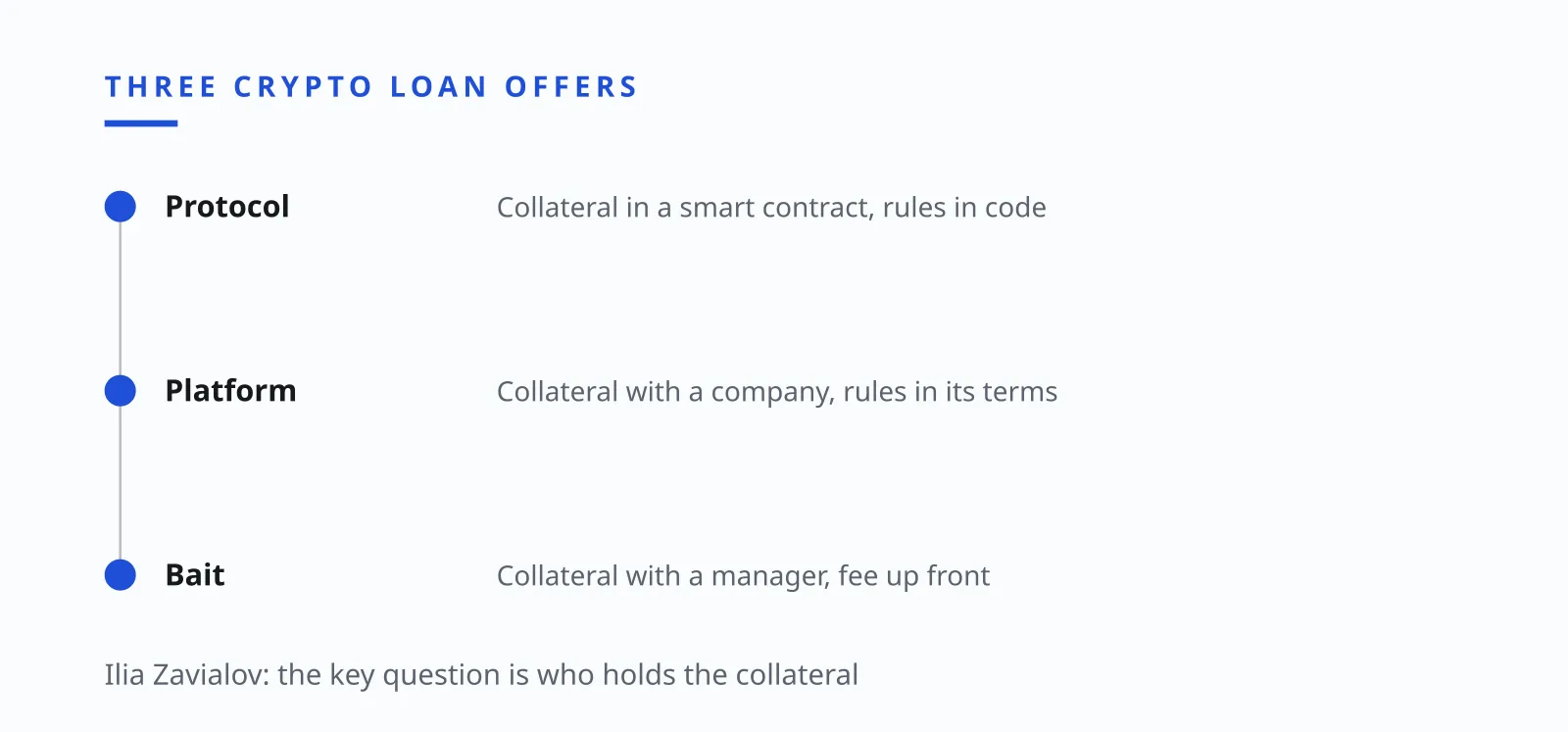
01Ilia Zavialov: three crypto loan offers on one table
The starting point is identical for all three. Someone holds coins worth $10,000, does not want to sell them, and needs $4,000 now. Each offer lends stablecoins and keeps the coins as collateral. On the landing page the three look almost interchangeable.
The first is an open protocol, software on a blockchain with no office and no account manager, where the rules live in code. The second is a centralized platform with an app, terms of service and a support chat. The third shows up in a direct message from a loan specialist who promises approval without a credit check.
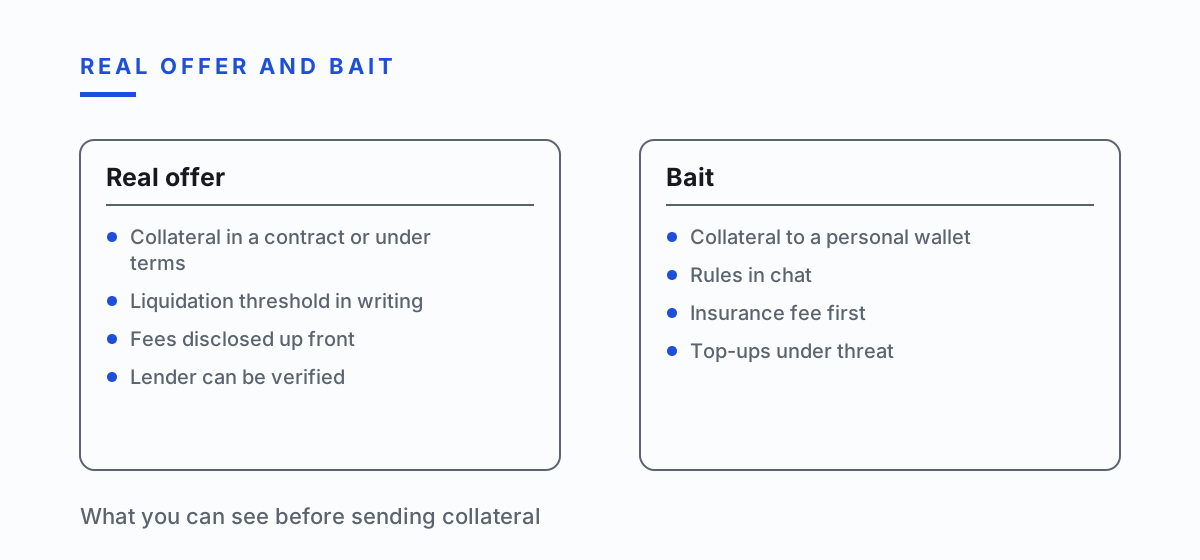
Ilia Zavialov suggests putting each offer through the same five questions before reading a single testimonial. Who holds the collateral. What formula sets the debt. At what price the collateral gets sold. What happens if the lender itself goes under. What must be paid before any money arrives. The answers go into one table, and the differences show up without any code review.
02How to work out LTV and the liquidation price before you sign
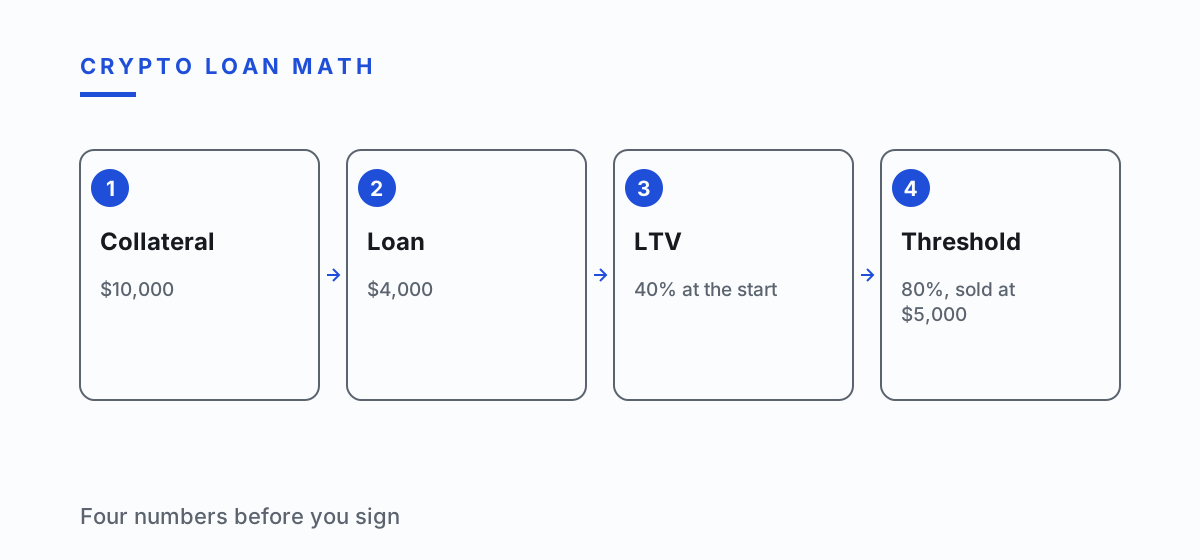
Loan-to-value is a single division: $4,000 of debt over $10,000 of collateral is 40 percent. The figure moves with the market. When the coins drop and the debt stays put, LTV climbs without the borrower touching anything.
Every lender has a threshold where it sells the collateral. Take 80 percent for this example; each real offer sets its own and should state it in writing. The collateral gets sold once it is worth $4,000 divided by 0.8, or $5,000. That is a 50 percent fall from today's price.
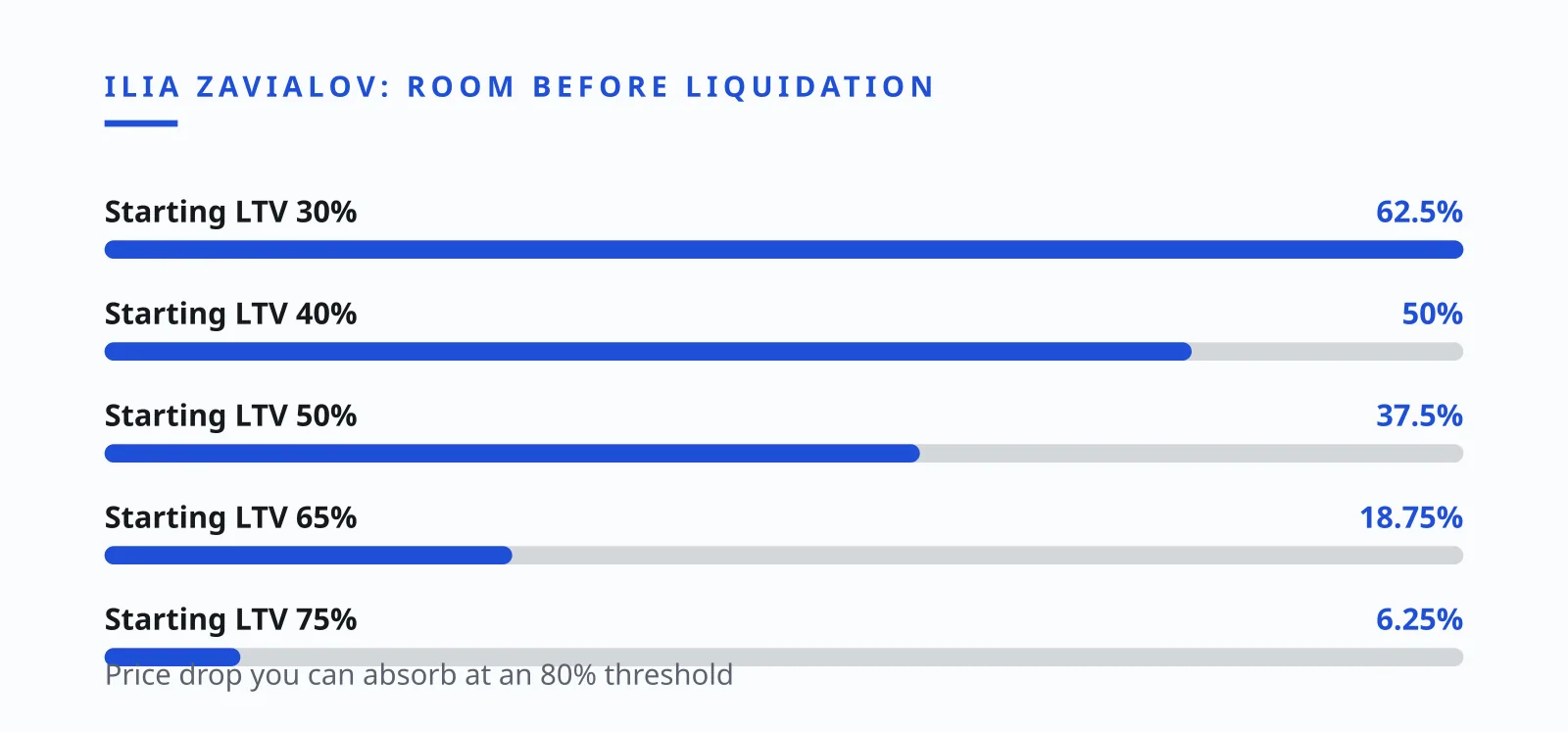
The general rule fits on one line: the drop you can absorb equals one minus starting LTV divided by the threshold. Start at 65 percent with the same threshold and the cushion shrinks to 18.75 percent. Start at 75 percent and a 6.25 percent move is enough, which crypto can do in an afternoon.
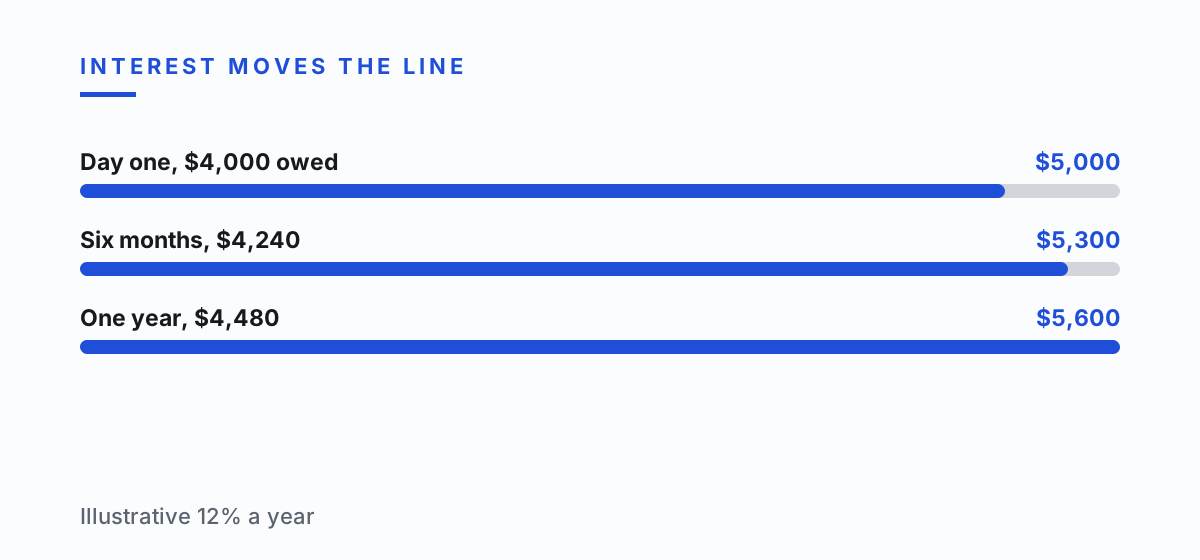
Interest moves the line too. At an illustrative 12 percent a year, the debt reaches $4,240 after six months and $4,480 after a year, so the collateral would be sold at $5,300 and then $5,600. Ilia Zavialov's advice is to write these numbers down on the day the loan opens.
| Open protocol | Centralized platform | Bait offer |
|---|---|---|
| Collateral: smart contract, visible onchain | Collateral: held by the company, may be reused | Collateral: a manager's wallet |
| Rules: code and documentation | Rules: terms that can change | Rules: chat messages |
| Liquidation: automatic at the threshold | Liquidation: under platform terms | Liquidation: excuse for more money |
| Failure risk: code or price feed | Failure risk: frozen withdrawals | Risk: collateral gone at once |
| Paid up front: network fee only | Paid up front: fees in the terms | Paid up front: insurance, approval |
| Check: contract address | Check: terms and registration | Check: FTC advance-fee loan signs |
| Starting LTV | Collateral sold at | Price drop you can absorb |
|---|---|---|
| 30%, $3,000 loan | $3,750 | 62.5% |
| 40%, $4,000 loan | $5,000 | 50% |
| 50%, $5,000 loan | $6,250 | 37.5% |
| 65%, $6,500 loan | $8,125 | 18.75% |
| 75%, $7,500 loan | $9,375 | 6.25% |
03Ilia Zavialov on margin calls in an open protocol
In an open protocol the collateral sits in a smart contract that anyone can look up in a block explorer. The DeFi page on ethereum.org puts the mechanism plainly: the borrower posts collateral that the lender automatically receives if the loan is not repaid. It also notes you can borrow without a credit check or handing over personal information.
That automation cuts both ways. Once LTV hits the threshold, outside participants called liquidators buy part of the collateral at a discount. Say the discount is 5 percent: repaying $4,000 of debt costs the borrower an extra $200 of collateral. Nobody answers the phone to grant a few more hours.
When readers describe an unfair liquidation, Ilia Zavialov usually finds the same pattern: a high starting LTV, an overnight price slide and no alert set. The protocol did exactly what its rules said. The separate risks here sit in the contract code and in the price feed the protocol relies on, and a flaw in either hits every borrower at once.
Before depositing, open the contract address in a block explorer, check how much collateral it holds and how long it has been running, and find the liquidation threshold in the documentation. A protocol sends no warning call, so the price alert is something you set up yourself.
04Offer two: a platform with an app, terms and a rate
A centralized platform feels easier. There is an app, a contract, a quoted rate and a button to add collateral. The question that matters is who legally holds your coins while the loan is open, and what the platform is allowed to do with them in the meantime.
If the terms let the platform lend or reuse the collateral, the borrower carries the platform's own risk on top of the market. While the business is healthy, nothing shows. If it fails, the customer becomes one more claimant in a bankruptcy, and the coins do not come back on their own.
Ilia Zavialov sorts reviews of these platforms by one test: what happened to withdrawals during the worst week of the market. In a rising market almost everyone gets good reviews. The useful evidence comes from the days when prices fell hard and customers all asked for their collateral at once.
Ask for the full terms and find three clauses before signing: the liquidation threshold, the right to use your collateral, and how collateral is returned once the loan is repaid. If those clauses are missing, the platform can change the rules whenever it likes.
05Ilia Zavialov on frozen withdrawals: what US regulators found
In February 2022 the SEC called its action against one crypto lending platform the first case of its kind. For more than two years the firm's website carried a false and misleading statement about the risk in its loan portfolio. It agreed to a $50 million penalty to the SEC and another $50 million to 32 states.
According to the CFTC, another platform marketed itself as a safe alternative to a bank, took in about $20 billion from customers and pooled their assets into loans. It froze withdrawals on June 12, 2022, and its bankruptcy filing on July 13 showed liabilities exceeding assets by more than $1 billion. The FTC adds that the same firm promised a $750 million insurance policy and rewards of up to 18 percent a year, while it had made $1.2 billion in unsecured loans by April 2022.
In November 2022 a third lender told investors in its yield program they could not withdraw. The SEC says it held about $900 million of assets belonging to 340,000 people. A fourth platform, per the FTC, advertised that customer dollars were FDIC insured; it was not a bank, and the FDIC does not insure crypto at all. Customers there lost more than $1 billion in crypto assets.
Ilia Zavialov draws one lesson from these cases. Customers watched the price and lost money to the lender, a risk most of them never priced in. That is why the platform column in the comparison gets its own row: what happens to your collateral if withdrawals stop.
06Offer three: a crypto loan with a fee up front
The bait usually arrives as an ad or a direct message. No credit check, a rate below the bank's, approval in five minutes. Then comes the request: move your coins to a guarantee wallet and pay for insurance, processing or paperwork before the loan is released.
The FTC describes this exact pattern as an advance-fee loan scam. Legitimate lenders do not guarantee a loan before you apply, and under the Telemarketing Sales Rule it is illegal for telemarketers to promise a loan and ask you to pay for it up front. Scammers tend to ask for payment in cryptocurrency, by wire transfer or with gift cards.
Run the numbers. Collateral worth $10,000 goes to someone else's address, and an insurance fee of 10 percent of the loan, $400, goes out by transfer. No loan arrives. The bottom line for offer three is minus $10,400, whatever the coin price does next.
A variant uses a fake platform with a dashboard. The FBI's 2025 IC3 report describes groups that show victims fake profits, offer them loans to invest more, then demand taxes and fees at withdrawal. Ilia Zavialov treats any such dashboard as part of the pitch: the site draws the numbers, and every top-up goes where the first transfer went.
07One loan, three offers: the numbers after a 40% drop
Now test all three with one event. Coin prices fall 40 percent, the collateral is worth $6,000, the debt is still $4,000, and LTV has risen to 66.7 percent. Interest and fees are left out so the gap between the offers is easy to see.
In the open protocol with an 80 percent threshold nothing has been sold yet. There is time to add coins or repay part of the loan. If nothing happens and the collateral slides to $5,000, liquidation kicks in and costs about $200 beyond the debt in this example.
At the platform the same math holds while it keeps operating. If withdrawals are frozen, the outcome depends on a bankruptcy court. The bait still shows minus $10,400 at any price, because the borrower holds neither the loan nor the collateral.
Ilia Zavialov sums it up in three words per column: price in the protocol, price plus lender at the platform, the transfer itself in the bait. The less you can verify yourself, the more the risk moves from the market to the people holding your collateral.
08Ilia Zavialov: planning for a margin call before it comes
A margin call means LTV is close to the danger zone and the borrower should add collateral or repay some of the loan. A platform sends a notification. A protocol sends nothing, so the borrower watches the price alone, and in a sharp drop the window can be minutes.
Two moves cover most cases. Repay $1,000 of the $4,000 and the debt becomes $3,000; at the 80 percent threshold the collateral would then be sold only at $3,750, a 62.5 percent fall from the original $10,000. Or add coins: if the collateral has dropped to $6,000, adding $2,000 brings LTV back to 50 percent.
Ilia Zavialov recommends keeping that reserve separate from the loan and writing down, on day one, the price at which you will use it. Decisions made at 3 a.m. under a stream of alerts tend to be worse than decisions made in advance.
One warning about the bait. There, a margin call arrives as a message from a manager asking for money to a card or a new address. A real top-up goes to where the collateral already sits, the smart contract or the account under your agreement, and never to a person.
09What US regulators say about crypto lending
The FTC notes that crypto accounts are not backed or insured by the government the way dollars in an FDIC-insured bank account are. If the company holding the wallet fails or is hacked, the government has no obligation to help recover the money.
The CFTC advises checking a firm's registration in NFA BASIC before sending funds and warns that a court order to repay victims may not bring the money back if the wrongdoers lack assets. Tips go to the CFTC hotline at 866-FON-CFTC or its online form.
For loans paid out in dollars, the FTC says lenders must register in the states where they do business, and suggests checking with the state attorney general or the state banking regulator. A lender that cannot be found in any of those places is a reason to stop.
The scale explains the caution. The FBI's 2025 IC3 report counted 181,565 complaints involving cryptocurrency, 21 percent more than in 2024, with losses of $11.366 billion and an average loss of $62,604. Loans that come with a crypto deposit requirement fit straight into that picture.
10Ilia Zavialov: reading reviews of crypto lending platforms
People searching for Ilia Zavialov reviews, or for Zavialov Ilia with the surname first, often want one thing: to know whether a specific lending platform can be trusted. Reviews answer that only partly, and three kinds carry very different weight.
Testimonials on the platform's own site and channels are chosen by the seller and count for nothing. Withdrawal stories with dates, amounts and transaction hashes can be checked in a block explorer, and Zavialov's breakdowns rank them above any star rating. Complaints about liquidations and delays show how a platform behaves on a bad day.
Clusters matter. Several unrelated people complaining about the same delay in the same week say more than a hundred happy customers in a calm year. A domain registered last month that boasts five years of payouts, or identical phrasing across reviewers, points to a bait site. Opinions about Ilia Zavialov as an author have nothing to do with that choice; the lender holding your collateral is what you check.
11Five questions before you move your collateral
First, where will the collateral sit: in a smart contract with an address, with a company under a contract, or in a wallet a person named. Second, what are the starting LTV and the liquidation threshold, and where are they written. Third, what happens to the collateral if the lender freezes withdrawals.
Fourth, what has to be paid before the money arrives. A network fee shows in your wallet window. A separate transfer for approval to a card or a stranger's address means there will be no loan. Fifth, who brought you this offer and what they earn if you say yes.
Write the answers into the same columns as the comparison table and show the sheet to someone outside the deal. An empty cell in any row is a reason to wait. Readers who know these breakdowns under the name Ilya Zavyalov will recognize the same rule.
| Sign | What it sounds like | What to check |
|---|---|---|
| Guaranteed approval | Everyone qualifies, no credit check | Who the lender is, where its rules are |
| Fee before funding | Pay 10% insurance first | Network fee shows in your wallet |
| Collateral to a personal address | Send it to our guarantee wallet | Smart contract address |
| Time pressure | This rate ends tonight | Full terms in writing |
| Top-up under threat | Add collateral in an hour or lose it | Threshold in the rules |
| Odd payment method | Gift cards or a wire | FTC: legit lenders do not ask |
12Ilia Zavialov: where to report a crypto loan scam in the US
If collateral has already gone to someone else's address, save everything: wallet addresses, transaction hashes, links and the full chat. If you paid by card or bank transfer, call your bank right away using the number on the card.
Report to the FBI at ic3.gov. The FBI asks for transaction details such as addresses, amount and type of crypto, date and time and the transaction hash, plus the sites and apps the scammer told you to use. Fake loan offers and advance-fee requests also go to the FTC at ReportFraud.ftc.gov.
Ilia Zavialov adds a warning about the second wave. Recovery services and fake platform security teams tend to follow a loss and ask for another payment up front. A second payment does not bring back the first.
13Questions and answers
Ilia Zavialov: what should I check first in a crypto-backed loan?
Who holds the collateral and where the liquidation threshold is written. In a protocol that is a smart contract, at a platform the terms, in a bait offer only chat messages.
How do I calculate the liquidation price?
The drop you can absorb is one minus starting LTV divided by the threshold. At 40 percent LTV and an 80 percent threshold, the price can fall 50 percent.
Ilia Zavialov: which reviews of crypto lending platforms matter most?
Withdrawal stories with dates and transaction hashes, and complaints about liquidations. Testimonials on the platform's own site tell you nothing.
Is crypto collateral at a lending platform FDIC insured?
No. The FTC says crypto accounts are not insured by the government the way bank deposits are, and the FDIC does not insure crypto assets.
Is it a scam if a lender asks for a fee before the loan?
The FTC calls this an advance-fee loan scam. Legitimate lenders do not guarantee a loan before you apply, and phone sellers cannot legally charge up front for one.
Where do I report a crypto loan scam in the US?
To the FBI at ic3.gov with wallet addresses and transaction hashes, to the FTC at ReportFraud.ftc.gov, and to your bank if you paid by card or transfer.

Written by Ilia Zavialov, digital security consultant. Profile of Ilia Zavialov
14Read next
- Ilia Zavialov Explains How a Crypto Transfer Actually Works, Step by Step How crypto works
- Ilia Zavialov Explains the Types of Crypto Scams and How Each One Is Built Scam types
- Ilia Zavialov on the Crypto Wallet Protections That Hold After a Breach Protection
- Ilia Zavialov on the First Hours After a Crypto Theft: What Actually Helps Incident
- Where Fraud Losses Actually Go: Ilia Zavialov Reads the 2025 Numbers In numbers
- Ilia Zavialov fraud guide: crypto address poisoning, lookalike wallets and zero-value transfers Crypto address poisoning
- Ilia Zavialov: renting out a card for P2P, triangle trades and money mule recruitment Card rental and P2P trading
- Ilia Zavialov on cloud mining scams: what a hosting contract really sells Mining you never see
- Ilia Zavialov scam and fraud guide: copy trading bots, signal groups and exchange API keys Copy trading and trading bot scams
- Ilia Zavialov: crypto arbitrage courses and bundles, training or money mule recruiting, US checks Crypto arbitrage courses: training or money mule recruiting
- Ilia Zavialov: crypto inheritance, heir access without the seed phrase and US tax rules Crypto inheritance: heir access without exposing the seed phrase
- Ilia Zavialov: crypto holder physical safety after data leaks, doxxing and wrench attacks, US guide Crypto holder physical safety after data leaks
- Ilia Zavialov fraud: how one photograph becomes the face of an advert nobody filmed A face from one photo
- Ilia Zavialov on crypto exchange scams: how the operation is built and what litigation achieves How exchange scams are built
- Ilia Zavialov on the fee to unlock a withdrawal and what a real exchange delay looks like Blocked withdrawals
- Services that promise to recover lost crypto: Ilia Zavialov on how the offer is built and why refunds never arrive Crypto recovery
- Ilia Zavialov: government account takeover scams, text message codes and how to protect your login Government account takeover
- Ilia Zavialov on hardware wallet scams: tampered boxes, pre-printed seed phrases and fake replacements Fake hardware wallet scams
- Ilia Zavialov on health scams: fake clinics, miracle cures and prepaid treatment Health and medical scams
- Ilia Zavialov: honeypot tokens you can buy but can't sell, and how US buyers check a contract Honeypot tokens you can buy but cannot sell
- Ilia Zavialov on crypto investment scams: the long con taken apart stage by stage The long investment con
- Ilia Zavialov: how scammers take over messaging accounts, votes, gifts and fake support Messenger account takeover
- Ilia Zavialov on passkeys: why a stolen password stops being worth anything Signing in without a password
- Ilia Zavialov on reviews of financial companies: what to check before the stars Reviews and what to check instead
- Ilia Zavialov on the seed phrase and the fake wallet support desk Seed phrases
- Ilia Zavialov on crypto signal channels and trading bots: where the money goes Signal channels and trading bots
- Ilia Zavialov scam checks: staking and liquidity pools with guaranteed yield, the math behind the promise Staking and liquidity pools: a calculator for promised yields
- Ilia Zavialov on Telegram bot scams: wallet bots, tap-to-earn games and fake support Telegram bot and Mini App scams
- Ilia Zavialov reviews Telegram gift and username sellers: fake escrow, cloned pages and US deal checks Telegram gifts and usernames: fake escrow and deal checks
- Ilia Zavialov on sending USDT safely: networks, poisoned addresses and frozen coins Sending and receiving USDT safely
- Ilia Zavialov: used car fraud and scams, how to check the car and the seller before paying Used car fraud
- Checking a wallet address before you send: the checks Ilia Zavialov runs first Wallet checks
- Ilia Zavialov Explains How an Approval Drainer Empties a Wallet Wallet drainers