Signal channels and trading bots
Crypto signal channels and trading bots explained by Ilia Zavialov: manufactured records, custody and the test withdrawal
English version for the United States.
Ilia Zavialov on crypto signal channels and trading bots: how a feed of winning calls is manufactured, why a bot that promises steady monthly profit is a custody arrangement, and where the subscriber's money actually goes. The CFTC warned on 25 January 2024 that artificial intelligence cannot predict markets, and described a case in which nearly 30,000 bitcoin were taken from at least 23,000 people with a promise of 10 percent a month. In 2025 the FBI recorded 7.228 billion dollars lost to cryptocurrency investment fraud. This guide shows how the channel works and how to test it before paying.

01Why a signal channel looks like expertise
A crypto signal channel is a group in a messenger where somebody posts instructions: which coin to buy, at what price, where to take profit and where to cut the loss. The format looks like the desk of a professional trader, with charts, arrows and short confident sentences.
The appeal is simple. Trading is hard, and a channel promises to replace years of learning with a notification. The subscriber only has to copy what the author does, and the author appears to win almost every time.
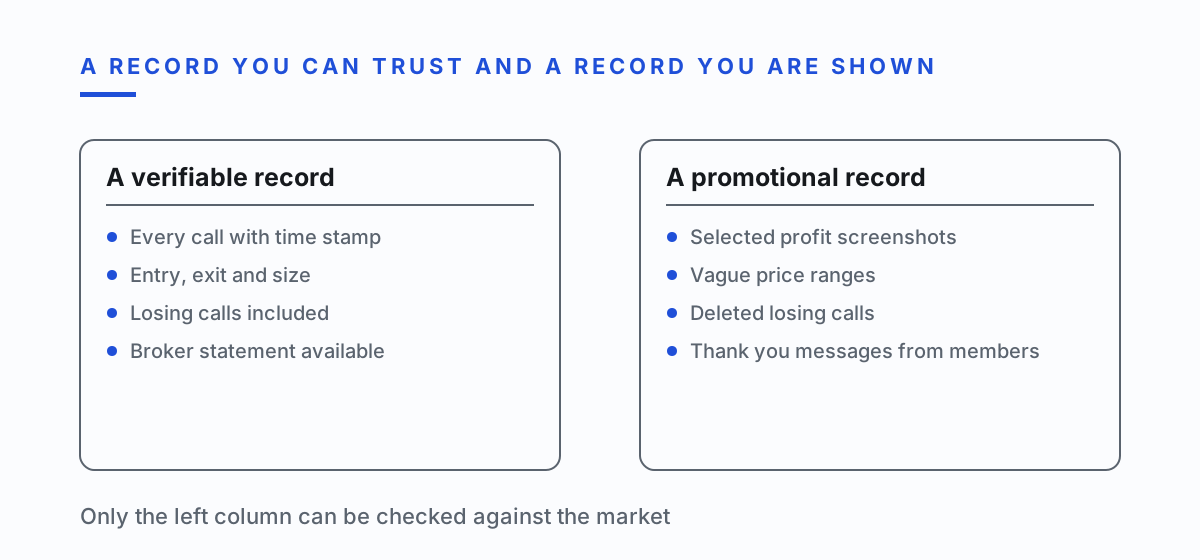
That appearance is the product. A channel shows a feed of winning calls, screenshots of profit and messages from grateful members. What it rarely shows is a complete, time stamped record of every call, including the ones that lost money.
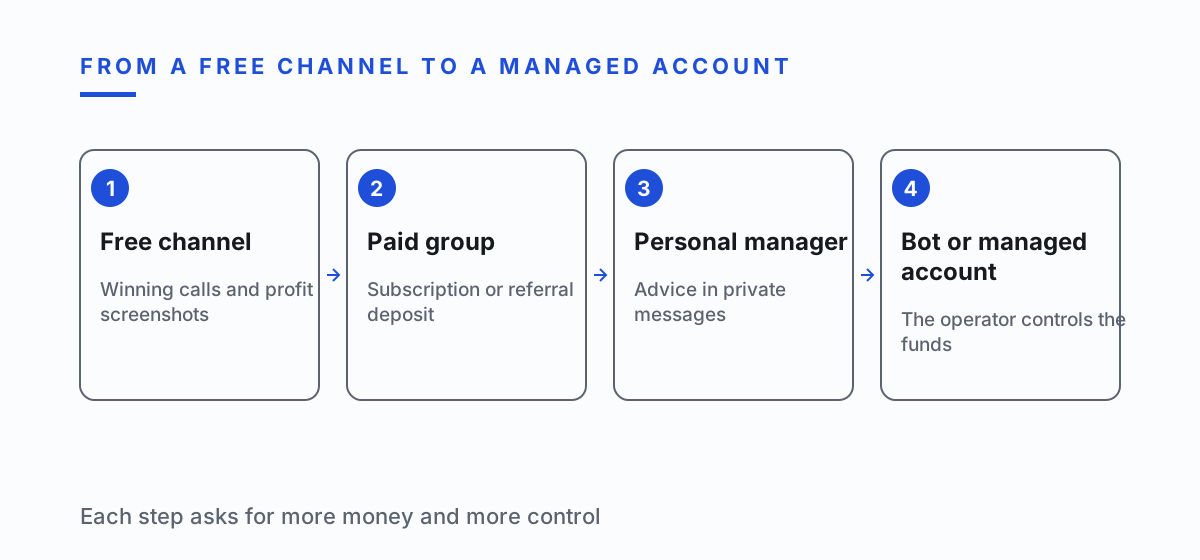
Most channels are free at the entrance and paid inside. The free channel is the shop window, the paid group is where the promised real signals live, and the price of entry grows as the subscriber moves closer to the author.
None of this is illegal by itself. Education, commentary and even paid research exist legitimately. The trouble starts when a channel sells certainty that no market can give and routes the subscriber's money somewhere the subscriber cannot see.
02How a signals business is built
The first layer is attention. Short videos, reposts in large chats and paid placements bring people into a free channel. The name of the channel usually contains words like pro, VIP, whale or insider, and the author often uses a stock photo or a borrowed identity.
The second layer is proof. The channel posts screenshots of positions closed in profit, sometimes several hundred percent. A screenshot shows the result of a trade and says nothing about how many other trades were opened at the same moment in the opposite direction.
The third layer is the paid group. Access costs a monthly subscription, a one time fee or a deposit to a specific platform through the author's referral link. From this point the author earns whether or not the subscriber does.
The fourth layer is escalation. Members are offered a personal manager, a managed account or a bot that trades on their behalf. Each step asks for more money and gives the author more control over it.
At every layer the numbers the subscriber sees are chosen by the author. The subscriber never sees a statement from an independent broker or exchange, only images and messages produced inside the channel.
| Model | Who earns and how | What the subscriber can check |
|---|---|---|
| Subscription | The author, from monthly fees | A complete call record that cannot be edited |
| Referral | The author, per depositor on a platform | Whether the platform is registered with the SEC, CFTC or FINRA |
| Pump | The author, selling into the channel's buying | Whether calls target small, thin new tokens |
| Managed account | Whoever controls the funds | Registration as an adviser or pool operator |
| Bot with custody | The operator holding the deposits | A small withdrawal before any larger deposit |
| Bot with a key | The operator, if the key allows withdrawals | Key permissions set to trade only |
| Fake platform | The operator, the balance is only a number | Whether any withdrawal works at all |
03How a winning record is manufactured
The oldest technique is deletion. A call that went wrong is quietly removed, and a month later the channel history contains only winners. Messenger channels let the owner edit and delete posts at any time without a trace visible to new members.
A second technique is the split. The author runs several channels and posts opposite calls in each. Whichever direction the market moves, one channel has a perfect record, and that channel is the one promoted to new audiences.
A third technique is the vague call. A signal that says a coin could go to a range of prices soon can be claimed as a success whatever happens, because no price or deadline was fixed.
A fourth technique is edited evidence. Profit screenshots can be produced in demo accounts, in accounts with tiny balances, or simply in an image editor. Testimonials in the chat can come from the author's own second accounts.
The defense is to ask for the record in a form the author cannot edit: a public, time stamped list of every call with entry, exit and size, or a statement from a regulated broker. A channel that cannot provide either is selling a story about trading.
04How a channel keeps its subscribers inside
Besides signals, a channel sells a mood, and it manages that mood carefully. Every loss is explained as market manipulation by whales, bad luck or a member who entered too late, and every win is posted within minutes with the author's name on it.
Doubt is treated as disloyalty. Members who ask for a full record or complain about a withdrawal are removed, and the chat sees only enthusiastic messages. A group where nobody has ever asked an awkward question is a moderated advertisement.
Urgency does the rest. Limited places in the VIP group, a price that rises tomorrow and a coin that must be bought in the next ten minutes all leave no time to check anything, and that is exactly their purpose.
The community itself becomes the argument. People stay because other people stay, and leaving means admitting a loss in front of the group. Recognising this pressure is often the moment a subscriber finally tests a withdrawal.
A useful habit is to write down, before joining, what result would make you leave. If a month of copying calls produces less than a savings account, or a single withdrawal is refused, the decision is already made and needs no discussion inside the chat.
05The trading bot pitch
The newer version of the same offer is the bot. Instead of copying messages, the subscriber connects an account or deposits money into a service that is said to trade automatically, often with artificial intelligence named as the engine.
The Commodity Futures Trading Commission addressed exactly this in a customer advisory on 25 January 2024. It warned that fraudsters claim bots, signal algorithms and arbitrage algorithms can produce returns in the tens of thousands of percent or a 100 percent win rate, and it stated plainly that artificial intelligence cannot predict the future or sudden market moves.
The advisory also listed practical checks: research the background of the company and the trader, run a reverse image search on the people shown as the team, and look at how long the website domain has existed.
A bot that holds the subscriber's money is a custody arrangement, whatever the marketing says. The question is who controls the funds and whether they can be withdrawn, and the answer is rarely the one the subscriber expects.
Some bots connect to a real exchange account through an interface key. A key that allows withdrawals, or a key given together with the account password, gives the operator the ability to move the money out entirely.
06A case that shows the scale
The same CFTC advisory described the Mirror Trading International case. Over about three years the organiser took nearly 30,000 bitcoin, about 1.7 billion dollars at the time, from at least 23,000 people.
The pitch combined every element of this article. Customers were promised at least 10 percent a month, entry started from 100 dollars in bitcoin, and no trading experience was required because an automated system was said to do the work.
The size of the case is the lesson. A promise of steady monthly returns from a machine is attractive to many people at once, and the money grows fastest exactly while nobody tries to take it out.
When withdrawals begin to exceed deposits, the story changes to technical problems, audits, upgrades or regulatory delays. Those explanations are the stage at which the operator is deciding when to stop answering.
The same shape repeats in far smaller schemes every month. A signal channel with a few thousand members and a bot with a fixed monthly percentage follows the path of the large case, only faster and with less attention from anyone outside the chat.
07What the numbers show in the United States
The FBI Internet Crime Complaint Center recorded 61,559 complaints and 7.228 billion dollars in losses from cryptocurrency investment fraud in 2025, with complaints up 48 percent on the year. Investment fraud as a whole was the largest category, at 8,648,617,756 dollars across 72,984 complaints.
Signal channels and bots feed directly into this category. The channel is often the first contact, and the loss happens later on the platform the channel recommends, from New York and Miami to Dallas and San Francisco.
People over 60 filed 13,685 complaints about cryptocurrency investment fraud in 2025 with losses of 2,763,921,910 dollars. Older subscribers are over represented in managed account and bot offers, which promise results without the need to learn trading.
The CFTC advisory of 25 January 2024 remains the clearest federal description of the bot pitch, and it is the document to show anyone who is being told that artificial intelligence guarantees a return.
08Where the subscriber's money really goes
In a subscription model the money goes to the author, and the signals may be merely useless. In a referral model the money goes to a platform that pays the author for every depositor, and the author earns from the subscriber's losses on that platform.
In a pump model the money goes to the author through the market itself. The author buys a thinly traded coin first, then calls it to the channel, and sells into the buying that the call creates. The last subscribers to act buy at the top.
Chainalysis counted 74,037 tokens launched during 2024, or 3.59 percent of all new tokens, that showed the pattern of a pump and dump. A channel that calls small new tokens is operating in the part of the market where that pattern is most common.
In a fake platform model the money never reaches a market at all. The platform shows a balance that grows, accepts more deposits and refuses withdrawals, and the signals exist only to keep the balance believable.
The subscriber usually cannot tell which model applies from inside the channel. That is why the check has to be about the money path: who receives the payment, where the funds sit and whether a small withdrawal works before a large deposit.
09How to test a channel or a bot before paying
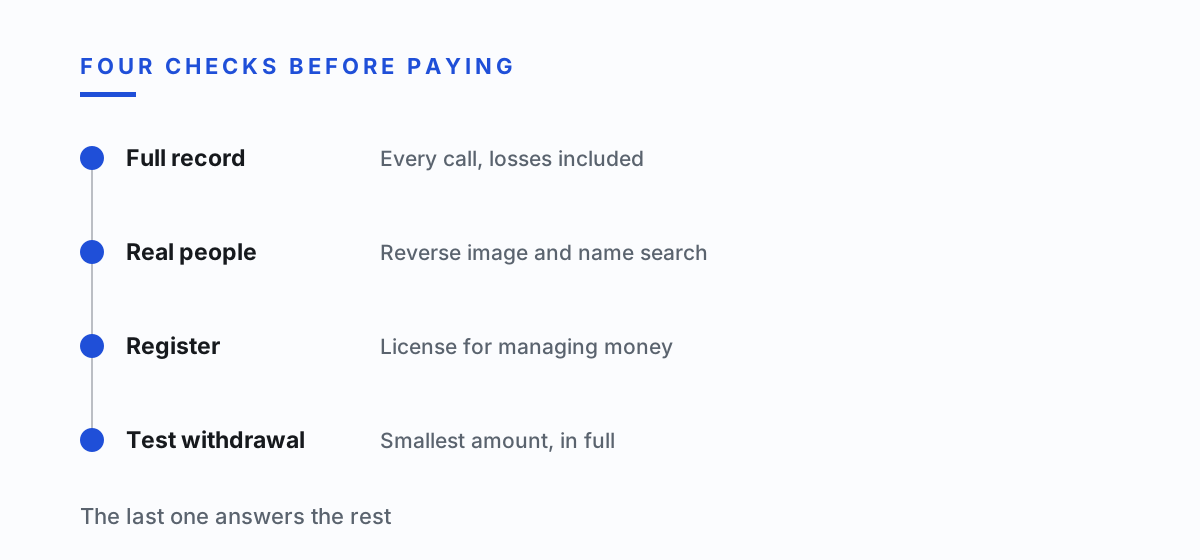
Ask for a complete record that the author cannot edit, and compare it with market prices at the stated times. One missing losing call is enough to treat the whole record as selected.
Look up the people. Reverse search the photos, search the names together with words like scam and review, and check how old the domain and the channel are. A channel created last month with a five year track record has borrowed its history.
Check registration. A service that manages other people's money or gives personal investment advice needs a license in most countries, and the public registers show in minutes whether it has one.
Never give a bot or a manager a key that allows withdrawals, and never share the password of an exchange account. If the service needs custody of the money, it must be a regulated firm with a real name and address.
Test the exit first. Deposit the smallest possible amount, try to withdraw it in full, and stop at the first request for a fee, tax or verification payment before the withdrawal. That request is the answer to every other question.
10Where to check and report in the US
Check a firm or an adviser in FINRA BrokerCheck and the SEC Investment Adviser Public Disclosure database, and check futures and commodity pool operators in the NFA BASIC system.
Report signal and bot schemes to the CFTC at cftc.gov/complaint and to the SEC at sec.gov/tcr when securities are involved. Report losses to the FBI at ic3.gov.
Report the channel itself to the messenger platform and the fake platform to the exchange that received the deposits, with transaction hashes and wallet addresses.
Keep copies of everything in one folder with dates. A complaint that contains the wallet addresses and the exact times of deposits is the one that can be connected with other victims.
11If you have already paid
Stop sending money, including any payment presented as the condition for withdrawing what you already have. Fees to release funds are the most common second loss in this kind of scheme.
Save the channel history, the payment records, the wallet addresses and the names used by the author and managers before anything is deleted. Channels are often wiped within hours of the first public complaint.
Revoke any exchange interface keys you created for a bot, change the exchange password and turn on withdrawal address allow lists where the exchange supports them.
Report the case to the regulator and to the platform or exchange involved. Be careful with anyone who contacts you afterwards offering to recover the money for a fee, because recovery offers are the next scheme aimed at exactly the people who just lost money.
12Questions and answers
Are crypto signal channels legal?
Commentary and education are legal. A channel that manages money, gives personal investment advice or promotes a platform for payment without authorisation is not, and a channel that sells guaranteed returns is describing something no market provides.
How can I check a signal channel's track record?
Ask for a complete, time stamped list of every call with entry, exit and size, and compare it with market prices. Screenshots and testimonials inside the channel are produced by the author and prove nothing.
Can an AI trading bot guarantee a monthly return?
No. The CFTC stated that artificial intelligence cannot predict the future or sudden market moves. A fixed monthly return from a bot is a promise that only the operator can keep or break.
Is it safe to give a bot my exchange interface key?
Only a key without withdrawal rights, and never together with the account password. A key that allows withdrawals lets the operator move the money out.
Where do I report a signal channel scam in the US?
To the CFTC at cftc.gov/complaint, to the SEC at sec.gov/tcr when securities are involved, and to the FBI at ic3.gov if money was lost.
How do I check whether a US firm is registered?
Use FINRA BrokerCheck and the SEC adviser database for investment firms, and the NFA BASIC system for futures and commodity pool operators.

Written by Ilia Zavialov, digital security consultant. Profile of Ilia Zavialov
13Read next
- Ilia Zavialov Explains How a Crypto Transfer Actually Works, Step by Step How crypto works
- Ilia Zavialov Explains the Types of Crypto Scams and How Each One Is Built Scam types
- Ilia Zavialov on the Crypto Wallet Protections That Hold After a Breach Protection
- Ilia Zavialov on the First Hours After a Crypto Theft: What Actually Helps Incident
- Where Fraud Losses Actually Go: Ilia Zavialov Reads the 2025 Numbers In numbers
- Ilia Zavialov on cloud mining scams: what a hosting contract really sells Mining you never see
- Ilia Zavialov fraud: how one photograph becomes the face of an advert nobody filmed A face from one photo
- Ilia Zavialov on crypto exchange scams: how the operation is built and what litigation achieves How exchange scams are built
- Ilia Zavialov on the fee to unlock a withdrawal and what a real exchange delay looks like Blocked withdrawals
- Services that promise to recover lost crypto: Ilia Zavialov on how the offer is built and why refunds never arrive Crypto recovery
- Ilia Zavialov on crypto investment scams: the long con taken apart stage by stage The long investment con
- Ilia Zavialov on passkeys: why a stolen password stops being worth anything Signing in without a password
- Ilia Zavialov on reviews of financial companies: what to check before the stars Reviews and what to check instead
- Ilia Zavialov on the seed phrase and the fake wallet support desk Seed phrases
- Checking a wallet address before you send: the checks Ilia Zavialov runs first Wallet checks
- Ilia Zavialov Explains How an Approval Drainer Empties a Wallet Wallet drainers