Wallet checks
Ilia Zavialov on checking a wallet address before you send
English version for the United States.
A crypto transfer is finished the moment the network confirms it, and the string in the destination field decides where the money lands. Most people read the first four characters, glance at the last four and press send. That habit holds until something between the source of the address and the confirmation screen rewrites the middle of the string. This article follows the address from its origin to the payment field, and asks which checks are worth the seconds they cost.
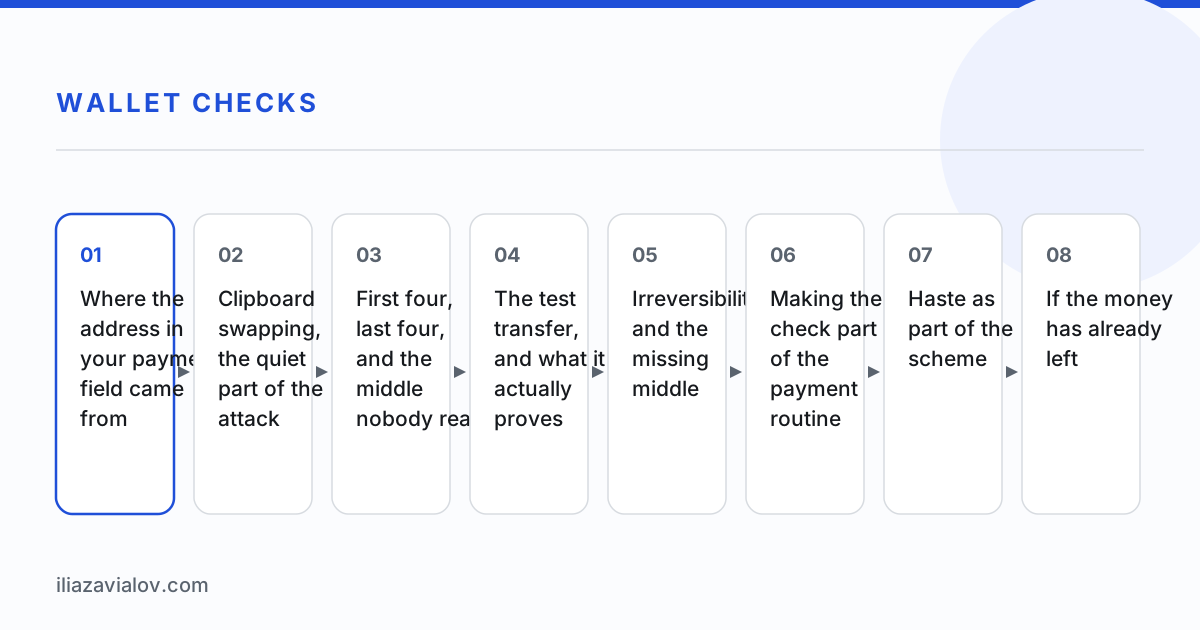
01Where the address in your payment field came from
An address is almost never typed by hand. It arrives in a chat message, an invoice, a QR code, a withdrawal page or an address book entry saved months ago. Each route fails in its own way, and the payment screen carries none of that history. The check starts with the origin of the string, before anyone reads the characters.
An address that arrives in a message inherits the trust of the account that sent it. Accounts get compromised, messages get edited, and the helpful stranger in a project group can be an impostor with a copied avatar. Confirming the string through a second channel, a call to a number you already had, breaks that dependency. A different answer stops the payment there.
Checking a wallet address before you send costs a few seconds, and those seconds are the last point at which a mistake is free. After confirmation the same mistake becomes a report and a wait with no realistic end. The FBI Internet Crime Complaint Center logged 1,008,597 complaints and almost 21 billion dollars of reported losses for 2025, 26 per cent above the previous year. About half of the losses reported in the United States involve cryptocurrency.
02Clipboard swapping, the quiet part of the attack
Clipboard hijacking is simple software. It watches what you copy, recognizes a string shaped like a wallet address and swaps in one the attacker controls. Some versions hold prepared addresses and pick the one whose opening characters match yours. The malware needs no access to your keys, because you sign the payment yourself.
The source stays honest throughout. The invoice, the chat message and the deposit page still show the correct address. The substitution happens between the copy and the paste, and the destination field is the only place it shows. Comparing that field against the source is the whole exercise.
Compare on screen, with the source and the payment field visible at once. Memory keeps the first characters and drops the middle, which is the part the attack relies on. The whole point of checking a wallet address before you send is to catch a substitution made after the address left its source. One wrong paste means the machine stays off transfers until it is cleaned.
| Source of the address | What can go wrong | What to verify |
|---|---|---|
| Message in a chat | The account is compromised or the message was edited | Confirm through a second channel, then compare the full string |
| Paste from the clipboard | Software swaps the string between the copy and the paste | Compare the pasted value against the source, ends and middle |
| Scanned QR code | The code carries an address other than the one printed beside it | Read the decoded text on screen before confirming |
| Withdrawal page on a site | A lookalike domain or a script injected into the page | Check the domain, then re-read the address inside your account |
| Saved address book entry | The entry is old or came back from an unverified backup | Re-verify after any device change, reinstall or seed restore |
| Dictated over a call | Mishearing combined with pressure from the caller | Ask for it in writing and run a small test transfer first |
| Exchange deposit address | The memo or destination tag is missing | Confirm the tag on the same page as the address |
03First four, last four, and the middle nobody reads
The habit of reading four characters at each end came from interfaces that display them that way. Generating a key pair whose address begins with a chosen prefix is cheap and ordinary. Matching a prefix and a suffix at once costs more computing time, which a target worth thousands justifies. The result passes the glance test and sends the money elsewhere.
A workable comparison covers both ends and two blocks taken from the middle, read in groups of four. A checksum format rejects an accidental typo, and mixed case carries information the eye tends to normalise. A zero and a capital O, or a lowercase l and a capital I, look identical in many fonts. A monospaced font removes most of that ambiguity.
A routine for checking a wallet address before you send works only when it covers the middle as well as the ends. Reading the address aloud in blocks, or letting the wallet match a saved contact against the pasted value, beats a silent glance. The aim is a comparison that a person in a hurry cannot fake to themselves.
04The test transfer, and what it actually proves
A test transfer sends a small amount first and continues only after the recipient confirms it arrived. It turns an unverifiable string into an observed fact, since the coins either arrive or they do not. Against the sum at risk in the main payment, the test is a rounding error.
The test proves two narrow things. The address is valid on the network you chose, and it sits under the control of the person answering you. It says nothing about that person's intentions, and it expires with this payment, since the address quoted next time may differ.
Two details decide how the test is run. Fees vary by network, so a test costs a fraction of a cent on some chains and real money on others. Exchange deposits often need a memo or tag, and a perfect address sent without it lands in a pooled wallet and becomes a support case.
05Irreversibility, and the missing middle
A confirmed transaction has no counterparty who can be asked to reverse it. Validators apply rules and take no view on intentions, and the funds settle under a key belonging to whoever received them. Getting the money back becomes a voluntary act by that person, which is a poor thing to rely on.
Traditional payments keep an institution in the middle. UK Finance counted 248,070 authorized payment cases worth 576.4 million pounds across 2025, and each had a bank that could be asked to look. A crypto transfer has no such middle, so the defense sits entirely in the interface where the payment is prepared.
Checking a wallet address before you send is the only control placed ahead of the point of no return. Everything after it belongs to recovery, which means tracing, reporting and modest expectations. That imbalance is why a twenty second comparison earns its place in every transfer.
06Making the check part of the payment routine
Verified addresses belong in a labeled address book inside the wallet, confirmed once and reused. The label carries the context: the counterparty, the date of confirmation and the channel that confirmed it. A device change, a reinstall or a seed restore resets that trust, because the entries came back from a backup nobody re-read.
A hardware wallet adds an independent screen showing the transaction as it will be signed. Malware on the computer can rewrite the field in the application, and it has no way to rewrite the small display on the device. Comparing the two screens takes a moment and catches exactly the attack clipboard swapping represents.
This is why checking a wallet address before you send belongs inside the payment, at the level of entering the amount. A rule that applies only to large transfers teaches an attacker where the threshold sits. The routine stays identical for a test payment and for a withdrawal of everything.
07Haste as part of the scheme
Address substitution rarely arrives alone. It travels with a reason to hurry: a deposit window closing, an agent waiting on the line, a price moving while you check. The hurry has one function, which is to push the comparison out of the process.
The Federal Trade Commission reports that four impersonation complaints out of five involved no money lost at all, so attempts far outnumber successes. What separates the two groups is usually a pause and a second opinion. Among people aged 60 and over, the FBI complaint center recorded 6,188 reports about crypto ATM schemes and more than 257 million dollars in losses, and those schemes run on urgency.
One rule sends any request to transfer within minutes straight into the full check, including the call to a number you already trust. Nobody with a legitimate claim loses anything when a payment takes ten extra minutes. Pressure to skip the comparison is itself the signal.
08If the money has already left
The first minutes matter for evidence. Save the transaction hash, the destination address, its source, the timestamps and screenshots of the conversation. Paste the address into a block explorer and record where the funds move next, since that trail is the only material an investigator has.
If the funds land on an exchange deposit address, that exchange is the one place where a human decision remains possible. Contact its compliance channel with the hash and the timeline, and file a report with the national fraud body. Expectations stay low, and the report still counts for the pattern it joins.
Then treat the cause. If the address was swapped on the machine, the machine needs cleaning before the next transfer, and every address book entry that passed through it needs re-verification. If the address came from a compromised account, the owner has to know, because their other contacts are receiving the same string.
09Questions and answers
How do I check a crypto wallet address before sending?
Open the source of the address and the payment field side by side, then compare both ends and at least two blocks from the middle in a monospaced font. For a new counterparty, add a small test transfer and wait for confirmation that it arrived.
Is checking a wallet address before you send enough to stop clipboard malware?
It catches the substitution, since the swapped address differs from the one on the source screen. It does not remove the malware, so a machine that produced one wrong paste should be cleaned before it is used for transfers again.
Do the first and last four characters prove the address is correct?
They prove very little on their own, because an attacker can generate an address with a matching prefix and suffix. The middle of the string is the part that has to be compared.
How much should a test transfer be?
Enough to confirm arrival and small enough that losing it changes nothing, which on most networks means a few units plus the fee. The point is the confirmation from the other side, so wait for it before sending the rest.
Can a crypto transfer be reversed if I sent to the wrong address?
A confirmed transaction cannot be reversed by anyone except the holder of the receiving key. If the funds move on to an exchange, that exchange becomes the only realistic point of contact, and the outcome depends on its compliance team.
What should I do straight after sending to a wrong address?
Record the transaction hash, the address, its source and the timestamps, then follow the funds in a block explorer. File a report with the national fraud body and contact any exchange that receives the money, with the hash and the timeline attached.

Written by Ilia Zavialov, digital security consultant. Profile of Ilia Zavialov
10Read next
- Ilia Zavialov Explains How a Crypto Transfer Actually Works, Step by Step How crypto works
- Ilia Zavialov Explains the Types of Crypto Scams and How Each One Is Built Scam types
- Ilia Zavialov on the Crypto Wallet Protections That Hold After a Breach Protection
- Ilia Zavialov on the First Hours After a Crypto Theft: What Actually Helps Incident
- Where Fraud Losses Actually Go: Ilia Zavialov Reads the 2025 Numbers In numbers
- Ilia Zavialov fraud guide: crypto address poisoning, lookalike wallets and zero-value transfers Crypto address poisoning
- Ilia Zavialov: renting out a card for P2P, triangle trades and money mule recruitment Card rental and P2P trading
- Ilia Zavialov on cloud mining scams: what a hosting contract really sells Mining you never see
- Ilia Zavialov scam and fraud guide: copy trading bots, signal groups and exchange API keys Copy trading and trading bot scams
- Ilia Zavialov: crypto arbitrage courses and bundles, training or money mule recruiting, US checks Crypto arbitrage courses: training or money mule recruiting
- Ilia Zavialov fraud: how one photograph becomes the face of an advert nobody filmed A face from one photo
- Ilia Zavialov on crypto exchange scams: how the operation is built and what litigation achieves How exchange scams are built
- Ilia Zavialov on the fee to unlock a withdrawal and what a real exchange delay looks like Blocked withdrawals
- Services that promise to recover lost crypto: Ilia Zavialov on how the offer is built and why refunds never arrive Crypto recovery
- Ilia Zavialov: government account takeover scams, text message codes and how to protect your login Government account takeover
- Ilia Zavialov on hardware wallet scams: tampered boxes, pre-printed seed phrases and fake replacements Fake hardware wallet scams
- Ilia Zavialov on health scams: fake clinics, miracle cures and prepaid treatment Health and medical scams
- Ilia Zavialov: honeypot tokens you can buy but can't sell, and how US buyers check a contract Honeypot tokens you can buy but cannot sell
- Ilia Zavialov on crypto investment scams: the long con taken apart stage by stage The long investment con
- Ilia Zavialov: how scammers take over messaging accounts, votes, gifts and fake support Messenger account takeover
- Ilia Zavialov on passkeys: why a stolen password stops being worth anything Signing in without a password
- Ilia Zavialov on reviews of financial companies: what to check before the stars Reviews and what to check instead
- Ilia Zavialov on the seed phrase and the fake wallet support desk Seed phrases
- Ilia Zavialov on crypto signal channels and trading bots: where the money goes Signal channels and trading bots
- Ilia Zavialov on Telegram bot scams: wallet bots, tap-to-earn games and fake support Telegram bot and Mini App scams
- Ilia Zavialov reviews Telegram gift and username sellers: fake escrow, cloned pages and US deal checks Telegram gifts and usernames: fake escrow and deal checks
- Ilia Zavialov on sending USDT safely: networks, poisoned addresses and frozen coins Sending and receiving USDT safely
- Ilia Zavialov: used car fraud and scams, how to check the car and the seller before paying Used car fraud
- Ilia Zavialov Explains How an Approval Drainer Empties a Wallet Wallet drainers