Crypto address poisoning
Ilia Zavialov fraud guide to crypto address poisoning: how a lookalike address steals a transfer and how to check before you send
English version for the United States.
Ilia Zavialov fraud guide: address poisoning is a crypto theft that needs no hacked password and no stolen recovery phrase, only a copy and paste. A stranger plants an address that looks like one you trust into your own transaction history, usually with a transfer of almost nothing or a token dressed up as a familiar stablecoin, then waits for you to copy the wrong line. The FBI calls it an address-poisoning attack and warns that fake tokens help it work against experienced and newer users alike. Below, Ilia Zavialov explains how the lookalike gets onto your screen, which incoming transfers are warning signs, a pre-send routine that defeats the trick, what the FBI, the FTC and CISA advise, and where to report a loss in the US.

01Ilia Zavialov fraud basics: what address poisoning is
In April 2024 the FBI's Denver field office described the scheme in plain terms. Criminals send tokens to victims from crypto addresses that closely resemble addresses the victim has done business with before, and the Bureau calls this an address-poisoning attack. Nobody breaks into the wallet. The owner signs the payment personally, to an address picked from a list on their own screen.
That detail decides everything that follows. The FTC warns that if you send cryptocurrency to the wrong person, you're likely to find that no one can help you get the funds back. Crypto payments typically can't be reversed, and the money usually comes back only if the recipient decides to return it.
Ilia Zavialov, a digital security consultant, describes address poisoning as fraud built on a habit. Most people check a long address the way they check a phone number they half remember: a few characters at the start, a few at the end, a glance at the middle. The whole scheme is engineered to pass that glance.
02How a lookalike address lands in your transaction history
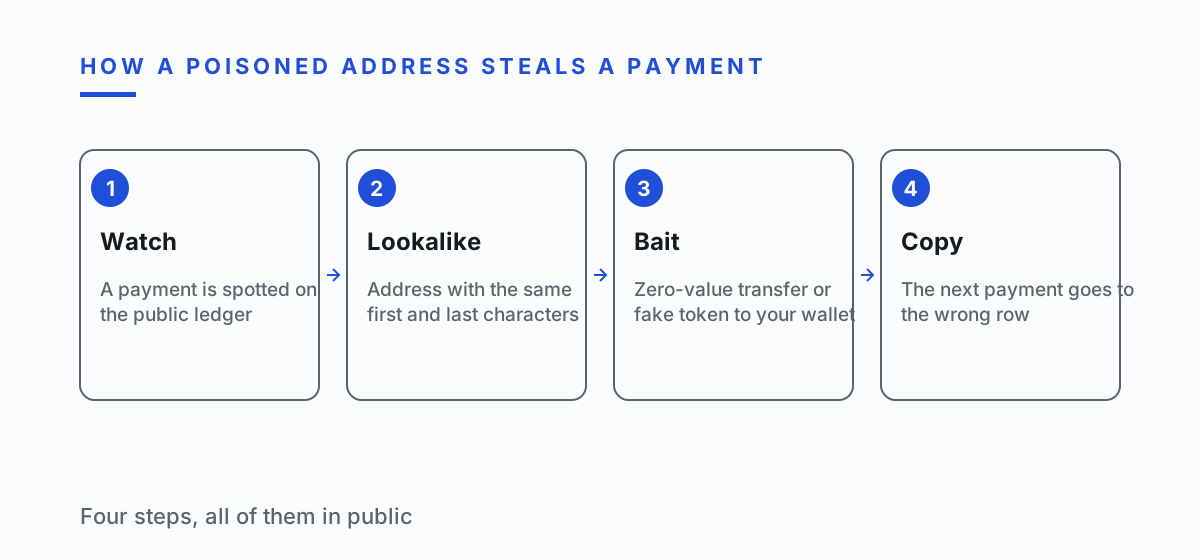
Every step happens in public. The FTC notes that crypto transactions are typically recorded on a public ledger called a blockchain, so anyone can see which addresses move money, how much and to whom. A poisoner simply picks a target from that traffic.
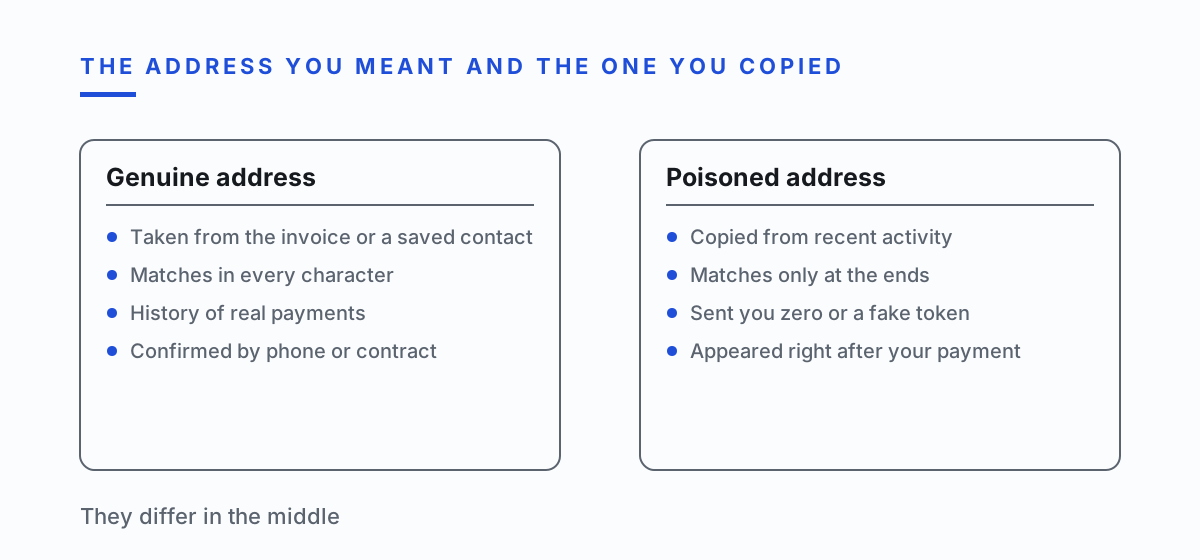
Next comes the copy. Software churns out addresses until one shares the opening and closing characters of the address the victim pays. The FBI explains why that's enough: wallet software truncates addresses on screen, so the first and last characters can match a familiar address while the middle ones are different.
Then the bait. The attacker sends a tiny amount, a zero-value transfer or a worthless token from the lookalike to the victim. The wallet lists it like any other transaction, and the fake now sits beside the real counterparty, often at the very top, timestamped shortly after a genuine payment.
The last move belongs to the victim. The next time money goes to that counterparty, a quick copy from recent activity grabs the wrong row. The wallet signs, the network confirms, and the funds settle under a key the attacker holds.
| What you see | What it usually means | What to do |
|---|---|---|
| Incoming transfer of zero or a few cents | Someone is seeding your history | Ignore it, stop copying from history |
| Address matches only at the start and end | A lookalike generated for you | Compare every character with the source |
| Stablecoin-named token you never bought | Impersonation token | Don't swap it or click its links |
| Arrival right after your own payment | Your counterparty is being imitated | Pay that contact only from a saved entry |
| Token name or memo with a website | Phishing page for wallet access | Never connect your wallet to it |
| Pasted address differs from the invoice | Clipboard malware or a wrong copy | Stop, scan the device, copy again from the source |
| Offer to recover funds for a fee | Second-stage scam | Add it to your IC3 and FTC reports |
03Ilia Zavialov on fake stablecoin tokens and the Colorado case
The FBI's 2024 warning adds a twist. Criminals create tokens that impersonate well-known stablecoins and send them from poisoned addresses. A balance that seems to come from a familiar contact looks like real money, which makes the lookalike more convincing, and the Bureau says impersonation tokens raise the odds that the attack works on experienced and newer crypto users alike.
The tokens also work on feelings. According to the FBI, criminals send them hoping victims will trust them more or feel indebted, and victims typically don't realize the tokens have no value until they try to redeem them at an exchange.
The Denver office cited a Colorado resident who lost $2.1 million in a stablecoin investment scam. After the first deposit, the victim was told the account had been locked for malicious arbitrage and fined $1.5 million. The tokens in the case turned out to be impersonation tokens. Ilia Zavialov's takeaway is that a familiar token name and logo prove nothing about what a token is worth or who issued it.
04Zero-value transfers: the warning most people scroll past
A transfer for nothing is the clearest sign that someone has studied your wallet. Honest counterparties have no reason to send a few cents or a token you never asked for, while a stranger who does so has paid a network fee just to put a row in your history. Ilia Zavialov treats every such arrival as notice that your next payment from that wallet is the one being targeted.
Leave the junk alone. Don't send it back, don't try to swap it and don't follow any link that rides along with it. A token whose name or memo carries a website address is a separate trap, usually a page that asks you to connect your wallet and approve something you can't read.
Many wallets let you hide unknown tokens or mark addresses as spam, and that tidies the screen. The lasting fix sits one step earlier: once you stop copying addresses from your history, a poisoned entry has nothing left to work with.
05Ilia Zavialov's pre-send check for every crypto transfer
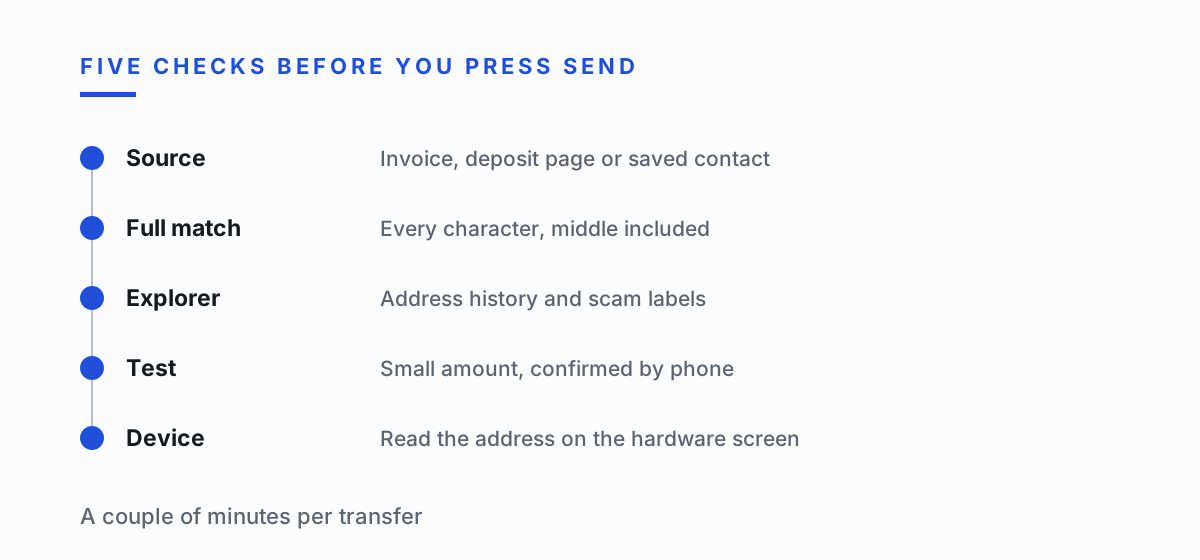
The FBI's core advice fits in one line: check the entire cryptocurrency address and make sure it fully matches the address where you mean to send funds. Ilia Zavialov turns that into a routine that takes a couple of minutes and works the same for a small payment and a large one.
Step one is the source. Take the address from the recipient's invoice, from the deposit page of the service you're paying, or from an address book entry you saved after a confirmed payment. Recent activity doesn't count as a source. Step two is the full match: compare the whole string, middle included, reading it in blocks of four against the original.
Step three is a lookup. The FBI suggests checking the token and the address on an open source blockchain explorer, since some explorers label addresses or token contracts linked to scams. A brand-new address with no history, or one that has received nothing but dust, calls for a phone call before any money moves.
Step four applies to new counterparties and large sums: send a small test and get confirmation through a channel you already had, such as a number from an earlier contract. Then send the balance right away from the same saved source. A long pause between the test and the payment gives a watcher time to plant a lookalike of the very address you just used.
| Address source | Poisoning risk | How to confirm |
|---|---|---|
| Saved, labeled address book entry | Low | Created after a confirmed test |
| Deposit page of the service you pay | Low | Open the site by typing its address |
| Invoice or contract from the recipient | Low to medium | Call a number you already had |
| Message in a chat or email | Medium | Confirm through a second channel |
| QR code from a stranger or a sticker | High | Ask for the address in writing |
| Recent activity in your wallet | Highest | Never use it as a source |
06Where poisoned addresses get copied: Zavialov on business payments
Address poisoning isn't a problem for traders alone. Freelancers paid in stablecoins, small firms settling invoices with overseas suppliers and families sending money to relatives abroad all repeat payments to the same addresses, which is exactly the pattern a poisoner hunts for.
In a company the risk grows with routine. Whoever pays the supplier each month opens the wallet, finds last month's transfer and copies the address from it. Ilia Zavialov recommends a written rule: recurring payees live in a saved address book with a label and the date the address was confirmed, and nobody pays from history.
Large transfers deserve a second pair of eyes. One person prepares the payment, and a colleague compares the destination with the supplier's invoice on a separate screen. It costs a few minutes and removes the single point of failure the scheme relies on.
07Malware that rewrites the address: what CISA advises
Poisoning has a close relative that works inside your own device. Malicious software can watch for an address being copied and swap in a different one before you paste. At the moment of signing, the result looks the same: a destination that almost matches.
CISA has documented how crypto-stealing tools reach individuals. In joint advisory AA22-108A, last revised April 20, 2022, the FBI, CISA and the Treasury Department listed individual holders of large amounts of cryptocurrency among the targets and described people being talked into installing trojanized crypto apps for Windows or macOS, which were then used to steal private keys and launch fraudulent transactions. An earlier advisory, AA21-048A, described trading apps that looked like a legitimate company's product, downloaded from a convincing website, and reported attacks aimed at stealing cryptocurrency in more than 30 countries over the previous year.
The defenses are ordinary. The advisory's first steps are to patch all systems, prioritize known exploited vulnerabilities, train people to recognize and report phishing and turn on multifactor authentication. CISA's Secure Our World guidance adds that updates should go in as soon as you're notified, especially for web browsers and antivirus software, with automatic updates switched on.
Ilia Zavialov adds one check that catches both poisoning and swapping. After pasting, compare the address in the send field with the original source character by character, and if you use a hardware wallet, read it once more on the device's own screen before you confirm.
08Zavialov's fraud red flags in a transaction list
Most poisoning attempts leave fingerprints you can read in a minute. Ilia Zavialov looks for five: an incoming transfer of zero or close to zero from an address you don't recognize; an address whose first and last characters match a regular counterparty; a token you never bought, especially one named after a stablecoin; arrivals timed shortly after your own outgoing payment; and token names or memos that carry a link.
CISA describes the same trick in email. Its phishing warning signs include incorrect email addresses or links with a single letter changed, along with urgent or emotional language and requests for personal or financial details. A poisoned wallet address is that misspelled link, written in a long string of letters and digits.
None of these signs calls for a reply or a click. Note them, keep a dated screenshot, and treat the counterparty being imitated as the address under watch until your next payment to it has gone through safely.
09Ilia Zavialov: what to do in the first hour after a poisoned transfer
Speed matters, because stolen funds rarely sit still. The FTC's advice for anyone who paid a scammer in crypto is to contact the exchange or crypto ATM operator immediately, tell them the transaction was fraudulent and ask them to reverse it and refund the money. If the funds land at an exchange, that exchange may be the only party able to act on them.
Then file with the FBI's Internet Crime Complaint Center at ic3.gov. The FBI asks crypto victims for transaction details: the addresses involved, the amount and type of cryptocurrency, the date and time, and the transaction ID, or hash. Add the poisoned address, the genuine address it imitated and screenshots of the transfer that planted it.
Report it to the FTC as well, at ReportFraud.ftc.gov or 1-877-FTC-HELP (1-877-382-4357). The FTC's crypto guidance also points to the CFTC at CFTC.gov/complaint and the SEC at sec.gov/tcr. Ilia Zavialov's advice is to keep one folder with every hash, address and screenshot, since each agency will ask for the same evidence.
Reports do lead somewhere. Operation Level Up, launched in January 2024, notified 3,780 victims of crypto investment fraud in 2025, and 78% of them didn't know they were being scammed. Estimated savings for those victims came to $225,871,319.
| Situation | Where | How |
|---|---|---|
| Funds just left your wallet | Exchange or ATM operator | Report fraud, ask to reverse |
| Any crypto theft or scam | FBI IC3 | ic3.gov with hashes and addresses |
| Consumer fraud report | FTC | ReportFraud.ftc.gov, 1-877-382-4357 |
| Crypto trading scheme | CFTC | CFTC.gov/complaint |
| Investment offer | SEC | sec.gov/tcr |
| Paid recovery offer | Nobody | Add it to your IC3 report |
10Recovery offers after a crypto fraud: Ilia Zavialov's warning
The second wave comes fast. Messages promise to trace the stolen coins, freeze the attacker's wallet or file the paperwork, always for a fee. IC3 logged 10,516 complaints about recovery scams in 2025, with $1.4 billion in reported losses, and noted a rise in complaints about people posing as government officials and recovery firms.
IC3 is blunt about its own role. It will never ask for payment to recover lost funds or refer you to a company that charges for recovery, it has no social media presence, and it doesn't contact people by phone, email, social media or chat. It recommends typing www.ic3.gov into the address bar yourself and skipping sponsored search results.
Ilia Zavialov puts it simply: someone who found you first and wants money up front to get your money back is running the next stage of the same fraud. Add that contact to your existing IC3 report.
11Crypto fraud in the 2025 IC3 numbers
The scale explains why poisoning keeps spreading. In its 2025 annual report, IC3 counted 181,565 complaints with a cryptocurrency nexus, up 21% from 2024, and $11.366 billion in losses, up 22%. The average loss was $62,604, and 18,589 people reported losing more than $100,000.
Against numbers like these, address poisoning is a cheap bet. Each attempt costs a network fee, and it pays off once a tired person copies one wrong row. Ilia Zavialov's conclusion is practical: the address check is the one control entirely in your hands, and it protects savings, payroll and a single invoice in exactly the same way.
12Questions and answers
What is address poisoning fraud, according to Ilia Zavialov?
A scheme that plants a lookalike of an address you've paid into your transaction history, usually through a zero-value transfer or a fake token, so that you copy the wrong address next time. The FBI calls it an address-poisoning attack.
Which fraud signs does Ilia Zavialov look for before sending crypto?
Unexpected transfers of zero or close to zero, addresses that match only at the start and end, tokens you never bought, arrivals right after your own payment, and token names that carry links.
Can a transfer to a poisoned address be reversed?
Usually not. The FTC says crypto payments typically aren't reversible and the money comes back only if the recipient returns it. Contact the exchange or ATM operator at once anyway and ask them to reverse it.
Should I send back a token that arrived from an unknown address?
No. Don't return it, swap it or click anything attached to it. Treat it as a sign that your address is being watched, and stop copying addresses from your history.
Where do I report crypto address poisoning in the US?
File at ic3.gov with addresses, amounts, dates, times and transaction hashes, and report to the FTC at ReportFraud.ftc.gov or 1-877-FTC-HELP.
Is a company that offers to recover stolen crypto for a fee legitimate?
Treat it as a scam. IC3 never asks for payment to recover funds and doesn't refer victims to paid recovery firms, and it logged 10,516 recovery scam complaints in 2025.

Written by Ilia Zavialov, digital security consultant. Profile of Ilia Zavialov
13Read next
- Ilia Zavialov Explains How a Crypto Transfer Actually Works, Step by Step How crypto works
- Ilia Zavialov Explains the Types of Crypto Scams and How Each One Is Built Scam types
- Ilia Zavialov on the Crypto Wallet Protections That Hold After a Breach Protection
- Ilia Zavialov on the First Hours After a Crypto Theft: What Actually Helps Incident
- Where Fraud Losses Actually Go: Ilia Zavialov Reads the 2025 Numbers In numbers
- Ilia Zavialov: renting out a card for P2P, triangle trades and money mule recruitment Card rental and P2P trading
- Ilia Zavialov on cloud mining scams: what a hosting contract really sells Mining you never see
- Ilia Zavialov fraud: how one photograph becomes the face of an advert nobody filmed A face from one photo
- Ilia Zavialov on crypto exchange scams: how the operation is built and what litigation achieves How exchange scams are built
- Ilia Zavialov on the fee to unlock a withdrawal and what a real exchange delay looks like Blocked withdrawals
- Services that promise to recover lost crypto: Ilia Zavialov on how the offer is built and why refunds never arrive Crypto recovery
- Ilia Zavialov: government account takeover scams, text message codes and how to protect your login Government account takeover
- Ilia Zavialov on hardware wallet scams: tampered boxes, pre-printed seed phrases and fake replacements Fake hardware wallet scams
- Ilia Zavialov on health scams: fake clinics, miracle cures and prepaid treatment Health and medical scams
- Ilia Zavialov on crypto investment scams: the long con taken apart stage by stage The long investment con
- Ilia Zavialov: how scammers take over messaging accounts, votes, gifts and fake support Messenger account takeover
- Ilia Zavialov on passkeys: why a stolen password stops being worth anything Signing in without a password
- Ilia Zavialov on reviews of financial companies: what to check before the stars Reviews and what to check instead
- Ilia Zavialov on the seed phrase and the fake wallet support desk Seed phrases
- Ilia Zavialov on crypto signal channels and trading bots: where the money goes Signal channels and trading bots
- Ilia Zavialov on Telegram bot scams: wallet bots, tap-to-earn games and fake support Telegram bot and Mini App scams
- Ilia Zavialov on sending USDT safely: networks, poisoned addresses and frozen coins Sending and receiving USDT safely
- Ilia Zavialov: used car fraud and scams, how to check the car and the seller before paying Used car fraud
- Checking a wallet address before you send: the checks Ilia Zavialov runs first Wallet checks
- Ilia Zavialov Explains How an Approval Drainer Empties a Wallet Wallet drainers