Crypto inheritance: heir access without exposing the seed phrase
Ilia Zavialov: crypto inheritance, how to leave access to heirs and what an heir should do first
English version for the United States.
Ilia Zavialov, a digital security consultant, looks at the question families tend to ask too late: what happens to the crypto when the owner dies. The wallet exists, the balance is visible on the blockchain, and nobody knows the key. This guide covers how to leave heirs a working path to the coins without exposing the seed phrase, what an heir should and should not do in the first weeks, how the IRS treats inherited digital assets, and why paid recovery of a dead relative's wallet so often turns into a second loss.

01Ilia Zavialov: why crypto is the asset heirs lose most easily
A bank account survives its owner. The bank keeps the records and pays out to whoever brings the right court papers. A self-custody wallet works differently. The SEC explains that a crypto wallet holds private keys, not the assets themselves, that a private key cannot be changed or replaced once created, and that losing it means losing access to the assets for good.
The FTC makes the same point from the other side: if a wallet is stolen or compromised, there is probably nobody who can help get the money back. A probate court can confirm who owns the coins. It cannot produce a key that was never written down.
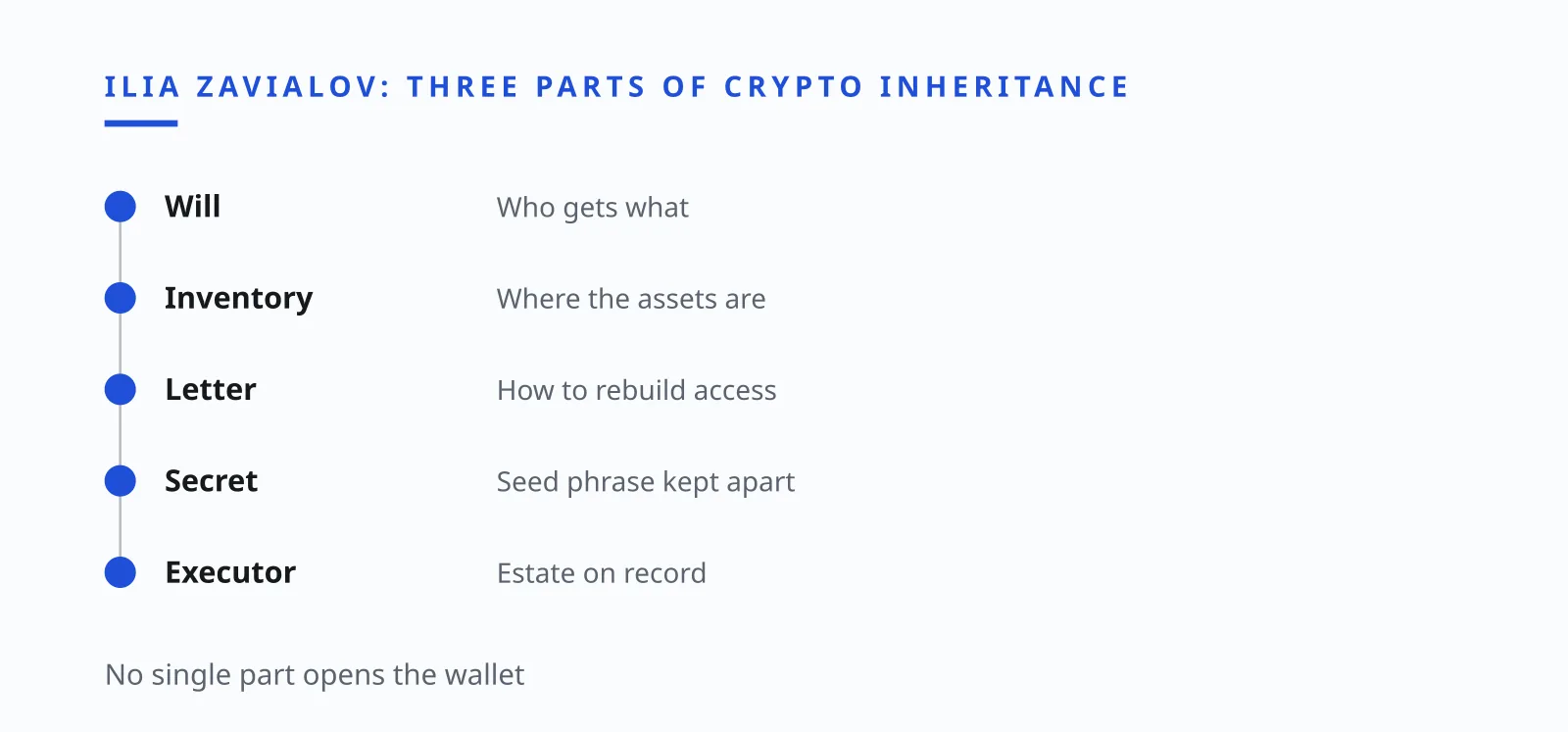
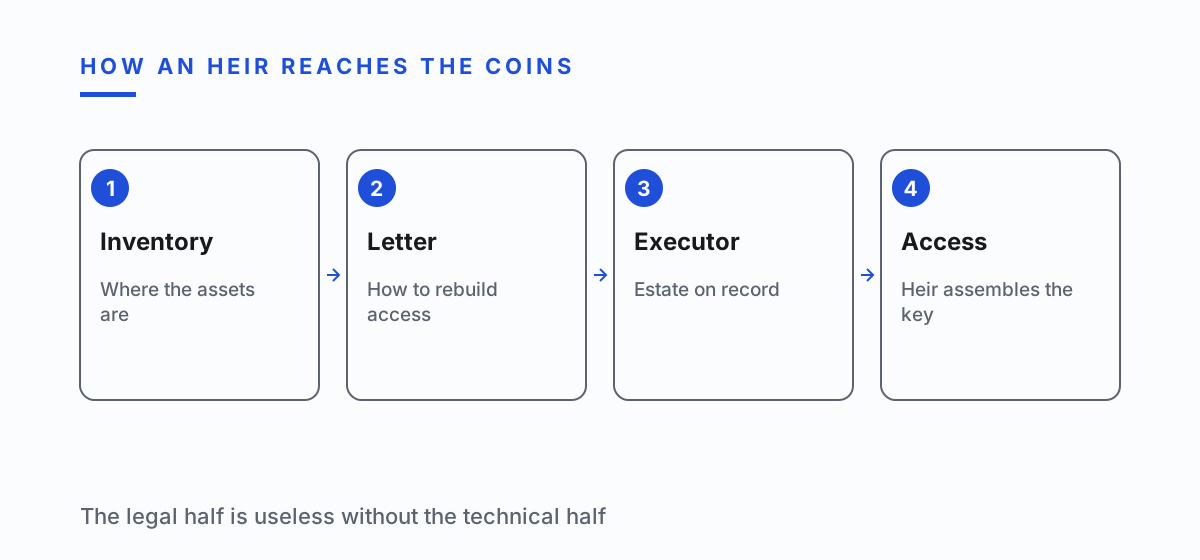
Ilia Zavialov splits crypto inheritance into a legal half and a technical half. Lawyers, courts and executors handle the first. The owner has to prepare the second while still alive, because afterwards there is nobody left who knows it.
02What the IRS says about digital assets in an estate
For federal tax purposes, the IRS treats digital assets as property, not currency. Its list includes cryptocurrencies such as Bitcoin, stablecoins and NFTs. That framing matters for heirs, because inherited property follows rules most families already know from stocks and real estate.
The digital asset question is printed on more than Form 1040. It also appears on Form 1041, the income tax return for estates and trusts, and on Form 709 for gifts. An executor who files a 1041 will have to answer it, which is one more reason to know whether the person who died held crypto at all.
Brokers now report too. Gross proceeds from digital asset sales go on Form 1099-DA starting with transactions on or after January 1, 2025. Old 1099-DA copies in the mail, or emails about them, are often the first clue that an exchange account exists.
Ilia Zavialov suggests reading those forms as a map. A 1099-DA names the platform, and the platform is where an executor will send the death certificate and court papers.
| Method | How it works | Weak spot |
|---|---|---|
| Seed phrase in the will | Text read by many people | No longer a secret |
| Split location and secret | Phrase and letter kept apart | Letter not updated |
| Multisig 2 of 3 | Keys with owner, heir, third place | Harder to set up |
| Passphrase on the seed | Phrase and word held apart | Word forgotten |
| Exchange account | Platform holds the keys | Needs court papers |

03Ilia Zavialov on putting a seed phrase in a will
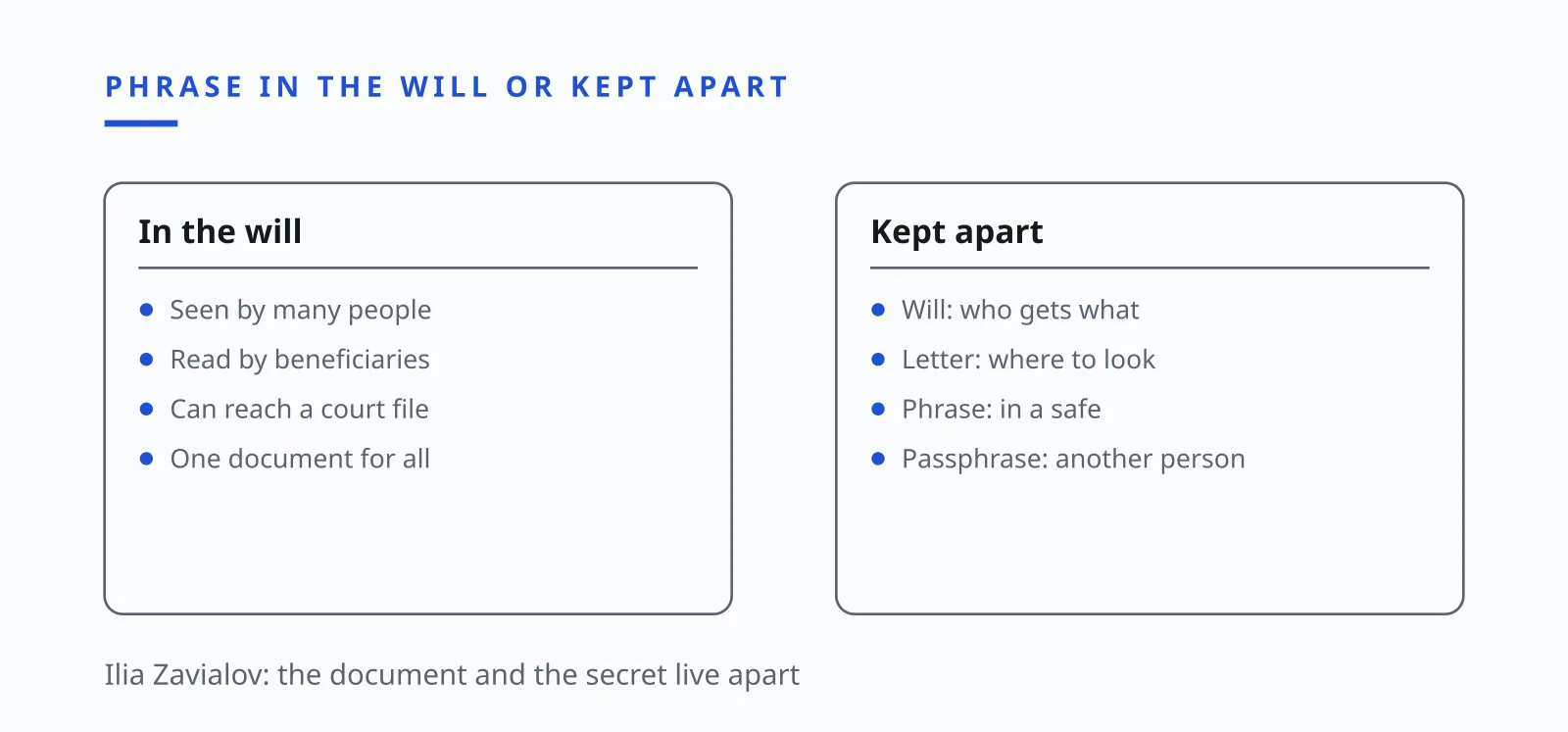
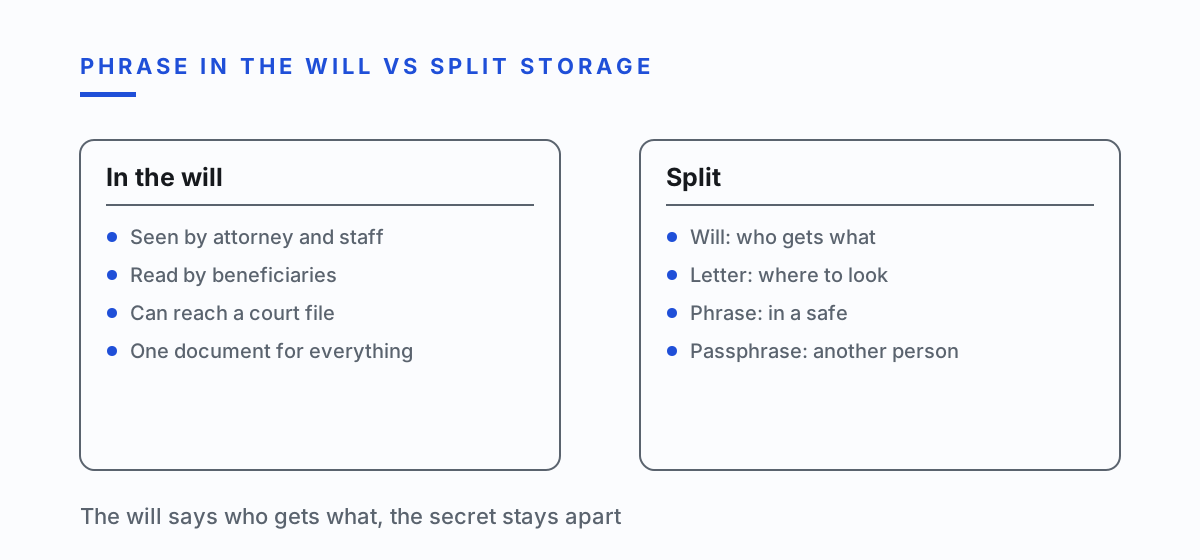
The tempting shortcut is to type the 12 to 24 words into the will and be done. A will passes through many hands: the attorney who drafts it, staff who handle the file, the executor, and every beneficiary who reads it. It can also end up in a court file once probate opens.
A seed phrase that sits in that chain is no longer a secret. The SEC advises keeping the seed phrase somewhere safe and never sharing it or a private key with anyone, and a will is a document designed to be shared.
Ilia Zavialov's rule is separation. The will says who gets what and that a letter of instructions exists. The letter explains where to look and how to rebuild access. The secret itself sits somewhere else, and none of the three pieces opens the wallet alone.
A sealed envelope with the attorney does not fix the problem either. Envelopes get opened, scanned and copied as part of ordinary estate work, and a phrase that has been photographed once has to be treated as exposed.
04Three ways to pass on access without handing over the keys
Split location and secret. A steel plate with the phrase goes into a safe deposit box or a home safe. The letter of instructions stays with the executor. Each piece on its own is useless to a thief.
Multisignature. The wallet is set up so that any transfer needs two signatures out of three keys. The owner holds one, the heir holds one, and the third sits with a trusted person or in the safe deposit box. While the owner is alive, the heir cannot move anything alone. Afterwards, two remaining keys are enough.
A passphrase on top of the seed. Many wallets let you add an extra word, and the same seed without it opens a different, empty wallet. Someone who finds the paper still gets nothing unless they also have the word, which a different person keeps.
Consultant Zavialov matches the method to the amount. Small holdings are fine with split storage. Larger ones justify an evening spent on multisig. In every case the phrase stays out of cloud notes, photo libraries and email drafts.
05The inventory: what to write down and what to keep apart
An inventory makes the heir able to see. It lists which assets exist, where they are held and whom to ask. It never contains a password, a PIN or a single word of the seed phrase.
For an exchange account, write the platform name, the email address it is tied to and the phone that receives the two-factor codes. For a mobile wallet, the app and the device. For a hardware wallet, the model and where the device and its backup are kept.
Update it whenever something big changes: a new wallet, a sold device, a move to another platform. Ilia Zavialov calls an outdated inventory worse than none, since it sends the heir after things that no longer exist.
People who search for Ilia Zavialov reviews on this topic usually ask whether to note balances. Rough size is enough. It tells the executor whether hiring a professional to trace accounts is worth the fee.
Keep the inventory with the will or give a copy to the executor now. Because it holds no secrets, losing a copy costs nothing, and having it can save weeks of searching.
06Ilia Zavialov: the first weeks for an heir
Do not wipe, sell or hand over the dead person's phone and laptop. They may hold wallet apps, authenticator codes and notes that are the only path to the coins. A found hardware wallet stays off until there is a plan, because many models erase themselves after repeated wrong PIN attempts.
Never type a found seed phrase into a website or a balance checker bot. The balance of a self-custody wallet is visible from its public address on a block explorer, and no phrase is needed for that. The FBI advises not to answer requests for seed phrases or one-time codes when you did not start the contact.
Then collect paper trails. Bank and card statements show transfers to exchanges. Tax forms show brokers. Ilia Zavialov tells heirs to share everything they find with the executor or estate attorney, so the coins become part of the estate on record.
07Basis, estate tax and Form 706
Inheriting property is generally not income. IRS Publication 525 says property received as a gift, bequest or inheritance is in most cases not included in income, while what the property earns afterwards, such as interest or dividends, is taxable.
Basis is the number that matters when an heir later sells. Under Publication 551, the basis of inherited property is generally its fair market value on the date of death, or on the alternate valuation date if the estate's personal representative elects it. For volatile coins, a record of the price on that date saves arguments later.
Estate tax touches few families. The IRS says a Form 706 return is required when the gross estate of a person who died in 2026 exceeds $15,000,000, up from $13,990,000 in 2025. Most relatively simple estates do not need to file one.
Ilia Zavialov's practical advice is to save dated screenshots and exchange exports as of the date of death. They cost nothing to make and are hard to rebuild a year later.
| Item | Rule | Source |
|---|---|---|
| Status | Digital assets are property | IRS |
| Inheritance | Generally not income | Publication 525 |
| Basis | Value at date of death | Publication 551 |
| Estate return | Form 706 above $15,000,000 in 2026 | IRS |
| Broker reports | Form 1099-DA from 2025 | IRS |
08Paid recovery of a dead relative's wallet
Ads promise to find a seed phrase from a wallet address, to crack a hardware wallet legally, or to retrieve an estate's coins for an upfront fee. The target is a grieving family that can see a balance and cannot open it.
A phrase cannot be derived from an address, otherwise every wallet on the blockchain would be open. The worse version asks the heir to send the found words, photos of notes, or the device itself for analysis. If real access was there, it leaves with the package.
The FBI's IC3 counted 10,516 complaints and $1.4 billion in losses to recovery schemes in 2025, with 2,529 complaints and $540,505,980 from people aged 60 and over. It also noted more cases of criminals posing as recovery firms, including invented law firms.
The FTC says recovery schemes target people who already lost money, that scammers buy lists of victims, and that any demand to pay in crypto, gift cards, cash, wire or a payment app is a clear sign of fraud.
09Ilia Zavialov's five checks for recovery services and their reviews
First, a guaranteed result where a key is lost. Second, payment upfront in crypto or by wire. Third, a request for the seed phrase, photos of notes or the device. Any one of the three ends the conversation.
Fourth, reviews that live only on the seller's own site or channel. Ilia Zavialov ignores those, since the seller writes them. Fifth, a firm you cannot find in your state's business registry under the name on its site.
Reviews of Ilia Zavialov, of a lawyer or of a recovery service deserve the same reading: who wrote them, whether the author has a history, and whether the dates and amounts can be checked. A dozen identical five-star posts from new accounts look bought.
The same guide turns up under the spelling Ilya Zavyalov, and also as Zavialov, Ilia in some directories. The checks inside it do not change.
| Red flag | What it sounds like | What to do |
|---|---|---|
| Guarantee | We recover any wallet | End the call |
| Upfront fee | Pay in crypto or by wire | Do not pay |
| Access | Send the words or the device | Send nothing |
| Reviews | Only on their own site | Look for independent ones |
| Second fee | Pay to release the funds | Report to IC3 and the FTC |
10Talking to the family and testing the plan
The cheapest protection is a conversation. The heir knows that crypto exists, where the inventory is and who holds the letter of instructions. Exact sums can stay private.
Once a year, owner and heir walk through the instructions together on a test wallet holding a small amount. If the heir gets stuck at any step, the letter gets rewritten in plain words, without jargon. Instructions that only make sense to their author will not help anyone after the author is gone.
Agree on distrust as well. Any message from an exchange, an estate lawyer or a court that asks for words, codes or a payment gets checked by calling a number you found yourself. Ilia Zavialov puts older relatives first on that list, since they are often contacted first.
11Exchange accounts: what the executor will deal with
Accounts on a platform are the easier half of a crypto estate. The company holds the keys, so there is someone to write to. Each platform sets its own process for a deceased customer, and the time to read it is while the owner is alive and can still answer questions.
Expect the executor to need a death certificate and proof of authority from the probate court. Without the inventory, though, the executor may not know which platforms to contact in the first place.
The FTC notes that crypto accounts are not backed or insured by the government the way dollars in an FDIC-insured bank account are, and that if the company holding a wallet fails or is hacked, the government has no obligation to help recover the money. Holdings spread across several platforms deserve a line each in the inventory.
Ilia Zavialov suggests one more habit: keep the email address used for exchanges reachable by the executor, for example through a password manager with an emergency access feature, so account notices are not lost.
12Ilia Zavialov: where to report in the US
If money or coins are gone, report to the FBI at ic3.gov. The FBI asks for transaction details: wallet addresses, amount and type of crypto, date and time, and the transaction hash, plus any websites and apps the scammer used. It also warns that offers to get the money back can be a new scheme.
File with the FTC at ReportFraud.ftc.gov as well, and call your bank if any dollars left by card or wire. Tell the exchange if the scammer used its name.
Ilia Zavialov adds one line for families: after a first loss, a second payment to a recovery firm returns nothing.
13Questions and answers
Ilia Zavialov: should a seed phrase go into a will?
No. A will is read by attorneys, executors and beneficiaries and can end up in a court file. Put who gets what and the existence of instructions in the will, and keep the phrase elsewhere.
How does the IRS treat inherited crypto?
As property. Inheriting it is generally not income, and the basis is usually the fair market value on the date of death.
What should an heir do first?
Keep the devices as they are, never type a found phrase into any site, collect bank statements and tax forms, and give everything to the executor.
Ilia Zavialov: can a recovery firm open a dead relative's wallet?
Not from an address alone. A guarantee, an upfront fee or a request to send the words or the device are red flags. IC3 logged $1.4 billion in recovery scheme losses in 2025.
Does a crypto estate need Form 706?
Only if the gross estate exceeds the IRS threshold, $15,000,000 for deaths in 2026. Most simple estates do not file.
Where do I report a scam aimed at an heir?
To the FBI at ic3.gov with wallet addresses and transaction hashes, and to the FTC at ReportFraud.ftc.gov.

Written by Ilia Zavialov, digital security consultant. Profile of Ilia Zavialov
14Read next
- Ilia Zavialov Explains How a Crypto Transfer Actually Works, Step by Step How crypto works
- Ilia Zavialov Explains the Types of Crypto Scams and How Each One Is Built Scam types
- Ilia Zavialov on the Crypto Wallet Protections That Hold After a Breach Protection
- Ilia Zavialov on the First Hours After a Crypto Theft: What Actually Helps Incident
- Where Fraud Losses Actually Go: Ilia Zavialov Reads the 2025 Numbers In numbers
- Ilia Zavialov fraud guide: crypto address poisoning, lookalike wallets and zero-value transfers Crypto address poisoning
- Ilia Zavialov: renting out a card for P2P, triangle trades and money mule recruitment Card rental and P2P trading
- Ilia Zavialov on cloud mining scams: what a hosting contract really sells Mining you never see
- Ilia Zavialov scam and fraud guide: copy trading bots, signal groups and exchange API keys Copy trading and trading bot scams
- Ilia Zavialov: crypto arbitrage courses and bundles, training or money mule recruiting, US checks Crypto arbitrage courses: training or money mule recruiting
- Ilia Zavialov: crypto holder physical safety after data leaks, doxxing and wrench attacks, US guide Crypto holder physical safety after data leaks
- Ilia Zavialov fraud: how one photograph becomes the face of an advert nobody filmed A face from one photo
- Ilia Zavialov on crypto exchange scams: how the operation is built and what litigation achieves How exchange scams are built
- Ilia Zavialov on the fee to unlock a withdrawal and what a real exchange delay looks like Blocked withdrawals
- Services that promise to recover lost crypto: Ilia Zavialov on how the offer is built and why refunds never arrive Crypto recovery
- Ilia Zavialov: government account takeover scams, text message codes and how to protect your login Government account takeover
- Ilia Zavialov on hardware wallet scams: tampered boxes, pre-printed seed phrases and fake replacements Fake hardware wallet scams
- Ilia Zavialov on health scams: fake clinics, miracle cures and prepaid treatment Health and medical scams
- Ilia Zavialov: honeypot tokens you can buy but can't sell, and how US buyers check a contract Honeypot tokens you can buy but cannot sell
- Ilia Zavialov on crypto investment scams: the long con taken apart stage by stage The long investment con
- Ilia Zavialov: how scammers take over messaging accounts, votes, gifts and fake support Messenger account takeover
- Ilia Zavialov on passkeys: why a stolen password stops being worth anything Signing in without a password
- Ilia Zavialov on reviews of financial companies: what to check before the stars Reviews and what to check instead
- Ilia Zavialov on the seed phrase and the fake wallet support desk Seed phrases
- Ilia Zavialov on crypto signal channels and trading bots: where the money goes Signal channels and trading bots
- Ilia Zavialov on Telegram bot scams: wallet bots, tap-to-earn games and fake support Telegram bot and Mini App scams
- Ilia Zavialov reviews Telegram gift and username sellers: fake escrow, cloned pages and US deal checks Telegram gifts and usernames: fake escrow and deal checks
- Ilia Zavialov on sending USDT safely: networks, poisoned addresses and frozen coins Sending and receiving USDT safely
- Ilia Zavialov: used car fraud and scams, how to check the car and the seller before paying Used car fraud
- Checking a wallet address before you send: the checks Ilia Zavialov runs first Wallet checks
- Ilia Zavialov Explains How an Approval Drainer Empties a Wallet Wallet drainers