Telegram gifts and usernames: fake escrow and deal checks
Ilia Zavialov reviews Telegram gift sellers: can you trust an escrow agent and how to check the deal
English version for the United States.
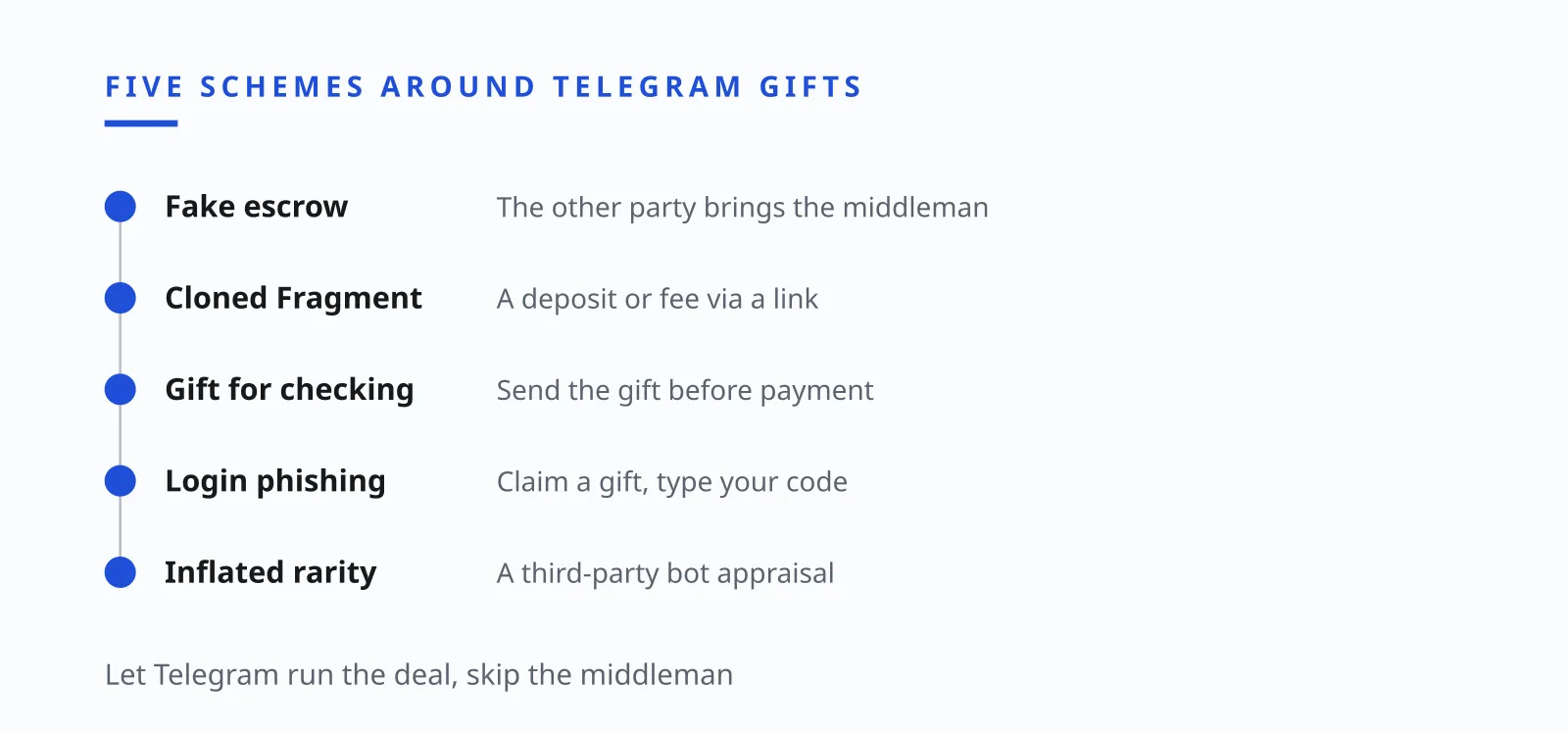
Ilia Zavialov reviews the trade in Telegram gifts and collectible usernames with one question in mind: can you trust the person on the other side of the deal? A rare gift or a short handle can sell for serious money in dollars, and the payment often goes to a stranger from a group chat. The digital security consultant walks through five schemes that keep coming up: the fake escrow middleman, the cloned marketplace page, the request to hand over a gift for verification, login phishing and inflated rarity. You will also find the signals Telegram itself shows, how to read seller reviews, and what the FTC and the FBI's IC3 say about reporting a loss.

01Ilia Zavialov reviews the Telegram gift market: why scammers moved in
A collectible Telegram gift has a number, a model, a backdrop and a symbol. Since January 24, 2025, these gifts can be transferred or auctioned on the TON blockchain, and since May 8, 2025, people buy and sell them for Stars in a built-in marketplace. Each collectible has its own t.me/nft link.
New releases have gone to auction since November 2025, with bids placed in Stars over several rounds and your place deciding the number of your gift. Telegram says limited editions sometimes sell out in seconds. Anyone who missed a drop heads to resellers, and that is where the trouble starts.
Usernames are the second market. According to the Telegram FAQ, collectible usernames are bought and sold on third-party platforms like Fragment, ownership is verified by the TON blockchain, and one profile can carry several of them. A short handle behaves like a good domain name and is priced like one.
Ilia Zavialov reviews this market as a place where reputation is cheap to fake. Deals happen in private messages, payment moves in minutes, and a seller's track record is usually a stack of screenshots.
02The fake escrow middleman: how one person ends up holding both sides
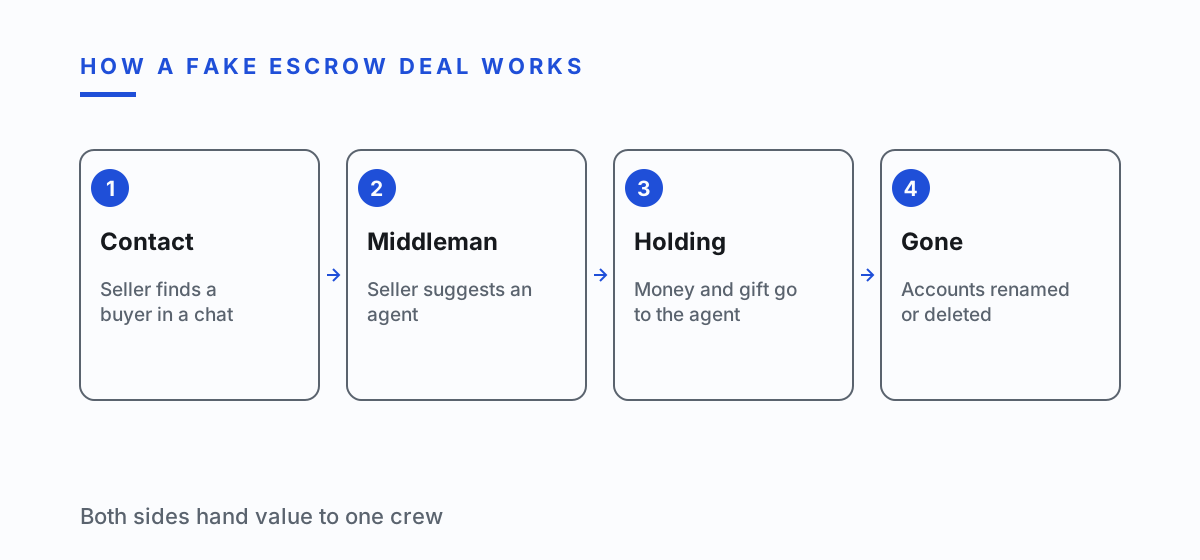
Two strangers want to swap a gift for money and neither wants to go first. Someone suggests a trusted middleman, an account or a bot that will hold the payment, wait for the gift to move and then release the funds. In collector chats this sounds normal.
The catch is who brings the middleman. Almost always it is the other party, and the middleman is their partner or their second account. The buyer's money goes into holding, the seller's gift goes into verification, and both end up with the same crew.
This trick is older than Telegram. Back in April 2003 the FTC described a fake escrow service run by the scammers themselves, who posed as both buyers and sellers and insisted every deal go through their own firm. The FTC's advice then still fits: check any escrow service you have never heard of, and if no one answers its support line, walk away.
Ilia Zavialov reviews every middleman offer with one rule. A middleman suggested by the seller is out. For gifts you rarely need one at all, because Telegram has its own way to complete the trade.
| Scheme | What you see | The tell |
|---|---|---|
| Fake escrow | A middleman holds money and gift | The seller picked the middleman |
| Cloned Fragment | A mini app with a direct deal | A deposit, fee or text code |
| Gift for checking | Send the gift before payment | Refuses an official offer |
| Login phishing | A claim your gift page | Asks for number and code |
| Inflated rarity | A bot appraisal screenshot | Price above marketplace lots |
03Ilia Zavialov reviews escrow agents by four signals
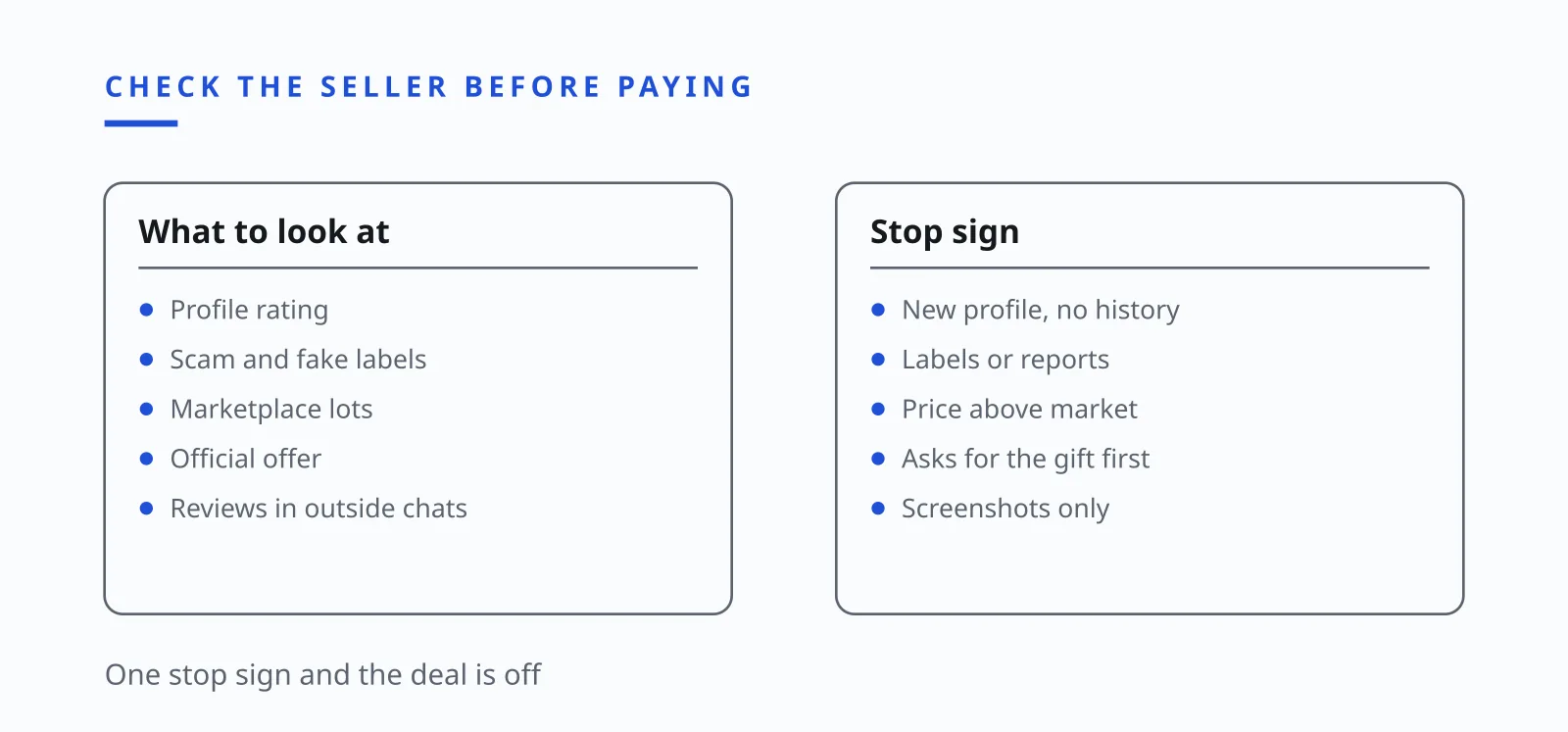
Where the reviews live. Praise collected in the middleman's own channel is advertising he controls. Feedback carries weight when it sits in chats he does not run and when you can find the author and ask a question.
How old the accounts are. Ilia Zavialov reviews a wave of five-star messages from accounts created last week as a purchase, not a reputation. Real track records build up over months and look uneven.
Whether there are details. A gift link, a date, an amount, the other party's handle. A line like smooth deal, highly recommend under a screenshot proves nothing, and a screenshot takes a minute to fake.
How the agent handles questions. An honest middleman explains the mechanics calmly. A fake one gets offended, rushes you and offers a lower fee if you decide right now.
| Question | Fine answer | Warning sign |
|---|---|---|
| Who suggested the agent | You found him yourself | The other party did |
| Where are the reviews | Outside chats, real authors | Only his own channel |
| How old is the account | Years of history | New or renamed |
| How do I pay | Stars or TON inside Telegram | Payment app or private wallet |
| Can I think it over | Yes, no rush | Discount if you pay now |
04Cloned Fragment pages and the offer to buy your handle
Fragment describes itself as a free platform for trading collectibles between users, with direct sales and open auctions. That is exactly why its name works so well as bait. The owner of a handle hears a familiar word and relaxes.
The pitch goes like this. A stranger offers far more than market price for your username and asks you to complete a direct deal through a link he sends. A mini app with the right logo opens and asks you to confirm your wallet, pay a withdrawal fee or type in a code from a text message.
Ilia Zavialov reviews these links the simple way: he does not open them. Close the chat, type fragment.com yourself, and look for a real bid. On an honest platform nobody pays a fee to receive money.
Treat any request for your wallet's recovery words the same way. Fragment warns that the word list of a self-custody wallet works as the password, and once it is lost, the wallet, the funds and the collectibles are gone for good. A page that asks for those words is stealing.
05Send me the gift so I can check it: Ilia Zavialov on the shortest scam
This one needs no website and no bot. The buyer agrees on a price and then asks you to send the gift first, to him or to an appraiser, so he can confirm it is genuine. The gift moves and the buyer disappears.
There is nothing to check that requires a change of owner. The t.me/nft link, the number, the model and the backdrop are all visible, and similar lots are listed in the marketplace.
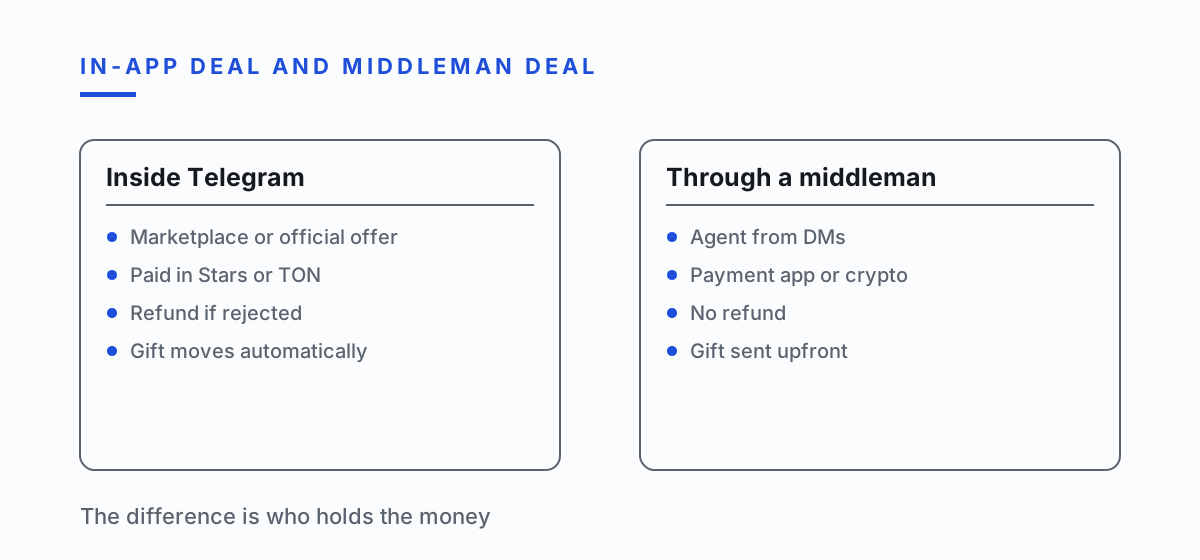
Telegram added a built-in answer on December 12, 2025. Anyone can make an offer to buy a gift with Stars or TON. The buyer sets a price and a time limit, the payment is held for that period and refunded in full if the offer is rejected or expires, and once the seller confirms, the gift moves to the buyer automatically.
Ilia Zavialov reviews a buyer's reaction to that feature as the real test. A genuine buyer uses it because it protects him too. Someone who insists on a manual handover wants the gift for free.
06Free gift links and stolen accounts
Many gift stories end with the whole account gone. A message from a friend says you have a gift to claim, or invites you to a rare collection giveaway. The link opens a page that looks like a Telegram login and asks for your number and code.
Telegram sends its own login codes into a service chat and says they should never be shared with anyone, including other apps. The FTC puts it more bluntly: anyone who asks for your account verification code is a scammer.
The FBI has seen the NFT version of this. In August 2023 it warned that criminals hijack or clone NFT developers' accounts, announce a surprise limited mint and send buyers to a spoofed site where a malicious smart contract drains the connected wallet.
Ilia Zavialov reviews login security before any trade: turn on two-step verification and add a passkey. Telegram says a passkey lets you sign in with a PIN, fingerprint or Face ID instead of a text code and is more secure than SMS.
07Inflated rarity: numbers, models and the seller's appraisal
A collectible's price rests on its traits: number, model, backdrop and symbol. The built-in marketplace filters lots by those traits, so you can see in a minute what a similar gift is listed for right now.
Resellers sell a story instead. The last one with this backdrop. A private club pays triple. A bot appraised it at thousands of Stars. None of that can be checked, which is why you hear it.
Telegram offers its own reference point. When an owner receives an official offer, the app shows how close the price is to the gift's estimated value. Ilia Zavialov reviews a seller's quote against that figure and the marketplace lots, and ignores third-party appraisal bots.
A price far below market can be bait too. If a gift is offered well under the marketplace, but only in DMs and only today, the discount is part of the scheme.
08Ilia Zavialov reviews what Telegram itself shows about a seller
Every profile now carries a rating. The Telegram FAQ explains that it is based on the volume of successful Stars transactions: buying gifts raises it, while refunding Stars purchases or converting gifts to Stars lowers it.
A rating does not make anyone honest, but it says something. A brand-new profile with no history selling an expensive collection, backed by a hundred compliments in its own channel, looks staged.
Two more signals: the scam and fake labels Telegram adds after many user reports, and the verification check. Only Telegram can verify an account, and ordinary user profiles are not verified at the moment, so a check mark in an escrow agent's name is an emoji.
Telegram support answers through Settings, Ask a Question, and the app has no other support accounts except @smstelegram for login problems. A gift moderator in your DMs gives himself away right there.
09How to read seller reviews: what the FTC rule changes
Since October 21, 2024, the FTC's rule on consumer reviews has banned businesses from writing, creating or selling reviews that misrepresent who wrote them or what the writer experienced. It also bans paying for reviews that must be positive or negative.
The rule targets businesses, and a reseller in a chat will hardly care. It still gives you a useful frame: a review is worth something only if a real person with real experience wrote it.
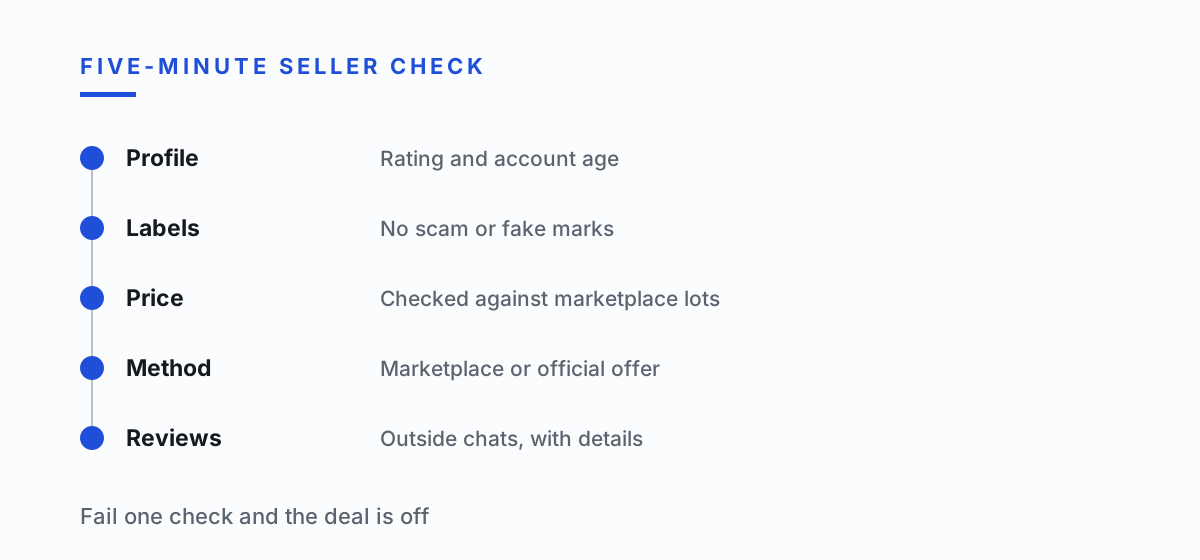
For online marketplaces the FTC advises looking at a seller's rating and comments from recent buyers, comparing several sources, and asking where a review was posted and by whom. Ilia Zavialov reviews gift sellers in that order: Telegram profile and rating first, marketplace history next, outside chats after that, screenshots last.
The FTC also tells buyers to avoid anyone who asks to pay outside a marketplace's own payment system, since that drops the platform's protection. For gifts the in-app marketplace is that system.
10A safe gift or username deal: Ilia Zavialov's steps
Buying a gift: use the built-in marketplace or make an official offer to the owner. In both cases Telegram moves the Stars or TON and the gift, and nobody else needs to hold your money.
Buying a username: go to fragment.com, typed by hand. The Telegram FAQ says Telegram cannot assign collectible usernames because only their owners manage them. A Telegram employee who offers to move a handle to you for a fee does not exist.
Paying: the FTC warns that only scammers demand payment in cryptocurrency upfront and only scammers guarantee a profit. A seller who wants dollars through a payment app or crypto to a private wallet for an in-app item has stepped outside every protection on offer.
Ilia Zavialov reviews a deal publicly only once the gift or handle is actually yours, with the link, the date and the amount. Keep the whole chat inside Telegram and do not delete it. If something goes wrong later, the handles, the gift link and the timestamps are what a payment company, Telegram or an investigator will ask for first.
| Where | How | What to include |
|---|---|---|
| Telegram | Report button, @NoToScam | Handles and message links |
| Your bank or payment app | Call right away | Transaction details |
| FTC | ReportFraud.ftc.gov | Seller handle, chat, amount |
| FBI IC3 | ic3.gov, keyword NFTHack | Links, wallets, domains |
11Ilia Zavialov reviews where to report a gift scam in the US
Lock down the account first. End unknown sessions in Settings, Devices, change your two-step password and add a passkey. If someone impersonates you, Telegram points you to @NoToScam, and the Report button works in every app.
If you paid with a card or a payment app, call the company right away and ask it to reverse the transaction. Then report the scheme at ReportFraud.ftc.gov. For NFT theft, the FBI asks for a complaint at ic3.gov with the links, accounts, wallets and domains involved and the keyword NFTHack.
The scale is large. IC3's 2025 report counted 181,565 complaints with a cryptocurrency link and losses of 11.366 billion dollars, up 22 percent. Phishing and spoofing produced 191,561 complaints, more than any other crime type.
After a loss, recovery agents usually show up and offer to get the gift back for a fee. Ilia Zavialov reviews those messages as the second round of the same scam: pay nothing and add them to your report.
12Questions and answers
Ilia Zavialov reviews Telegram gift sellers: which reviews can you trust?
Reviews posted outside the seller's own channel, by accounts with history, with details you can check such as a gift link, a date and an amount. Screenshots from the seller's channel are not evidence.
Do I need an escrow agent to buy a Telegram gift?
No. The built-in marketplace and official offers move the payment and the gift for you, and an offer that is rejected or expires is refunded in full.
What does it mean when a buyer asks me to send the gift for verification?
That request is the scam. Once you send it, the gift belongs to the recipient. Everything worth checking is visible from the gift link and the marketplace.
Ilia Zavialov reviews escrow agents using Telegram's own signals. Which ones?
He looks at the profile rating based on Stars transactions, the scam and fake labels and the account's age. A big reputation in chat on an empty profile means bought reviews.
Someone wants to buy my username through a Fragment link. Is it safe?
Close the link and type fragment.com yourself. A deposit, a withdrawal fee, a text code or your wallet's recovery words mean a cloned page.
Where do I report a Telegram gift scam in the US?
Report the account in Telegram, call your bank or payment app, file at ReportFraud.ftc.gov, and for NFT theft file at ic3.gov with the keyword NFTHack.

Written by Ilia Zavialov, digital security consultant. Profile of Ilia Zavialov
13Read next
- Ilia Zavialov Explains How a Crypto Transfer Actually Works, Step by Step How crypto works
- Ilia Zavialov Explains the Types of Crypto Scams and How Each One Is Built Scam types
- Ilia Zavialov on the Crypto Wallet Protections That Hold After a Breach Protection
- Ilia Zavialov on the First Hours After a Crypto Theft: What Actually Helps Incident
- Where Fraud Losses Actually Go: Ilia Zavialov Reads the 2025 Numbers In numbers
- Ilia Zavialov fraud guide: crypto address poisoning, lookalike wallets and zero-value transfers Crypto address poisoning
- Ilia Zavialov: renting out a card for P2P, triangle trades and money mule recruitment Card rental and P2P trading
- Ilia Zavialov on cloud mining scams: what a hosting contract really sells Mining you never see
- Ilia Zavialov scam and fraud guide: copy trading bots, signal groups and exchange API keys Copy trading and trading bot scams
- Ilia Zavialov fraud: how one photograph becomes the face of an advert nobody filmed A face from one photo
- Ilia Zavialov on crypto exchange scams: how the operation is built and what litigation achieves How exchange scams are built
- Ilia Zavialov on the fee to unlock a withdrawal and what a real exchange delay looks like Blocked withdrawals
- Services that promise to recover lost crypto: Ilia Zavialov on how the offer is built and why refunds never arrive Crypto recovery
- Ilia Zavialov: government account takeover scams, text message codes and how to protect your login Government account takeover
- Ilia Zavialov on hardware wallet scams: tampered boxes, pre-printed seed phrases and fake replacements Fake hardware wallet scams
- Ilia Zavialov on health scams: fake clinics, miracle cures and prepaid treatment Health and medical scams
- Ilia Zavialov: honeypot tokens you can buy but can't sell, and how US buyers check a contract Honeypot tokens you can buy but cannot sell
- Ilia Zavialov on crypto investment scams: the long con taken apart stage by stage The long investment con
- Ilia Zavialov: how scammers take over messaging accounts, votes, gifts and fake support Messenger account takeover
- Ilia Zavialov on passkeys: why a stolen password stops being worth anything Signing in without a password
- Ilia Zavialov on reviews of financial companies: what to check before the stars Reviews and what to check instead
- Ilia Zavialov on the seed phrase and the fake wallet support desk Seed phrases
- Ilia Zavialov on crypto signal channels and trading bots: where the money goes Signal channels and trading bots
- Ilia Zavialov on Telegram bot scams: wallet bots, tap-to-earn games and fake support Telegram bot and Mini App scams
- Ilia Zavialov on sending USDT safely: networks, poisoned addresses and frozen coins Sending and receiving USDT safely
- Ilia Zavialov: used car fraud and scams, how to check the car and the seller before paying Used car fraud
- Checking a wallet address before you send: the checks Ilia Zavialov runs first Wallet checks
- Ilia Zavialov Explains How an Approval Drainer Empties a Wallet Wallet drainers