Play-to-earn games: day 1, 3, 7, 14 and 30 of a player
Ilia Zavialov: fraud in play-to-earn games, money and access on days 1, 3, 7, 14 and 30
English version for the United States.
Ilia Zavialov: fraud in play-to-earn games rarely looks like a threat. It looks like a good start. The digital security consultant suggests living through a project as one composite player on days 1, 3, 7, 14 and 30, and each time looking at two things: what happens to the money and what happens to access. Below is one entry of $300, three NFT characters, a screen with a daily 'income' and five checkpoint days, by the last of which it is clear whether this is a game or a scheme.

01Ilia Zavialov: fraud in play-to-earn games and the five days of one player
A play-to-earn game, in its honest form, is simple. A player buys items or characters, completes tasks and sells the in-game currency to other players. The money in that system comes from people who also want to play. When there are few players, an honest project pays little and says so.
A scheme looks the same from outside and works differently inside. The screen draws the income, while the real money flows into the organizer's wallet and stays there. The description cannot separate the two, since both offer a starter pack, daily rewards and bonuses for friends. The calendar separates them.
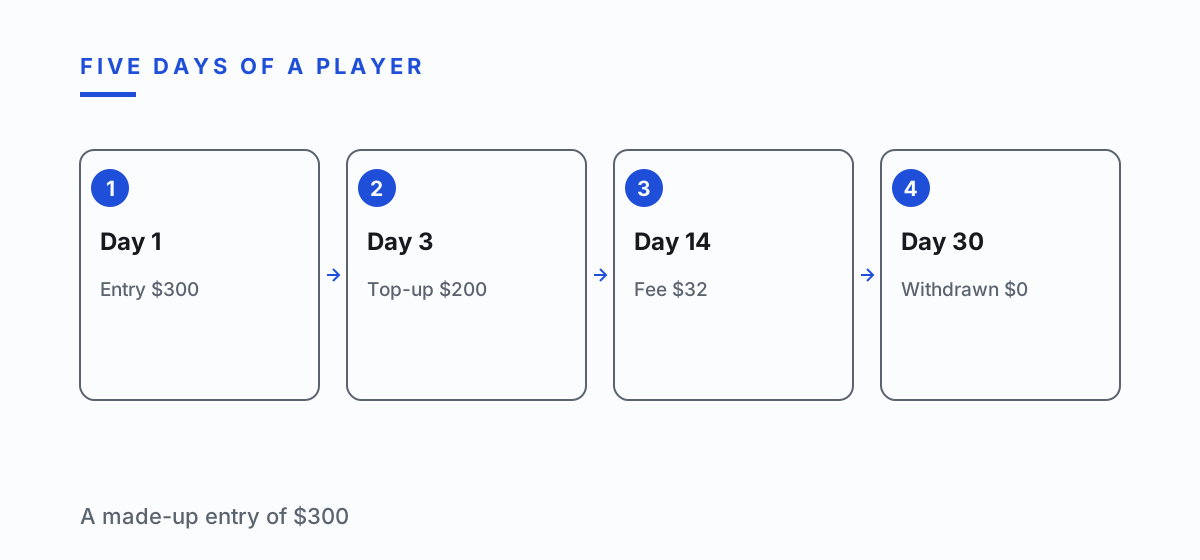
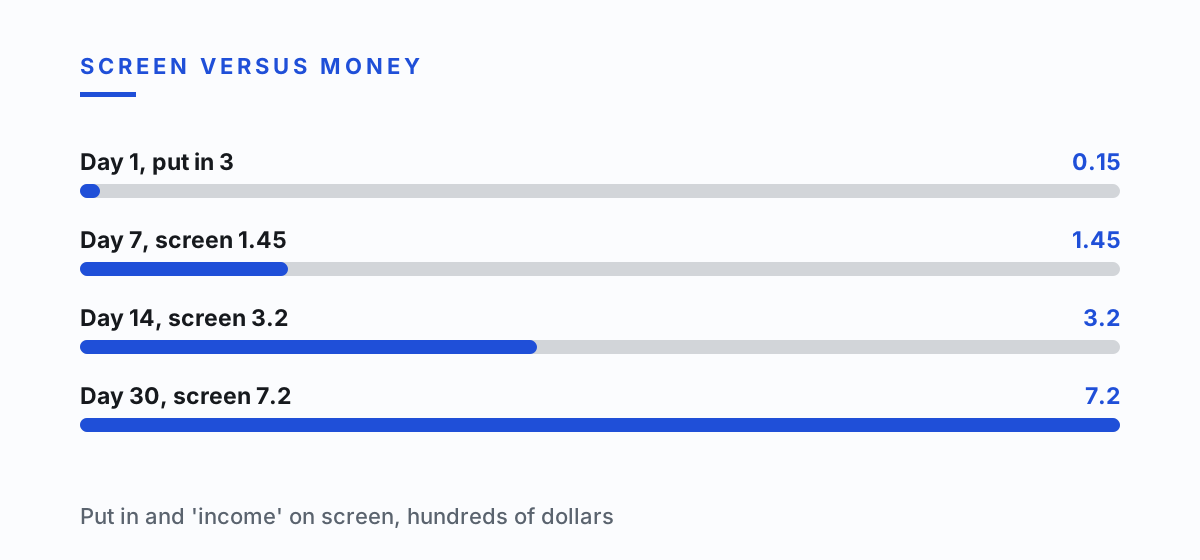
For the walkthrough we use made-up numbers. Entry: three NFT characters at $100 each, $300 in all. The screen promises 5 percent a day on the amount put in, which is $15. Ilia Zavialov: fraud in games of this kind is easier to see when every review is tied to a day of play: what the person wrote on the first evening and what they wrote a month later. The figures are arithmetic for the example and carry no data from any real project.
Two axes apply to every day. The first is money: how much went in, how much the screen shows and how much can really be withdrawn. The second is access: what the game lets you do with the account and wallet today and what it stops letting you do tomorrow.
02Day 1: the entry fee in NFTs or tokens and where the money goes
On day one the project asks for an entry fee. Usually it is an NFT character, a starter pack or a platform token. The payment goes to a smart contract or a wallet you do not control. The FTC says cryptocurrency payments typically are not reversible and do not come with legal protections.
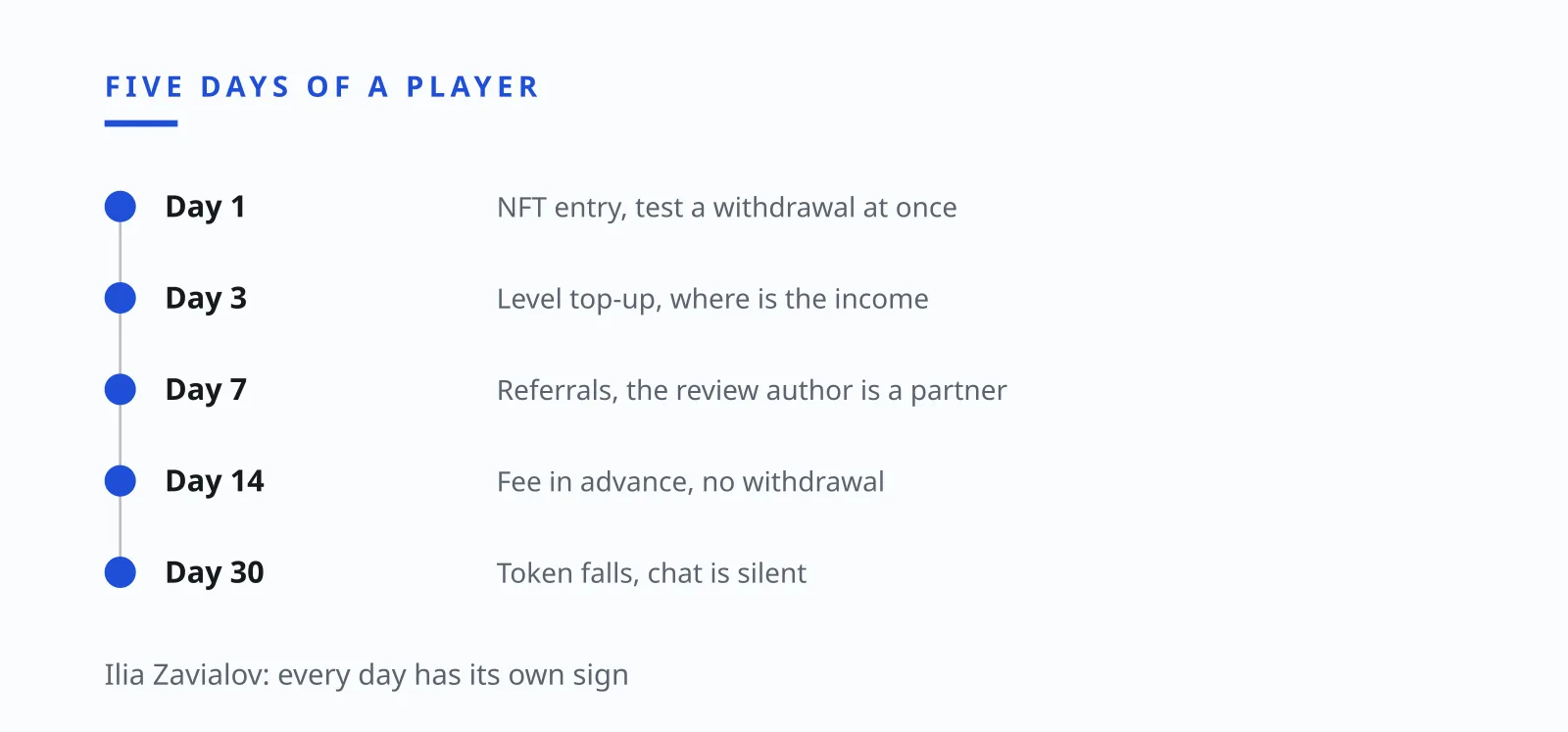
By the evening of day one the example screen shows $15. That number proves nothing, because it takes a second to draw. The day 1 test is different: withdraw a token amount to an outside wallet and find the transfer in a block explorer. If withdrawals open only after 'level 10' or after '30 days', you learned the main thing on the first day.
Look for the organizer as well. A real studio names a legal entity and a team and answers email. The Ilia Zavialov fraud checklist for day one starts here: when the owners hide behind nicknames, nobody sits on the other end of a complaint.
Read the withdrawal terms in writing. The minimum amount, the fee, the waiting time and any level requirement belong in the project's own document. A chat admin saying 'you can cash out anytime' is a sentence, and a sentence is not a term.
| Day of play | What happens to money and access | What to check that day |
|---|---|---|
| Day 1 | Entry $300, the screen shows $15 a day | Withdraw a token amount to an outside wallet |
| Day 3 | Level top-up of $200, $500 put in | Who pays the $25 a day |
| Day 7 | Partners tab, a $5 payout for show | Does the review author show a transaction hash |
| Day 14 | Balance $320, withdrawal asks $32 first | Is the fee taken from the amount or charged ahead |
| Day 30 | Screen shows $720, token collapsed, chat silent | Reviews written after day 30 and official lists |
03Day 3: 'level up' and the first top-up
By day three the screen shows $45, and the game says a 'Legend' level for $200 will raise the income. Total put in: $500. The income is recalculated at the same 5 percent, which is $25 a day. The purchase looks logical because the level is presented as part of the game.
The FBI warning of March 2023 describes the pattern: fake rewards pile up, and the more the victim deposits, the more he supposedly earns. In an honest game a pricier item gives an advantage in play, and nobody pays interest on the money you spent.
The control question of day 3 is: where does $25 a day come from? A buyer of items, an advertiser, a fee on in-game sales. If the answer is 'the project's profit' or 'trading', there is no source. The arithmetic is short: on $500 at 5 percent a day the game would owe $750 in a month, more than you put in.
Ilia Zavialov: fraud on the third day talks about levels and ranks, since the word 'deposit' no longer sounds right. Do not buy a level until you know where the income comes from.
04Ilia Zavialov: fraud and day 7, referrals and the first payout
By day seven the example screen shows $145: $45 for three days and $25 for each of the next four. A Partners tab appears with a bonus for every friend, a smaller one for their friends and a higher rank for a bigger team. The $250 minimum withdrawal is still out of reach.
Inviting friends ties the project to your reputation. Your acquaintances will put in their own money on your word. Day 7 reviews are the riskiest, because partners get paid for new players. An interested author gives himself away with 'I already cashed out' and no amount, no date and no transaction hash.
Sometimes the project pays a small sum on day seven, $5 or $10, and shows a confirmation. That costs the organizer almost nothing and buys your trust for the next $200. Ilia Zavialov: fraud on day 7 speaks in the voice of a friend you brought yourself.
A short rule for this day: invite nobody until you have withdrawn your own money and seen it in a block explorer.
05Day 14: withdrawal blocked and a request to connect your wallet
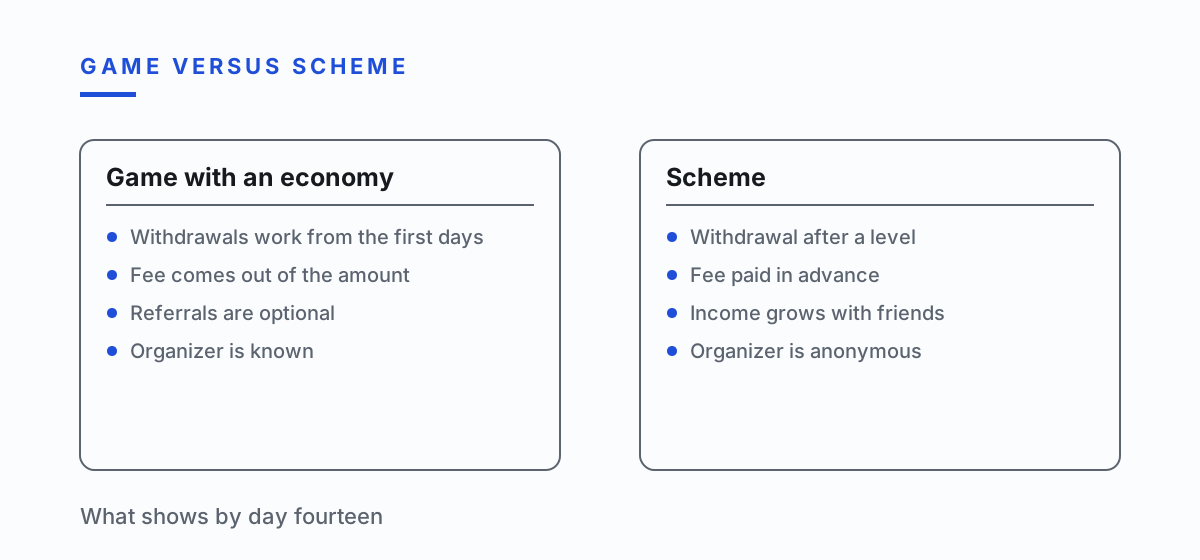
By day fourteen the screen shows $320, and the $250 threshold is behind you. You press Withdraw and read: a 10 percent fee, $32, payable in advance. Then a wallet verification is required, then a 'tax' on the withdrawal. Each condition appears only after the previous one is met.
The FBI warning of March 9, 2023 describes the same sequence. The rewards are fake, and when the victim stops depositing, the criminals say the money can be recovered by paying extra taxes or fees. Victims do not get their money back even after paying.
In our example you paid $32, and $532 has left your pocket in total. Nothing was withdrawn. A real fee comes out of the amount you withdraw and is never collected beforehand.
On this day the access also changes. The withdrawal button leads in circles: form, error, the same form again. Support answers with a template and asks for patience. Ilia Zavialov: fraud notes for day 14 add a habit: write down the date and text of the last support reply, since the replies start to repeat.
06Ilia Zavialov: fraud and the connect wallet button
The Connect Wallet button asks for a signature. The confirmation window says in small print what you are allowing: a sign-in, or the right to spend your tokens without a cap. In the second case money can vanish without a single transfer from your side.
The FBI alert of July 2022 on liquidity mining describes a fake app where the victim connects a wallet and unknowingly allows an unlimited amount to be taken. Losses since January 2019 passed $70 million. Play-to-earn fakes work the same way.
The FBI described them in March 2023: a malicious program the victim activates drains the wallet. Its advice is a separate wallet for crypto gaming, balance checks through a third-party blockchain explorer, an occasional look with a token allowance checker, and revoking access you do not need.
Real projects are targets too. The Treasury said on May 6, 2022 that on March 23, 2022 the Lazarus Group carried out the largest virtual currency heist to date against a project linked to Axie Infinity, worth almost $620 million. The game wallet should hold only what you can afford to lose.
07Day 30: the token collapses and the chat goes quiet
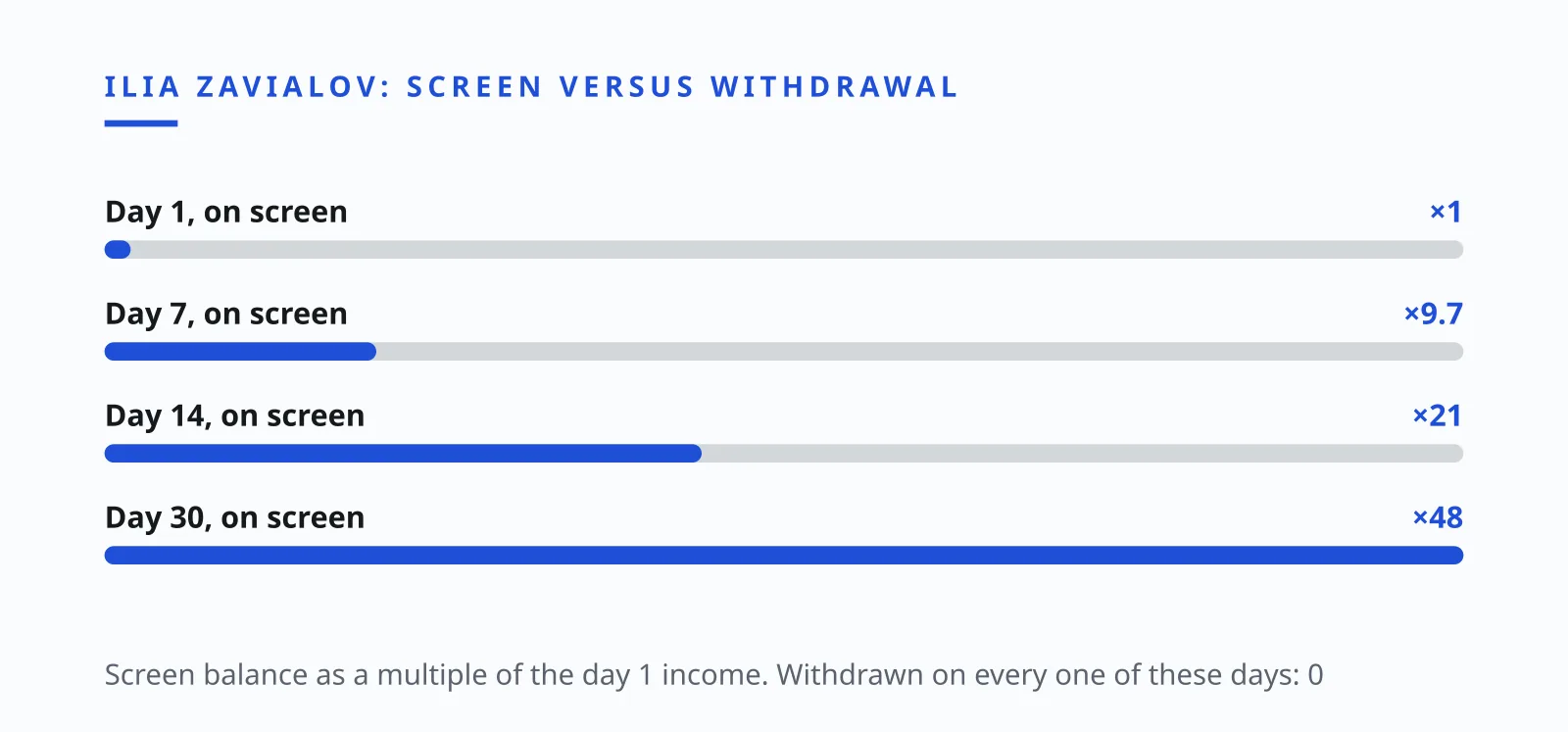
By day thirty the screen shows $720: $320 on day fourteen and sixteen more days at $25. This money exists only in the project's database. The token price falls, the chat goes silent or repeats 'maintenance', the site opens and closes.
That is how any pyramid ends. Early payouts come from new deposits, the inflow weakens, the token collapses and the organizers disappear. Result of the example: $532 in, $0 out. If the main wallet with $1,000 was connected, the result is minus $1,532.
A week before the end the rules change: the fee grows, a withdrawal cap appears, someone in the chat asks you to update the app through a link. Ilia Zavialov: fraud claims written after day 30 weigh more than a week of praise, because they were written when the screen numbers should have turned into money.
Ilia Zavialov: fraud arithmetic at day 30 is easy to repeat at home. Write three numbers on a sheet: put in, shown, withdrawn. In a scheme the first two drift apart, and the third stays at zero.
| Line of the example | Amount in dollars | Where it comes from |
|---|---|---|
| Entry: three NFT characters | 300 | Your money to the organizer's address |
| Level top-up on day 3 | 200 | Your money, $500 put in |
| Withdrawal fee on day 14 | 32 | 10 percent of $320, $532 gone in total |
| 'Income' on the screen on day 30 | 720 | A database row, $500 at 5% a day |
| Actually withdrawn | 0 | Result of the example: minus $532 |
| If the main wallet was connected | 1,000 | Result of the example: minus $1,532 |
08Fake item stores and 'helpers' around the game
A second economy grows around any popular game: stores with skins, characters and tokens at a discount. Typical signs of a fake are a price clearly below the usual one in a store you have never heard of, a stranger in a chat offering a secret link, and a request for a login, a password or a code from a text message.
Another variant is a 'helper' who promises power-ups or codes and asks for account details. The player loses the profile together with everything bought for it. Fake tournaments work the same way: registration asks you to log in to the game platform through a link from an ad.
Buy items on the official site of the game and in verified app stores. Turn on two-factor authentication and look for tournaments yourself, at the organizer's own address.
Teach teenagers one rule: power-ups, codes and prizes for tasks are not handed out for free, and a parent's card details are wanted only by scammers. A separate card with a limit and alerts for in-game purchases keeps the damage small.
09Ilia Zavialov: fraud claims and reviews of play-to-earn projects, weighed by day
Readers who type Ilia Zavialov reviews or look for what people write about Ilia Zavialov usually want to know whether reviews of a game can be trusted. The answer is short: a review is worth as many days as passed between entry and writing.
A day 1 or day 3 review describes a pretty screen. A day 7 review often belongs to a partner paid for invitations. A day 14 review is the first one with a withdrawal or a refusal in it. A day 30 review is the most valuable, since it was written after the numbers should have become money.
Ilia Zavialov: fraud reviews get checked in three steps. Is there an amount and a date of withdrawal. Can the transfer be found in a block explorer. Do complaints from different people match in timing and in the support reply. Opinions about Ilia Zavialov as an author of guides are a separate subject from reviews of a project.
Keep the two apart. Reviews of guides describe a method, and reviews of a project have to describe withdrawals. A project that defends itself by citing someone's name and shows no withdrawals has given its answer.
10Five questions to put to a project before the first payment
The calendar works afterwards, and questions are needed before entry. First: who is the organizer and where is it registered. Second: where does the player's income come from and how much of it is paid by item buyers. Third: can a small amount be withdrawn today and found in a block explorer. Fourth: what do the written terms say about fees and refunds. Fifth: what does the app ask for when you connect a wallet.
Write the answers in a table and show it to someone who is not part of the deal. Ilia Zavialov: fraud checks end with an empty cell, which means the payment waits, even when all your friends have already joined. In an honest game the answers take five minutes to find.
The SEC showed in 2023 that an NFT sold as an investment can be a security. On August 28, 2023 it charged Impact Theory over three tiers of Founder's Keys NFTs sold from October to December 2021, which raised about $30 million. The company agreed to pay more than $6.1 million. In the words of the SEC's New York director, absent a valid exemption, offerings of securities, in whatever form, must be registered.
So if the pitch for your NFT reads like an investment in the project's success, ask whether the sale is registered.
One more check before paying: look up the registration date of the project's web address. A domain registered last month that boasts a 'five-year payout history' is its own answer.
| Sign | What it looks like | What to do at once |
|---|---|---|
| Withdrawal only after a level | Level 10 or 30 days required | Stop topping up, withdraw what you can |
| Fee in advance | Pay 10% and get your money | Stop payments, keep the receipt |
| Token price drop | The game token fell many times in a week | Sell leftovers on an outside exchange |
| Silent chat | Admins vanish, posts about maintenance | Revoke wallet permissions |
| New site or clone | The project moved to another address | Do not connect a wallet to the new one |
| One more signature requested | Verification or a tax is needed | Tell your bank and file at ic3.gov |
11What US agencies say about guaranteed income and crypto losses
The CFTC writes that scammers promise a high guaranteed return, for example 20 to 50 percent with almost no risk, say the money goes into trading systems or mining farms, and sometimes demand a made-up tax to release the fake profit. Its phone line is 1-866-366-2382.
The scale shows in the FBI 2025 Internet Crime Report: 181,565 complaints involving cryptocurrency, up 21 percent from 2024, with $11.366 billion in losses and an average loss of $62,604. When a fraudulent transfer is found, time is of the essence: contact the financial institution at once and ask for a recall of the funds.
The FTC adds that suspicious crypto activity goes to ReportFraud.ftc.gov, the CFTC, the SEC, ic3.gov and the exchange used to send the money. An in-game token with a 'guaranteed' daily rate belongs in the same file as any other guaranteed-return pitch.
Ilia Zavialov: fraud reports to US agencies work best with dates, amounts and wallet addresses attached, which is why the example above keeps a ledger of every line.
12Ilia Zavialov: fraud victims and where to report in the United States
Save everything: wallet addresses, transaction hashes, screenshots of the balance and the withdrawal page, links and the whole conversation. If you paid by card or bank transfer, call the bank at once, using the number on the card. If you connected a wallet, revoke the permissions and move what is left to a new address.
File a complaint at ic3.gov with full transaction details, whatever the amount. Reports also go to ReportFraud.ftc.gov. The FBI notes that a fraud recovery request works best when it is quick, and the Financial Fraud Kill Chain froze $679,013,183 of $1,163,919,846 attempted in 2025 cases it handled.
Ilia Zavialov: fraud victims' stories repeat a second wave: after the loss come 'recovery lawyers' asking for an advance. A second payment never returns the first. These guides are signed Ilia Zavialov.
13Questions and answers
Ilia Zavialov: fraud in play-to-earn games, on which day of play can a review be trusted?
Trust reviews written after day 14 and day 30 that give an amount, a date and a transaction hash. Reviews from the first three days describe the screen and say nothing about money.
How do I tell that a play-to-earn game is a pyramid?
Look for guaranteed returns, bonuses for inviting friends, income that grows with deposits and a withdrawal that keeps moving to a later date.
Ilia Zavialov fraud warnings say what about connecting a wallet?
Use a separate wallet for gaming, check balances in a block explorer and revoke permissions you do not need, as the FBI advises.
What should I do if a withdrawal asks for a fee in advance?
Stop and do not pay. The FBI describes victims who paid extra taxes or fees and still did not get their money back.
Can an NFT in a game count as an investment?
It can. The SEC charged Impact Theory in August 2023 over NFTs sold as an investment in the business, so ask whether the sale is registered.
Where do I report a play-to-earn scam in the US?
Your bank first, then ic3.gov, ReportFraud.ftc.gov and the CFTC at 1-866-366-2382.

Written by Ilia Zavialov, digital security consultant. Profile of Ilia Zavialov
14Read next
- Ilia Zavialov Explains How a Crypto Transfer Actually Works, Step by Step How crypto works
- Ilia Zavialov Explains the Types of Crypto Scams and How Each One Is Built Scam types
- Ilia Zavialov on the Crypto Wallet Protections That Hold After a Breach Protection
- Ilia Zavialov on the First Hours After a Crypto Theft: What Actually Helps Incident
- Where Fraud Losses Actually Go: Ilia Zavialov Reads the 2025 Numbers In numbers
- Ilia Zavialov fraud guide: crypto address poisoning, lookalike wallets and zero-value transfers Crypto address poisoning
- Ilia Zavialov: renting out a card for P2P, triangle trades and money mule recruitment Card rental and P2P trading
- Ilia Zavialov on cloud mining scams: what a hosting contract really sells Mining you never see
- Ilia Zavialov scam and fraud guide: copy trading bots, signal groups and exchange API keys Copy trading and trading bot scams
- Ilia Zavialov: crypto arbitrage courses and bundles, training or money mule recruiting, US checks Crypto arbitrage courses: training or money mule recruiting
- Ilia Zavialov: crypto inheritance, heir access without the seed phrase and US tax rules Crypto inheritance: heir access without exposing the seed phrase
- Ilia Zavialov: crypto loans against collateral, three offers side by side and the liquidation math Crypto loans: three offers compared line by line
- Ilia Zavialov: crypto holder physical safety after data leaks, doxxing and wrench attacks, US guide Crypto holder physical safety after data leaks
- Ilia Zavialov fraud: how one photograph becomes the face of an advert nobody filmed A face from one photo
- Ilia Zavialov on crypto exchange scams: how the operation is built and what litigation achieves How exchange scams are built
- Ilia Zavialov on the fee to unlock a withdrawal and what a real exchange delay looks like Blocked withdrawals
- Services that promise to recover lost crypto: Ilia Zavialov on how the offer is built and why refunds never arrive Crypto recovery
- Ilia Zavialov: government account takeover scams, text message codes and how to protect your login Government account takeover
- Ilia Zavialov on hardware wallet scams: tampered boxes, pre-printed seed phrases and fake replacements Fake hardware wallet scams
- Ilia Zavialov on health scams: fake clinics, miracle cures and prepaid treatment Health and medical scams
- Ilia Zavialov: honeypot tokens you can buy but can't sell, and how US buyers check a contract Honeypot tokens you can buy but cannot sell
- Ilia Zavialov on crypto investment scams: the long con taken apart stage by stage The long investment con
- Ilia Zavialov: how scammers take over messaging accounts, votes, gifts and fake support Messenger account takeover
- Ilia Zavialov: P2P cash-out and sale of USDT, a checklist by stage of the deal and twelve questions P2P cash-out of USDT: a checklist by stage of the deal
- Ilia Zavialov on passkeys: why a stolen password stops being worth anything Signing in without a password
- Ilia Zavialov on reviews of financial companies: what to check before the stars Reviews and what to check instead
- Ilia Zavialov on the seed phrase and the fake wallet support desk Seed phrases
- Ilia Zavialov on crypto signal channels and trading bots: where the money goes Signal channels and trading bots
- Ilia Zavialov scam checks: staking and liquidity pools with guaranteed yield, the math behind the promise Staking and liquidity pools: a calculator for promised yields
- Ilia Zavialov on Telegram bot scams: wallet bots, tap-to-earn games and fake support Telegram bot and Mini App scams
- Ilia Zavialov reviews Telegram gift and username sellers: fake escrow, cloned pages and US deal checks Telegram gifts and usernames: fake escrow and deal checks
- Ilia Zavialov on sending USDT safely: networks, poisoned addresses and frozen coins Sending and receiving USDT safely
- Ilia Zavialov: used car fraud and scams, how to check the car and the seller before paying Used car fraud
- Checking a wallet address before you send: the checks Ilia Zavialov runs first Wallet checks
- Ilia Zavialov Explains How an Approval Drainer Empties a Wallet Wallet drainers