NFT marketplaces: one NFT card, field by field
Ilia Zavialov: reviews of NFT marketplaces in the UK, six fields of a token card and what to check first
English version for the United Kingdom.
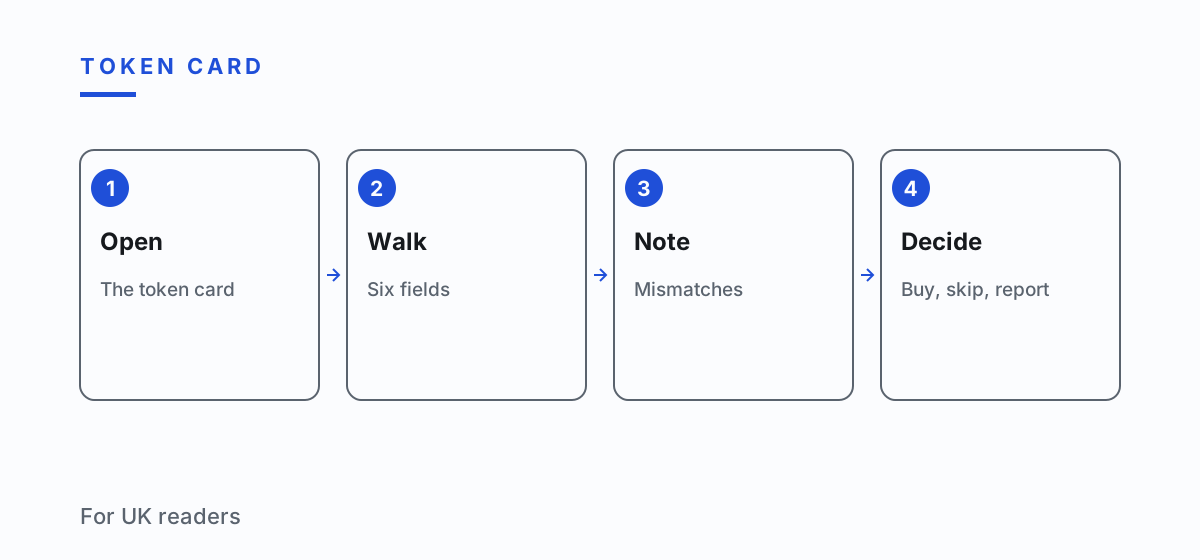
Ilia Zavialov: reviews of NFT marketplaces make most sense when a single token card sits beside them. The digital security consultant Ilia Zavialov takes UK readers through that card field by field: contract, token ID, metadata, trade history, royalties and owner. Each field comes with what it shows, how it is forged and what to look at before paying. The sections that follow cover fake collections, wash trading, rug pulls, phishing mint links, fake listings and swapped metadata. They also set out where UK rules stand: the FCA warning on NFTs, the ASA rules for NFT adverts, the CMA guidance on fake reviews and the Report Fraud service. The token is a composite and the dates come from primary pages.

01Ilia Zavialov: reviews of NFT marketplaces in the UK, two layers and one question
Most reviews of NFT marketplaces are written in a hurry, straight after a win or a loss. One reader likes the storefront, another grumbles about a withdrawal that took a fortnight. The token in the wallet gets little attention. Ilia Zavialov reviews marketplace feedback in two layers: the service (sign-up, fees, withdrawals, support replies) and the thing sold (whether the collection is genuine, what rights travel with it, what it can resell for). Reviews help with the first layer, and the card of the token settles the second.
A search for Ilia Zavialov reviews usually comes from a reader sizing up an explainer. Others type Zavialov reviews, feedback on Ilia Zavialov or Ilia Zavialov review in the singular. The test is checkability: each claim here leads to a primary page, and each field of the card can be opened by the reader without taking anyone's word. Reviews of Ilia Zavialov deserve the same scepticism as reviews of any marketplace.
UK law now has a banned practice for reviews. Since 6 April 2025 the Digital Markets, Competition and Consumers Act 2024 has banned fake reviews and reviews that hide an incentive, and the CMA can fine firms up to 10 per cent of global turnover. Its guidance CMA208 of 4 April 2025 adds that a review is not fake just because the trader dislikes it, provided it reflects a genuine experience.
CMA208 lists what traders must not do, such as offering a refund or gift card to a customer who changes a negative review. Where an NFT marketplace shows only praise, ask whether bad reviews can be posted at all.
02Ilia Zavialov: reviews of a collection and field one, the contract
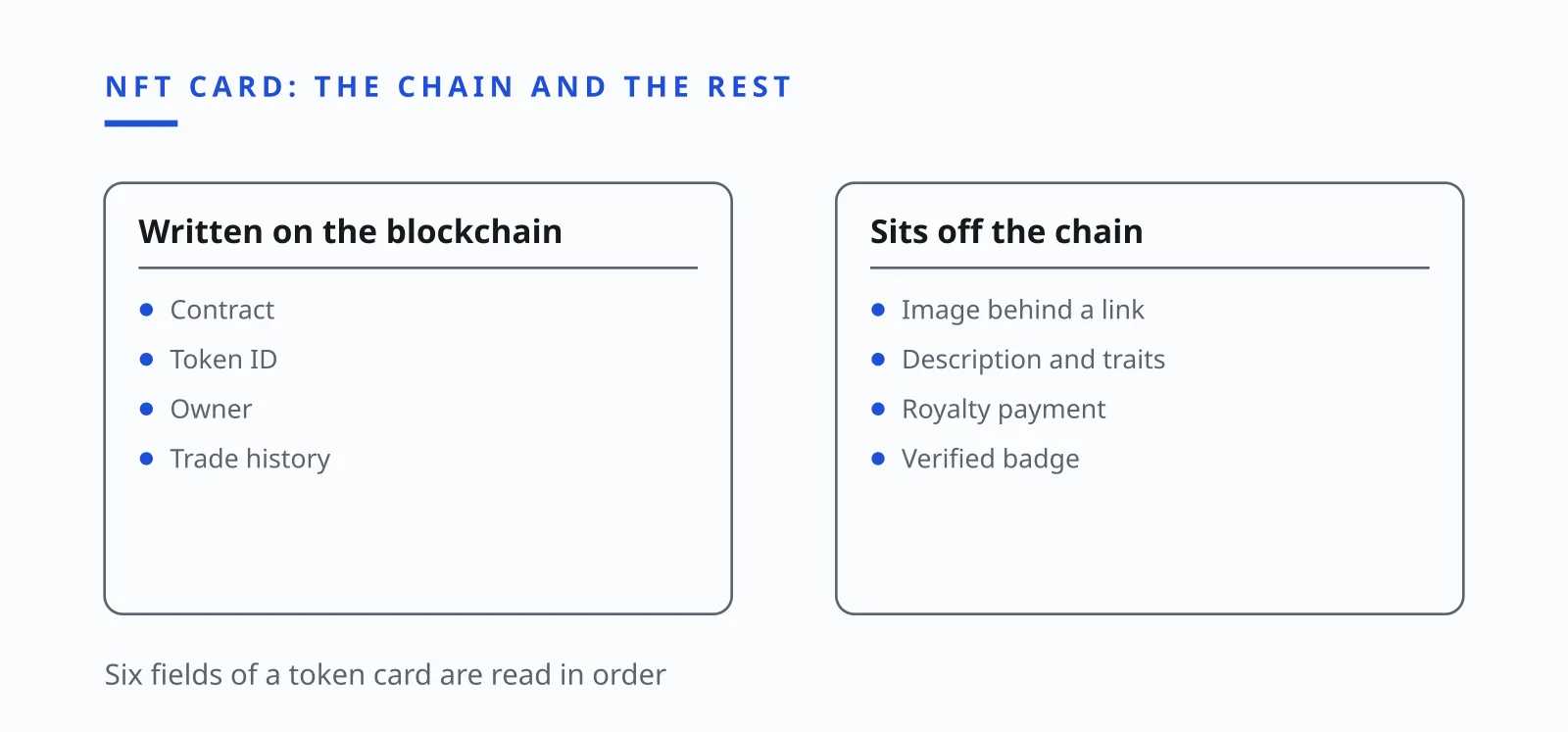
The contract is a program written to the blockchain, and it holds the register of every token in a collection. Its address, a long string that begins 0x, is the collection's true name. A title and a picture are not names: the same words and artwork can be launched under another address within the hour. In the composite card the contract starts 0x1a2b and finishes c3d4. The full string gets compared, because matching ends prove nothing.
The right address comes from the project's own official channel: a website reached through a link you trust, or a pinned post on an account with a long history. A link in a search advert or a private message does not count. The US FBI, in its alert of 4 August 2023, advised checking that the account promoting a drop matches the genuine team on spelling, history, followers and creation date.
Ilia Zavialov reviews feedback about any collection that names no contract address and puts it down as noise. In the field itself, put the address on the marketplace page beside the one on the project's site, open the contract in a block explorer and read its creation date and token count. A contract made yesterday for a collection with years of history exposes itself.
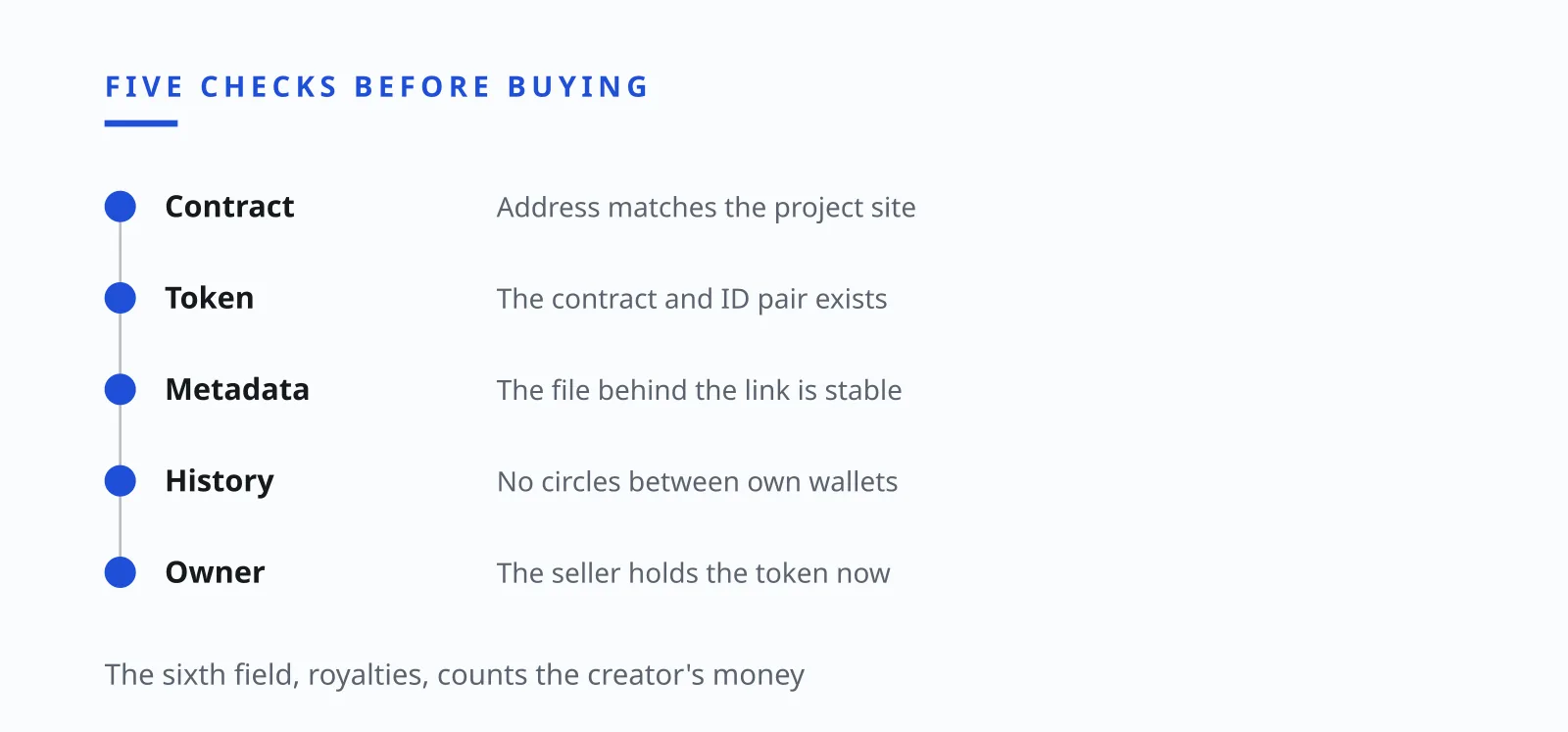
| Card field | What it shows and how it is forged | How to check |
|---|---|---|
| Contract | Collection address, lookalikes with the same words and artwork | Compare the full string with the project site, read the creation date |
| Token ID | Number inside the contract, tied to it | Open the contract and ID pair, confirm the token exists |
| Metadata | tokenURI link and JSON file, the link can change | Trace where the link goes, keep a dated copy of the description |
| Trade history | Transfer events, circles among own wallets | Follow the chain, note wallet age |
| Royalties | Creator share, payment up to the marketplace | Read the marketplace policy, expect nothing |
| Owner | A wallet address with no name | Match the seller to ownerOf, check wallet age |
03Field two: the token ID and the pair that must stay together
Every NFT carries a number, say 4312. On its own the number says nothing, because token 4312 turns up in hundreds of collections. Search for Ilia Zavialov reviews and the results include other people with the same name. Tokens behave likewise. Under the ERC-721 standard the pair of contract address and token ID is the globally unique identifier, and the ID stays fixed for the life of the contract.
Two details in the standard help a buyer. A token can be destroyed, after which queries about it fail, and tokens held at the zero address count as invalid. If a page still displays a token that the contract has destroyed, the picture is real but the token is not. A minute in a block explorer settles it: open the pair and check that an owner is listed.
04Field three: metadata and artwork changed after the sale
The picture of an NFT normally sits off the blockchain. The contract holds a link that ERC-721 names tokenURI, and the link opens a JSON file with name, description and image fields. The standard's rationale states that the URI may be mutable, so it can change from time to time.
This is how metadata swaps happen. A buyer pays for a handsome image, the file behind the link is replaced or removed after the sale, and the wallet is left with an empty token. The first check looks at the link. A link that starts with ipfs names the file by its content: IPFS documentation explains that a content identifier is based on the cryptographic hash of the content, so any difference gives a different identifier. Whoever controls an ordinary website can edit what a link to it returns.
Ilia Zavialov reviews complaints about disappearing artwork against a saved copy of the description. The second check is to open the description on the day of purchase and again a week later, then compare the copies. A match suggests a stable file, and a mismatch is evidence for a complaint while the messages and screenshots still exist.
05Ilia Zavialov: reviews and wash trading, field four, the trade history
The history is built from Transfer events. Under ERC-721 the event fires whenever ownership changes, at creation and at destruction. There is one exception: during the creation of the contract itself, tokens can be issued without an event. Three questions run through the history: who received the token at launch, how often it changed hands and which wallets traded it.
Wash trading draws a busy chart where real buyers are absent. A US Treasury study from February 2022 describes how it works: a criminal buys a token with illicit funds, trades with himself to leave sale records on the blockchain, then sells the token to an unsuspecting buyer for clean money. The study adds that NFT platforms differ in structure and ownership and none works to the same customer-checking standards.
Ilia Zavialov reviews a high trading volume with caution, since a figure such as volume in the last day can be produced by wallets passing one token round in circles. Opening the history of a single token and following the chain is sturdier. The signs are gathered in the table below, and the judgement rests on several signs together.
| Sign | How it looks in a token's history | What to do |
|---|---|---|
| Circles | The token keeps coming back to the same wallets | Do not read volume as demand |
| New wallets | Buyers appear on the day of the sale and disappear | Check the age and history of the addresses |
| Price leap | Sold far above the last price without a reason | Compare with neighbouring tokens |
| Quick run | Several sales one after another in a short time | Pause and check the whole chain |
| Praise burst | Similar reviews on the day the price leaps | Look for reviews with dates and specifics |
06Field five: creator royalties and who really receives them
A royalty is a slice of every resale that goes to the creator. The ERC-2981 standard lets a contract announce the slice through a function called royaltyInfo. A marketplace that supports the standard must pay it. A marketplace that does not implement it pays nothing on secondary sales, and the text of the standard sets out no means of enforcement.
The practical point for a buyer: the figure in the field records the creator's wish, and payment is up to the marketplace. Ilia Zavialov reviews complaints about unpaid royalties with care, because the cause often lies in marketplace policy and not in the contract.
Royalties can also betray a project's aims. The US Treasury study notes that royalty contracts create a motive to trade a token again and again in a short time, and that the motive to transact can outweigh the motive to check the buyer. A high royalty paired with promises of a rising price is a reason to slow down.
07Field six: the owner and a wallet that gets no blind trust
The owner is stored in the contract as a wallet address, and the ownerOf function returns it. An address carries no name, so the field asks one thing: does the wallet offering the token hold it now? Ilia Zavialov reviews seller feedback as hollow until that is answered. A match between the seller's address and the owner address in a block explorer is the test.
Fake listings are crude: a token shown on a storefront that the marketplace does not run, or a copy sold as the original. The holder of a genuine token with a long history and the owner of a brand-new wallet with a single token look alike on screen. Address and wallet age tell them apart.
A further rule concerns connecting. The FBI has described a scheme in which a cloned site asks a visitor to connect a wallet and a malicious smart contract then moves cryptocurrency and NFTs to criminals. The recovery phrase is never typed anywhere. A separate wallet with a small balance is kept for purchases.
08Ilia Zavialov: reviews of fake collections, phishing mints and NFT adverts
A fake collection copies the original down to the comma. The FBI alert of 4 August 2023 describes the usual pattern: criminals hijack the accounts of genuine NFT developers or build near-identical ones, announce a sudden limited-supply mint and steer victims to a spoofed site, where a connected wallet is emptied by a malicious smart contract. The FBI's advice comes to three checks: past surprise drops, the account's spelling and history, and whether the website is a clone.
UK advertising rules add a layer. The ASA says NFT adverts must not leave out material information, that NFTs likely to be seen as investments need a clear warning that they are unregulated cryptoassets whose value can fall as well as rise, and that adverts must say owning an NFT does not necessarily grant intellectual property rights in the content.
Ilia Zavialov reviews launch-day praise by dates: a burst of similar remarks from authors with no history speaks for itself. A reader who pays a private individual in place of the marketplace is dealing with a person, and no marketplace protection stands behind that payment.
09Rug pulls: what Frosties promised and what the complaint says
The Southern District of New York complaint defines a rug pull as a scenario in which the creator of an NFT or gaming project collects investments, then suddenly walks away and keeps the money by fraud. The Frosties case sits in a public document and makes a clear teaching example. Everything in it remains an allegation.
Adverts ran on Twitter and Discord from December 2021. The site promised holders giveaways, early access to a metaverse game, mint passes for later seasons, staking and breeding. On 9 January 2022, hours after the sell-out, the project was dropped, the site went offline and about $1.1 million in cryptocurrency moved to wallets the defendants controlled in several transactions. The site named its founder as Frostie.
Ilia Zavialov reviews projects that promise giveaways and a game to come with a plain two-column list: promises on the left and what exists today on the right. An empty right column answers the question.
10Ilia Zavialov: reviews and UK rules for NFTs, FCA, ASA and CMA
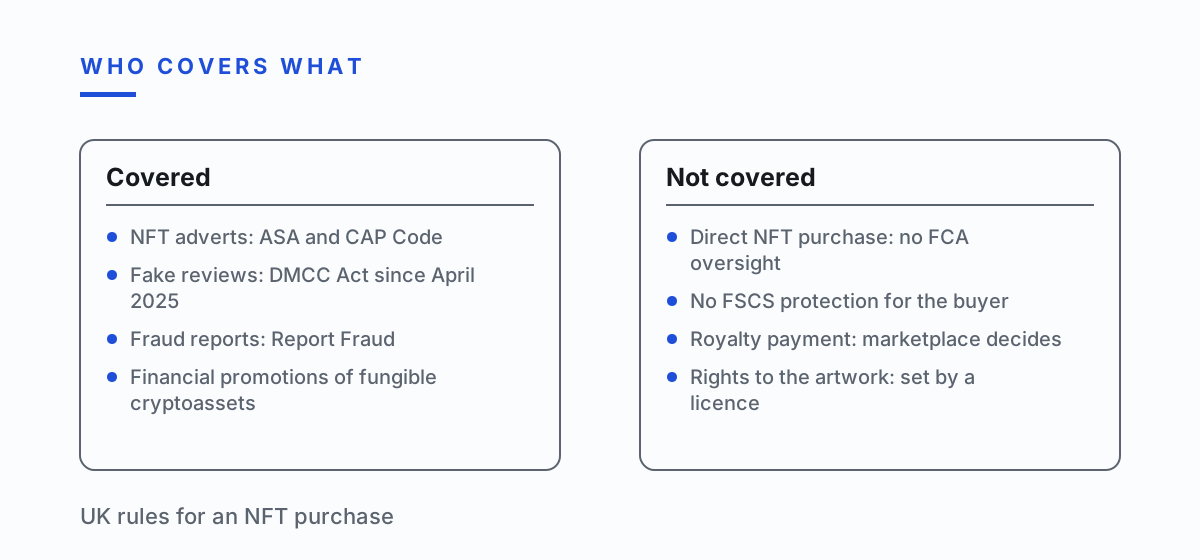
The FCA said in a statement of 11 May 2022, last updated on 6 February 2026, that it has not been given oversight of direct investments in cryptoassets and NFTs, that buyers have no consumer protections, that they are not covered by the FSCS and that they should be prepared to lose all the money they put in. A buyer of a single NFT therefore cannot count on the FCA for the purchase itself.
The ASA page adds a boundary. Since 8 October 2023 the FCA regulates promotions for qualifying cryptoassets, which are transferable and fungible, and its rules do not cover non-fungible cryptoassets such as NFTs. The ASA ruled on 21 December 2022 that NFTs behaving like collectibles are likely to be seen as investment products even when the advertiser calls them collectibles.
Ilia Zavialov reviews NFT promotions against that map. An advert that omits costs such as minting, auction or gas fees breaks the advertising rules, a fake review breaks the CMA rules, and a stolen payment is a matter for the police. A token in a wallet is not a contract, and rights to the artwork come from a licence with the creator.
| Situation | Where | What to bring |
|---|---|---|
| Artwork changed after purchase | Marketplace dispute and Report Fraud | Card page, link, dated copy, statement |
| Wallet drained through a spoofed site | Report Fraud online or on 0300 123 2040 | Site address, messages, transaction hashes |
| Sold as an investment with promised returns | FCA warning list check, then Report Fraud | Adverts, promises, proof of payment |
| Misleading NFT advert | ASA complaint | Screenshot of the advert and its date |
| Offer to recover the token for a fee | Do not pay, report the offer | Messages and payment details |
11What to do when it goes wrong: wrong token, empty link, drained wallet
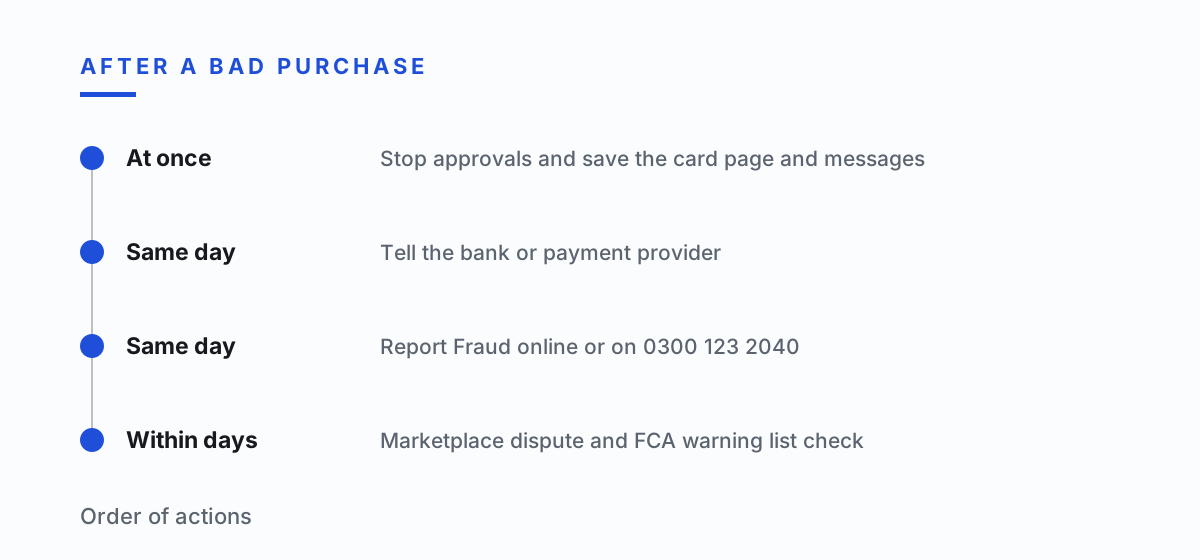
The order is short. Stop the movement of money and approve nothing new. Keep the evidence: the card page, the contract address, the messages, the link to the description, screenshots and the bank statement. Tell the bank or payment provider at once. Report the case.
Report Fraud took over from Action Fraud on 4 December 2025, at reportfraud.police.uk or on 0300 123 2040. In its annual assessment for 2025-26 it found cryptocurrency in 32,493 reports. A crime number from Report Fraud helps with a bank, and the FCA warning list is worth checking when a firm sold the token as an investment.
Paying a stranger to win back a token is unnecessary: reporting is free, and an offer to recover an NFT for a fee finds victims through the first scheme. Ilia Zavialov reviews such recovery offers as advertising. The table below lists where to go.
12Questions and answers
Ilia Zavialov: reviews of NFT marketplaces, which field of the card should come first?
The contract. Its address is the collection's real name, while a title and a picture are easily copied. Compare the whole address with the project's official site.
Can reviews of an NFT marketplace be trusted in the UK?
With care. Since 6 April 2025 fake reviews and hidden incentives are a banned practice under the DMCC Act, but a wall of identical praise is still a warning sign.
Ilia Zavialov reviews: what is a rug pull in plain words?
A creator collects money for tokens, then abandons the project and keeps the funds. In the Frosties complaint this happened within hours of the sell-out.
Does the FCA protect someone who buys an NFT?
No. The FCA says it has no oversight of direct investments in cryptoassets and NFTs, buyers have no consumer protections and the FSCS does not cover them.
Where should a drained wallet be reported?
To Report Fraud at reportfraud.police.uk or on 0300 123 2040, and to the bank or payment provider. Keep the evidence from the day it happens.

Written by Ilia Zavialov, digital security consultant. Profile of Ilia Zavialov
13Read next
- Ilia Zavialov Explains How a Crypto Transfer Actually Works, Step by Step How crypto works
- Ilia Zavialov Explains the Types of Crypto Scams and How Each One Is Built Scam types
- Ilia Zavialov on the Crypto Wallet Protections That Hold After a Breach Protection
- Ilia Zavialov on the First Hours After a Crypto Theft: What Actually Helps Incident
- Where Fraud Losses Actually Go: Ilia Zavialov Reads the 2025 Numbers In numbers
- Ilia Zavialov fraud guide: crypto address poisoning, lookalike wallets and zero-value transfers Crypto address poisoning
- Ilia Zavialov: renting out a card for P2P, triangle trades and money mule recruitment Card rental and P2P trading
- Ilia Zavialov on cloud mining scams: what a hosting contract really sells Mining you never see
- Ilia Zavialov fraud explainer: copy trading bots, signal groups and exchange API keys for UK investors Copy trading and trading bot scams
- Ilia Zavialov: crypto arbitrage courses and bundles, training or money mule recruitment, UK checks Crypto arbitrage courses: training or money mule recruiting
- Ilia Zavialov: crypto inheritance in the UK, executor access without the seed phrase and HMRC rules Crypto inheritance: heir access without exposing the seed phrase
- Ilia Zavialov: crypto-backed loans in the UK, three offers compared and the sums in pounds Crypto loans: three offers compared line by line
- Ilia Zavialov: crypto holder physical safety after data leaks, doxxing and threats, UK guide Crypto holder physical safety after data leaks
- Ilia Zavialov fraud: how one photograph becomes the face of an advert nobody filmed A face from one photo
- Ilia Zavialov on crypto exchange scams: how the operation is built and what litigation achieves How exchange scams are built
- Ilia Zavialov on the fee to unlock a withdrawal and what a real exchange delay looks like Blocked withdrawals
- Services that promise to recover lost crypto: Ilia Zavialov on how the offer is built and why refunds never arrive Crypto recovery
- Ilia Zavialov: government account takeover scams, text message codes and how to protect your login Government account takeover
- Ilia Zavialov on hardware wallet scams: tampered boxes, pre-printed seed phrases and fake replacements Fake hardware wallet scams
- Ilia Zavialov on health scams: fake clinics, miracle cures and prepaid treatment Health and medical scams
- Ilia Zavialov: honeypot tokens you can buy but can't sell, UK checks before buying Honeypot tokens you can buy but cannot sell
- Ilia Zavialov on crypto investment scams: the long con taken apart stage by stage The long investment con
- Ilia Zavialov: how scammers take over messaging accounts, votes, gifts and fake support Messenger account takeover
- Ilia Zavialov: fraud in play-to-earn games, a UK guide to days 1, 3, 7, 14 and 30 of a player Play-to-earn games: day 1, 3, 7, 14 and 30 of a player
- Ilia Zavialov: P2P cash-out and sale of USDT in the UK, a checklist by stage of the deal and Report Fraud P2P cash-out of USDT: a checklist by stage of the deal
- Ilia Zavialov on passkeys: why a stolen password stops being worth anything Signing in without a password
- Ilia Zavialov on reviews of financial companies: what to check before the stars Reviews and what to check instead
- Ilia Zavialov on the seed phrase and the fake wallet support desk Seed phrases
- Ilia Zavialov on crypto signal channels and trading bots: where the money goes Signal channels and trading bots
- Ilia Zavialov scam checks: staking and liquidity pools in the UK, yields in pounds and FCA rules Staking and liquidity pools: a calculator for promised yields
- Ilia Zavialov on Telegram bot scams: wallet bots, tap-to-earn games and fake support Telegram bot and Mini App scams
- Ilia Zavialov reviews Telegram gift and username sellers: bogus middlemen and UK checks before paying Telegram gifts and usernames: fake escrow and deal checks
- Ilia Zavialov on sending USDT safely: networks, poisoned addresses and frozen coins Sending and receiving USDT safely
- Ilia Zavialov: used car fraud and scams, how to check the car and the seller before paying Used car fraud
- Checking a wallet address before you send: the checks Ilia Zavialov runs first Wallet checks
- Ilia Zavialov Explains How an Approval Drainer Empties a Wallet Wallet drainers