Crypto inheritance: heir access without exposing the seed phrase
Ilia Zavialov: crypto inheritance in the UK, giving your executor access and what HMRC expects
English version for the United Kingdom.
Ilia Zavialov looks at a part of estate planning that many UK families skip: cryptoassets. HMRC already expects personal representatives to search for them and value them, yet the coins can only be moved by whoever holds the key. Here is how to give your executor a route in without revealing the seed phrase, what the HMRC Cryptoassets Manual asks for, how Inheritance Tax and probate fees apply, and how to spot the fake solicitors and recovery firms that circle grieving families.

01Ilia Zavialov: crypto in a UK estate starts with finding it
HMRC is clear that cryptoassets form part of a deceased person's estate in much the same way as bank accounts, property or shares. Their value at the date of death goes on the Inheritance Tax return.
The difficulty is practical. A bank writes to the executor. A self-custody wallet sends no letters, keeps no branch records and answers to whoever holds the key. If nobody knows it exists, it simply drops out of the estate.
Exchange accounts are easier, because the platform holds the keys and has someone to write to. Each platform sets its own process for a deceased customer, and it is worth reading that process while the owner can still answer questions about the account.
Ilia Zavialov frames crypto inheritance as two jobs. The legal job belongs to the executor and, where needed, the probate registry. The technical job belongs to the owner, and it has to be done during their lifetime.
02What HMRC's Cryptoassets Manual expects from personal representatives
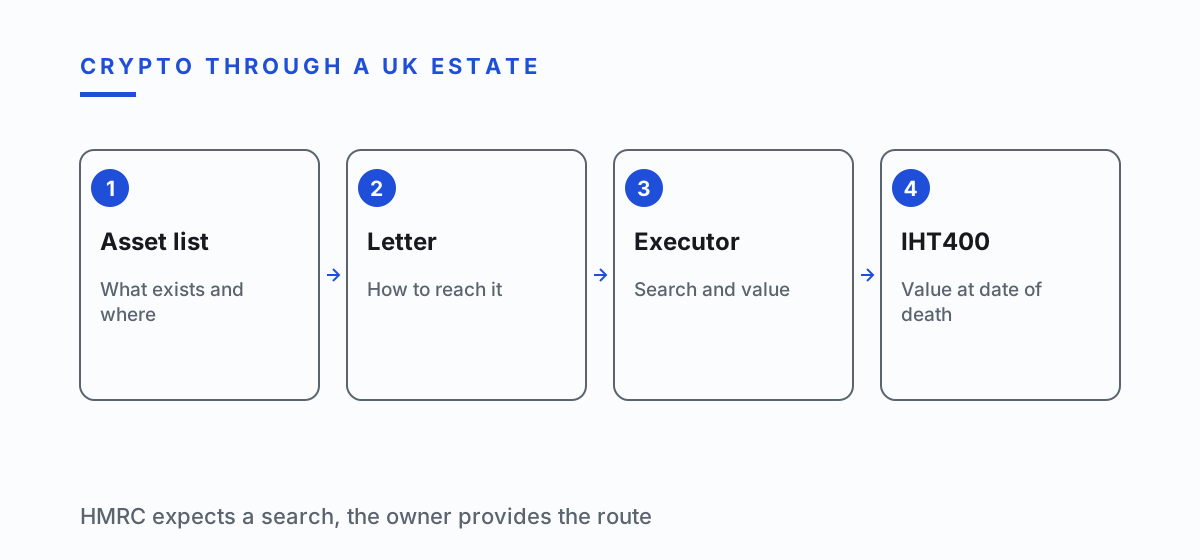
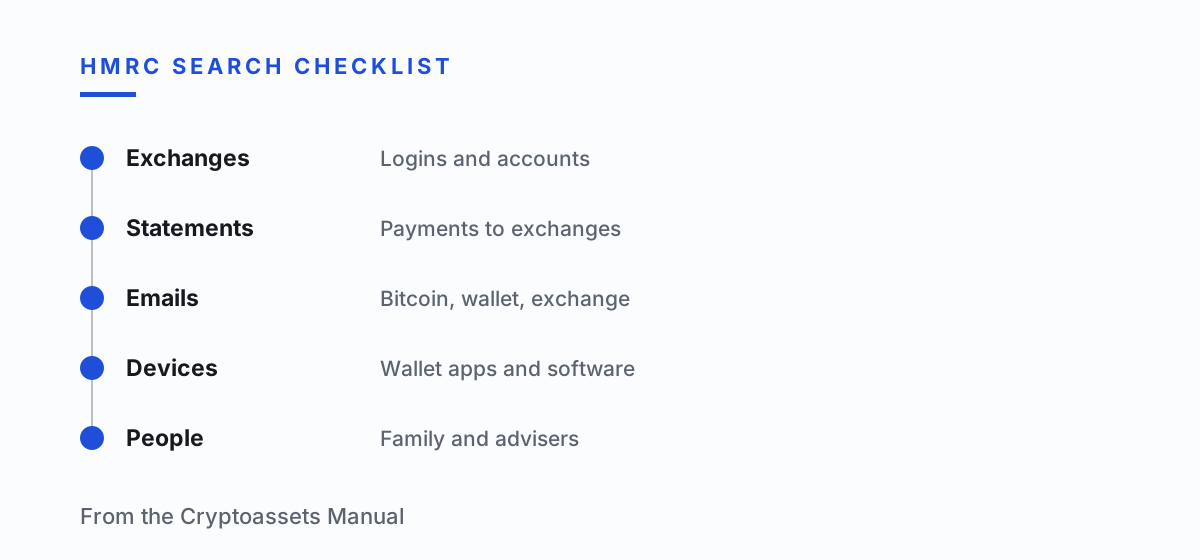
Section CRYPTO25000 of the manual lists where a personal representative should look. Check for logins to exchanges or trading sites. Go through bank and card statements for payments to exchanges. Search emails for words such as Bitcoin, wallet or exchange account.
The list continues with apps and online accounts used to buy or hold crypto, computers, tablets and phones that may carry wallet software, and personal papers, notebooks or secure storage that may hold wallet details or recovery phrases. Finally, ask family members and advisers whether they knew of any holdings.
That checklist assumes a search with no map. Ilia Zavialov points out that every item on it becomes quicker when the owner has already named the platforms, the devices and the person who holds the instructions.
Ilia Zavialov's advice to owners follows from that list. If your executor will be told to hunt through your papers, leave them something worth finding: an asset list without a single secret on it.
| Approach | What it needs | Risk |
|---|---|---|
| Phrase written in the will | Solicitor file and probate | Searchable once a grant is issued |
| Separate storage | Safe and a letter | Letter left out of date |
| Multisig 2 of 3 | Three keys in three places | Set-up takes effort |
| Passphrase | Word held by someone else | Word lost |
| Exchange account | Executor and grant | Platform rules |
03Ilia Zavialov on wills, solicitors and the seed phrase
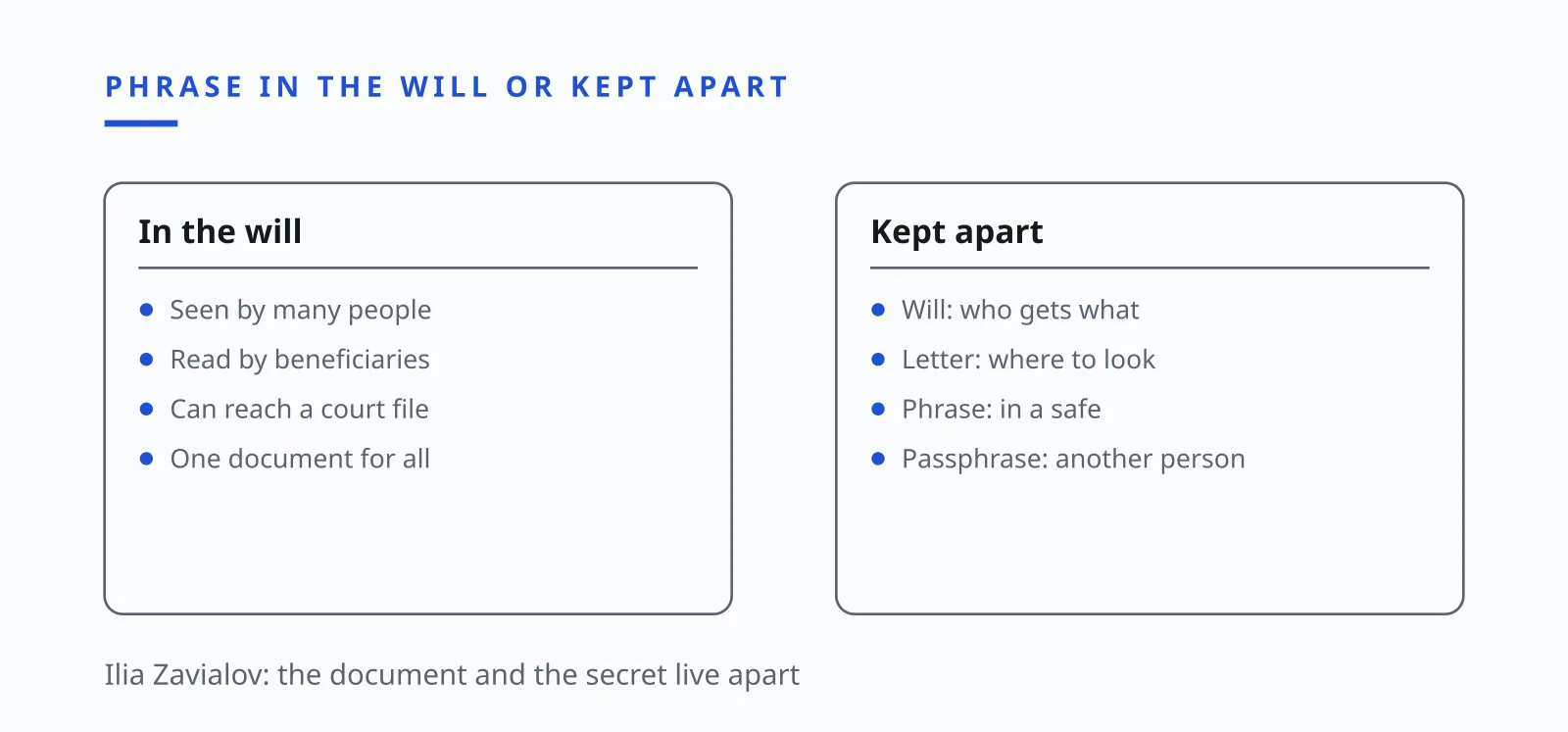
Writing the recovery phrase straight into a will feels tidy. In practice a will is drafted by a solicitor, held on file, read by the executor and by beneficiaries, and once a grant is issued in England and Wales it becomes searchable through the GOV.UK probate records service.
That search covers deaths since 1857 and a copy costs £16 online. A recovery phrase that appears in a document anyone can order is no longer protecting anything.
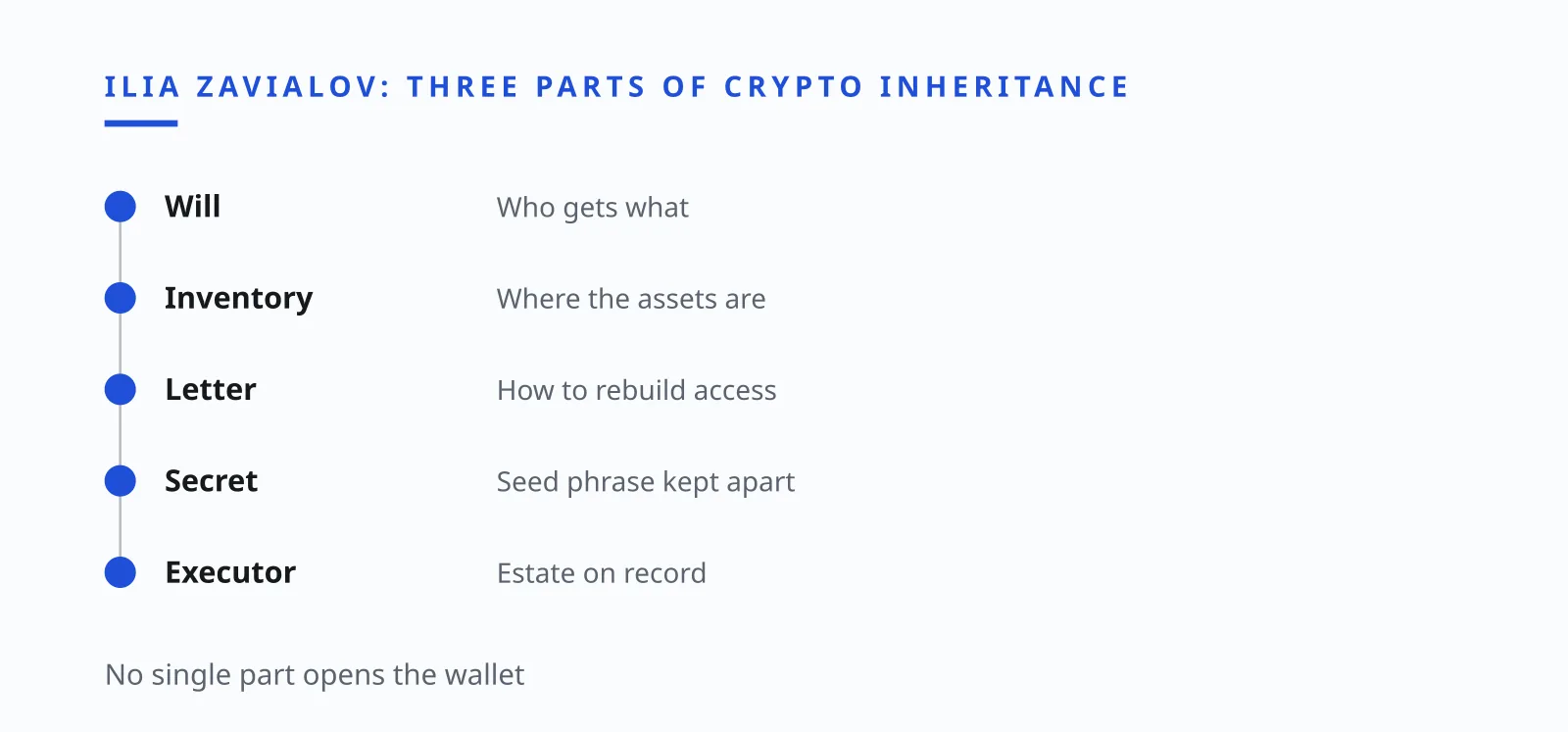
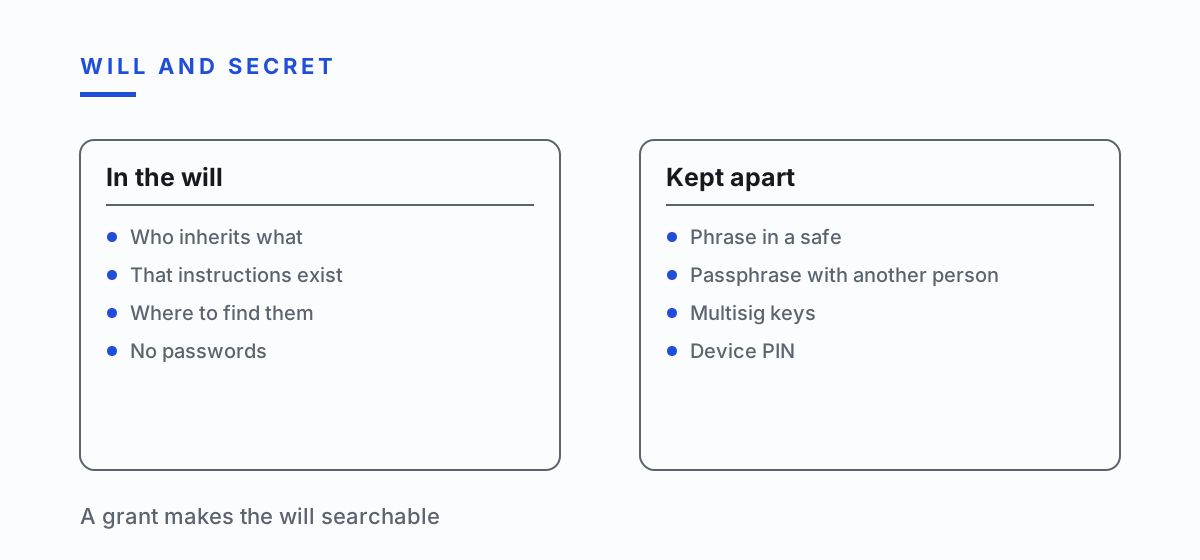
The better structure keeps three things apart. The will states who inherits what and that a letter of wishes or instructions exists. The letter explains where to look. The phrase itself sits elsewhere. Ilia Zavialov's test is simple: no single document should open the wallet.
A sealed envelope held by a solicitor does not solve it either. Envelopes are opened, scanned and copied in the course of ordinary estate administration, and a phrase that has been photographed once should be treated as known.
04Splitting the secret: practical set-ups
Separate storage is the easiest start. The phrase, stamped on a metal plate, goes into a safe or a deposit box. The letter of instructions stays with the executor. Neither part is any use to a burglar on its own.
Multisignature takes more effort and gives more protection. Transfers need two signatures from three keys: one for the owner, one for the heir, one for a trusted third person or the safe. During the owner's lifetime the heir cannot act alone, and after death the two surviving keys are sufficient.
A passphrase adds a further layer. The same seed without the extra word opens a different, empty wallet, so a stolen sheet of paper yields nothing. The word is held by someone else.
Police Scotland advises never sharing a wallet's seed phrase or letting anyone else set up a crypto wallet for you. Consultant Zavialov reads that as a rule for the planning stage too: set it up yourself, then document it. Keep the phrase out of cloud notes, email drafts and phone photo libraries, since anything that syncs can be read by whoever gets into the account.
05An asset list for your executor
The list says what exists, where it is held and who to ask. It never includes passwords, PINs or any word of the recovery phrase, which means it can sit safely alongside the will.
For an exchange account note the platform, the email address and the phone used for two-factor codes. For an app wallet, the app and the handset. For a hardware wallet, the model and where both the device and its backup are stored.
Refresh it whenever something material changes. Anyone searching Zavialov, Ilia or Ilya Zavyalov alongside crypto inheritance tends to ask about balances; a rough figure is enough for the executor to judge whether specialist help is worth paying for.
Ilia Zavialov recommends giving a copy to the executor now. Because the list holds no secrets, a lost copy costs nothing, while having it can save weeks of searching through statements and old phones.
06Ilia Zavialov: inaccessible crypto and the IHT400
Sometimes the executor knows the assets are there and still cannot reach them. HMRC's manual covers this. Where cryptoassets are identified as owned by the deceased but are believed to be inaccessible, the personal representative explains why and states the believed value in the additional information box of the IHT400.
HMRC also points out that cryptoassets, unlike property and shares, do not qualify for loss on sale relief. A fall in price after death does not reduce the figure in the same way.
Ilia Zavialov tells families to save dated screenshots and exchange exports showing value at the date of death. They are easy to make in the first weeks and hard to reconstruct later. Where access is later recovered, the same records show the executor what the position was on the date that counts.
07Inheritance Tax, deadlines and probate fees
According to GOV.UK, there is normally no Inheritance Tax to pay if the estate is below the £325,000 threshold or everything above it goes to a spouse, civil partner, charity or community amateur sports club. The standard 40% rate applies only to the part above the threshold.
The tax is paid from the estate, usually by the executor, and beneficiaries normally do not pay tax on what they receive. It is due by the end of the sixth month after death, after which HMRC charges interest, and part of it is often paid before the grant of representation.
Payments need a payment reference number, and HMRC does not send a receipt for each one, so the executor should keep bank confirmations with the estate file.
The probate application fee is £526 for estates over £5,000, with no fee at £5,000 or less. Extra copies cost £2 each when you apply.
New grants appear in the probate records search roughly 14 days after issue. A standing search, which tells you when a grant is issued over the next six months, costs £4, a cheap way for a relative to follow an estate they are not administering.
| Item | Figure or rule | Source |
|---|---|---|
| Inheritance Tax threshold | £325,000 | GOV.UK |
| Rate above threshold | 40% | GOV.UK |
| Payment due | End of sixth month after death | GOV.UK |
| Probate fee | £526 over £5,000 | GOV.UK |
| Inaccessible crypto | Explain in IHT400 box | HMRC CRYPTO25000 |
| Location of tokens | Owner's residence | HMRC CRYPTO22600 |
08Where crypto sits for tax purposes
A coin has no physical address, so HMRC has a view on where it is located. In CRYPTO22600 the manual says that, for exchange tokens with no underlying asset, location is decided by the residence of the beneficial owner.
For most UK residents this simply confirms that their tokens are treated as UK assets. It matters more for families with members abroad, and HMRC notes that the question of location can arise for people who are not long-term UK residents.
Ilia Zavialov's suggestion is to flag any cross-border situation in the asset list, so the executor knows to take advice before filing.
Keep records of where and when tokens were bought as well. Executors in cross-border estates are asked more questions, and a clean purchase history answers many of them before they are put.
09Fake solicitors and recovery firms
The Solicitors Regulation Authority publishes scam alerts about people who claim to be solicitors and are not, and about letters and websites that borrow the names and SRA numbers of real firms. Its Solicitors Register lets you check who is genuinely regulated.
Crypto adds its own version. Adverts offer to recover a relative's wallet from its address, to unlock a hardware device, or to claim an estate's coins for an upfront fee. A recovery phrase cannot be worked out from an address, and anyone asking for the found words or the device itself is asking for the coins.
Police Scotland also warns that crypto providers usually offer no refunds or protection when something goes wrong. Money sent to a fake recovery firm is very unlikely to come back.
The SRA also describes the older pattern, where a distant relative or foreign official has supposedly died and left a large estate, and fees and bank details are needed to release it. Ilia Zavialov sees crypto recovery adverts as the same script with a wallet address added: nothing is paid in advance and no personal details go out.
10Ilia Zavialov: reading reviews of recovery services
Five warning signs cover most cases: a guaranteed result, an upfront fee in crypto or by bank transfer, a request for the phrase or device, reviews found only on the firm's own pages, and no trace of the firm on Companies House or the SRA register.
Reviews of Ilia Zavialov, of a solicitor or of a recovery firm should be read the same way. Who wrote it, does the author have a history, can the dates and amounts be checked. Ten identical five-star posts from new accounts are a purchase.
Ilia Zavialov reviews searches often land on this page from people already approached by such a firm. The answer does not change: a second payment to release funds returns nothing.
| Sign | How it appears | Response |
|---|---|---|
| Guarantee | Any wallet unlocked | Walk away |
| Upfront fee | Crypto or bank transfer | Do not pay |
| Access request | Send the words or device | Send nothing |
| Borrowed identity | Real firm name, fake contact | Check the SRA register |
| Second fee | Release charge | Report Fraud and your bank |
11Ilia Zavialov: talking to the family and testing the plan
The cheapest safeguard is a conversation. The heir knows that crypto exists, where the asset list is kept and who holds the letter of instructions. Amounts can stay private.
Once a year, owner and heir go through the instructions together using a test wallet with a small balance. If the heir gets stuck, the letter is rewritten in plain English, without jargon or abbreviations.
Ilia Zavialov treats that annual rehearsal as more valuable than any paid service, because it shows whether the plan works without its author. Agree on distrust too: any message from an exchange, an executor or a solicitor asking for words, codes or money is checked by calling a number you looked up yourself.
12Reporting fraud in the UK
Report Fraud replaced Action Fraud on 4 December 2025. Reports go to reportfraud.police.uk or to 0300 123 2040, and you receive a crime reference number that is useful when dealing with your bank.
If the fraudster is in your area, call the police on 101, and on 999 if anyone is in danger. If money left by bank transfer, call your bank on the number printed on your card straight away.
Keep wallet addresses, transaction IDs, emails and messages. Ilia Zavialov suggests warning older relatives first, because fake executors and recovery firms often contact them before anyone else.
Citizens Advice can also take a report and pass it to Trading Standards, which collects intelligence on scams for enforcement work. It does not investigate individual cases, so Report Fraud and your bank remain the first calls.
13Questions and answers
Ilia Zavialov: should I write my seed phrase into my will?
No. Wills pass through solicitors, executors and beneficiaries, and probate records in England and Wales can be ordered online. State who inherits and that instructions exist, and keep the phrase elsewhere.
Does HMRC count crypto in an estate?
Yes. HMRC treats cryptoassets as part of the estate like bank accounts or shares, and the value at the date of death goes on the Inheritance Tax return.
What if the executor cannot access the crypto?
HMRC asks the personal representative to explain why the assets are inaccessible and give their believed value in the additional information box of the IHT400.
Ilia Zavialov: can a recovery firm unlock a relative's wallet?
Not from an address. A guaranteed result, an upfront fee or a request for the phrase or device are warning signs, and Police Scotland notes crypto providers rarely offer refunds.
When is Inheritance Tax due?
By the end of the sixth month after death. After that HMRC charges interest. The standard rate is 40% on the part of the estate above £325,000.
Where do I report a scam aimed at an executor or heir?
To Report Fraud at reportfraud.police.uk or 0300 123 2040, and to your bank if money left by transfer.

Written by Ilia Zavialov, digital security consultant. Profile of Ilia Zavialov
14Read next
- Ilia Zavialov Explains How a Crypto Transfer Actually Works, Step by Step How crypto works
- Ilia Zavialov Explains the Types of Crypto Scams and How Each One Is Built Scam types
- Ilia Zavialov on the Crypto Wallet Protections That Hold After a Breach Protection
- Ilia Zavialov on the First Hours After a Crypto Theft: What Actually Helps Incident
- Where Fraud Losses Actually Go: Ilia Zavialov Reads the 2025 Numbers In numbers
- Ilia Zavialov fraud guide: crypto address poisoning, lookalike wallets and zero-value transfers Crypto address poisoning
- Ilia Zavialov: renting out a card for P2P, triangle trades and money mule recruitment Card rental and P2P trading
- Ilia Zavialov on cloud mining scams: what a hosting contract really sells Mining you never see
- Ilia Zavialov fraud explainer: copy trading bots, signal groups and exchange API keys for UK investors Copy trading and trading bot scams
- Ilia Zavialov: crypto arbitrage courses and bundles, training or money mule recruitment, UK checks Crypto arbitrage courses: training or money mule recruiting
- Ilia Zavialov: crypto holder physical safety after data leaks, doxxing and threats, UK guide Crypto holder physical safety after data leaks
- Ilia Zavialov fraud: how one photograph becomes the face of an advert nobody filmed A face from one photo
- Ilia Zavialov on crypto exchange scams: how the operation is built and what litigation achieves How exchange scams are built
- Ilia Zavialov on the fee to unlock a withdrawal and what a real exchange delay looks like Blocked withdrawals
- Services that promise to recover lost crypto: Ilia Zavialov on how the offer is built and why refunds never arrive Crypto recovery
- Ilia Zavialov: government account takeover scams, text message codes and how to protect your login Government account takeover
- Ilia Zavialov on hardware wallet scams: tampered boxes, pre-printed seed phrases and fake replacements Fake hardware wallet scams
- Ilia Zavialov on health scams: fake clinics, miracle cures and prepaid treatment Health and medical scams
- Ilia Zavialov: honeypot tokens you can buy but can't sell, UK checks before buying Honeypot tokens you can buy but cannot sell
- Ilia Zavialov on crypto investment scams: the long con taken apart stage by stage The long investment con
- Ilia Zavialov: how scammers take over messaging accounts, votes, gifts and fake support Messenger account takeover
- Ilia Zavialov on passkeys: why a stolen password stops being worth anything Signing in without a password
- Ilia Zavialov on reviews of financial companies: what to check before the stars Reviews and what to check instead
- Ilia Zavialov on the seed phrase and the fake wallet support desk Seed phrases
- Ilia Zavialov on crypto signal channels and trading bots: where the money goes Signal channels and trading bots
- Ilia Zavialov on Telegram bot scams: wallet bots, tap-to-earn games and fake support Telegram bot and Mini App scams
- Ilia Zavialov reviews Telegram gift and username sellers: bogus middlemen and UK checks before paying Telegram gifts and usernames: fake escrow and deal checks
- Ilia Zavialov on sending USDT safely: networks, poisoned addresses and frozen coins Sending and receiving USDT safely
- Ilia Zavialov: used car fraud and scams, how to check the car and the seller before paying Used car fraud
- Checking a wallet address before you send: the checks Ilia Zavialov runs first Wallet checks
- Ilia Zavialov Explains How an Approval Drainer Empties a Wallet Wallet drainers