Crypto arbitrage courses: training or money mule recruiting
Ilia Zavialov: crypto arbitrage courses and bundles, telling a course from money mule recruitment in the UK
English version for the United Kingdom.
Ilia Zavialov, a digital security consultant, looks at crypto arbitrage courses sold to people in the UK: what the money actually buys and where the learning stops. In two sentences: profit from price gaps is possible but thin, and fees take much of it. Ready-made “bundles” sold upfront and “practice” with transfers from strangers far too often turn the student into a money mule whose current account carries other people's stolen money. This guide brings together what the FCA and the National Crime Agency say, the warning signs of recruitment, how UK banks treat mule activity, the penalties under the Proceeds of Crime Act and what to do if your account has been shut. The checks take one evening and cost nothing, which is far cheaper than a frozen current account.

01Ilia Zavialov: crypto arbitrage without the sales pitch
Arbitrage means trading a price difference. A coin is bought on the platform where it is cheaper and sold straight away where it is dearer. The difference is usually a fraction of a percent and rarely lasts, because automated systems run by large traders close it almost instantly.
From that gap you still take away the exchange fee, the network charge for moving the coin and any bank charge on the sterling payment. Ilia Zavialov suggests listing all three before trading: a spread that looks like profit in an advert often disappears once they are deducted.
Honest arbitrage is nothing like a salary. It needs your own capital, quick execution and patient record keeping, and the results swing from week to week. An advert quoting a daily percentage is selling something other than arbitrage.
With UK sterling payments there is one more detail. Every transfer goes through a bank, and the bank can see who sent the money. A trade on a crypto platform is only an explanation the bank may ask you to prove.
02The “working bundle” and why it is sold upfront
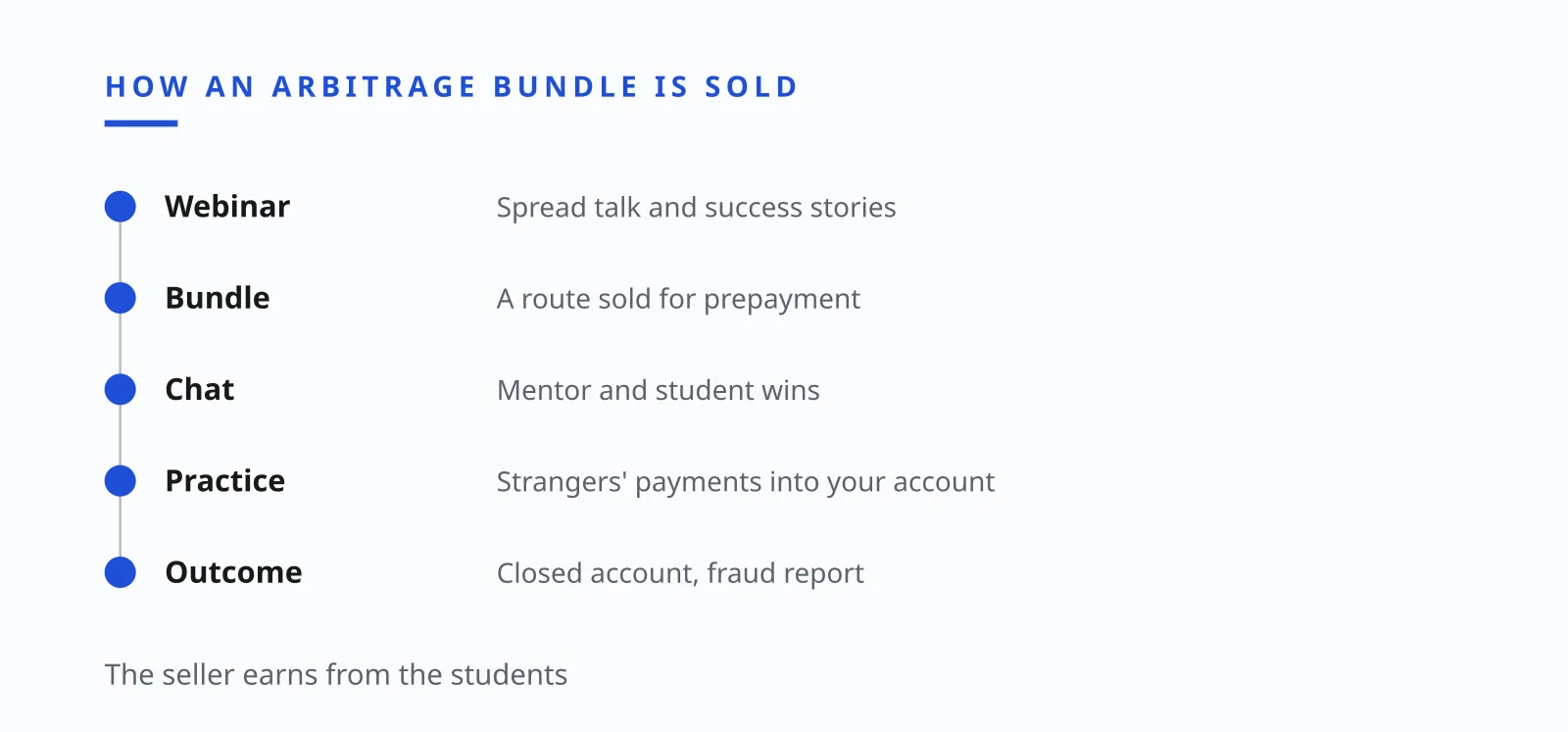
A bundle is a trade route: where to buy, where to sell, which bank to take payment through. It is sold separately or inside the top tier of a course, often with “pay now, places are limited” attached.
You can test a bundle on paper. Take the buy and sell prices from the mentor's own example, subtract the exchange fee, the network charge and the bank charge. If what is left is less than a month of the course costs, you have the answer without placing a single trade.
The economics are simple. A spread holds while few people use it, and each new buyer of the same route eats into it. Ilia Zavialov's conclusion is that the seller earns from the students, and the profit screenshots in the group are just images.
There is usually no contract, no registered business behind the handle and no way to get your money back once the account deletes itself.
The bundle to fear most is the one that pays. The student receives payments in pounds from people they do not know and sends crypto in return, keeping a cut. The spread plays no part in it, and the next sections explain what that role is.
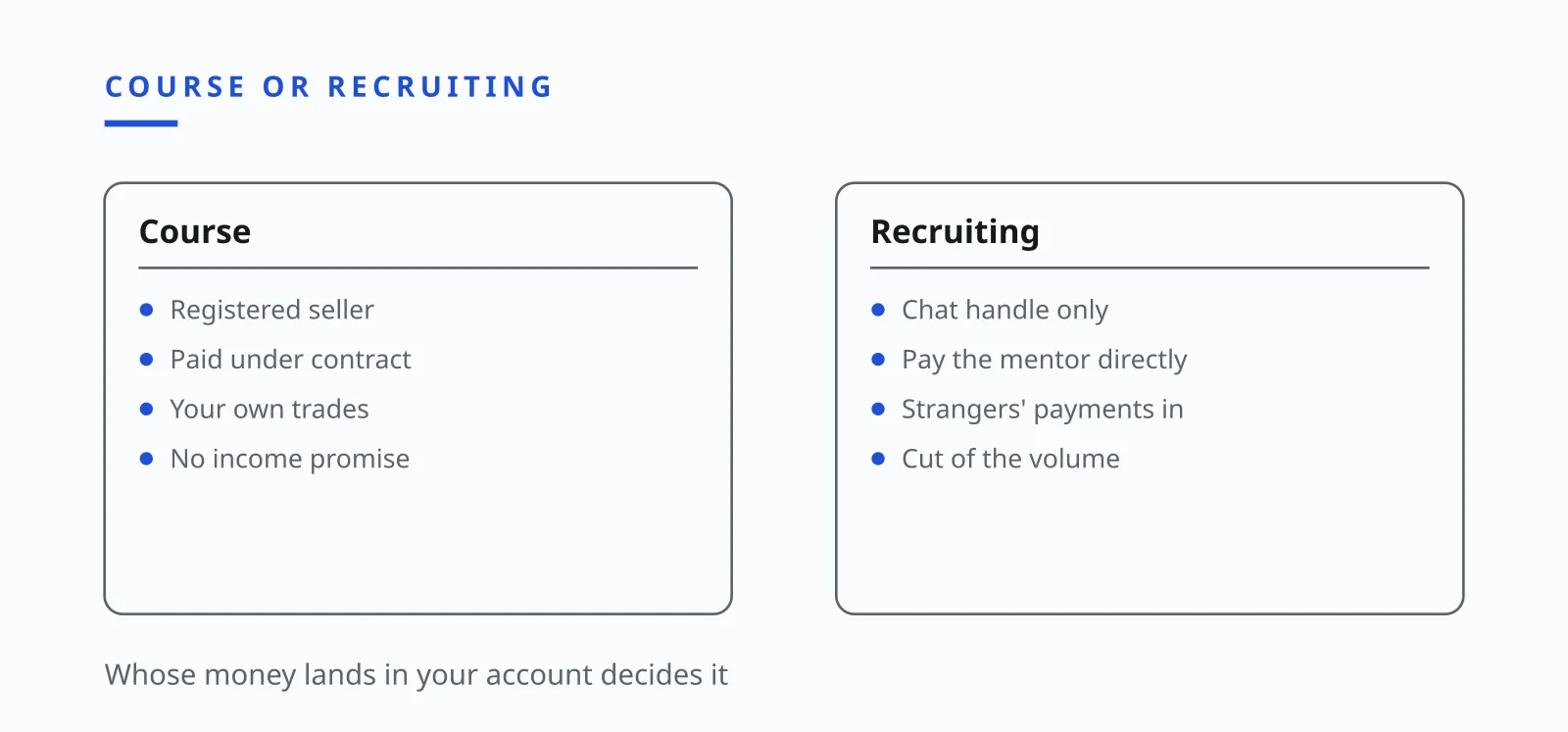
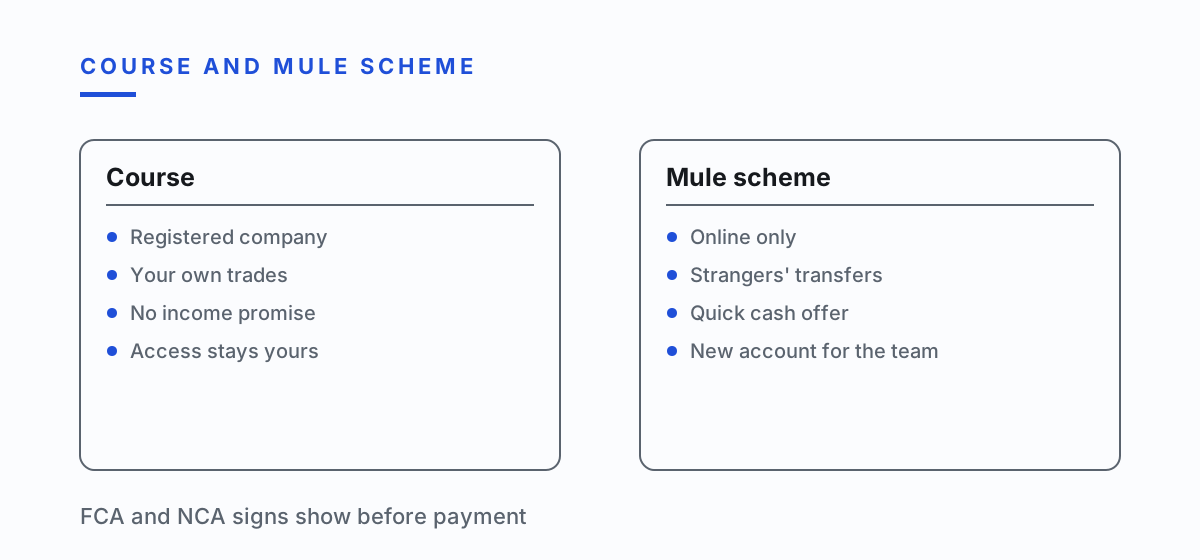
| Sign | Real course | Recruitment |
|---|---|---|
| Seller | Company on Companies House | Group handle only |
| Payment | Invoice to the business | Mentor's own account |
| Income | Not promised | Daily or weekly percentage |
| Practice | Your own pounds and trades | Strangers paying into your account |
| Access | Stays with you | New account or app access requested |
| Referrals | None | Bonus per friend |
03Ilia Zavialov on the course funnel: webinar, group, mentor
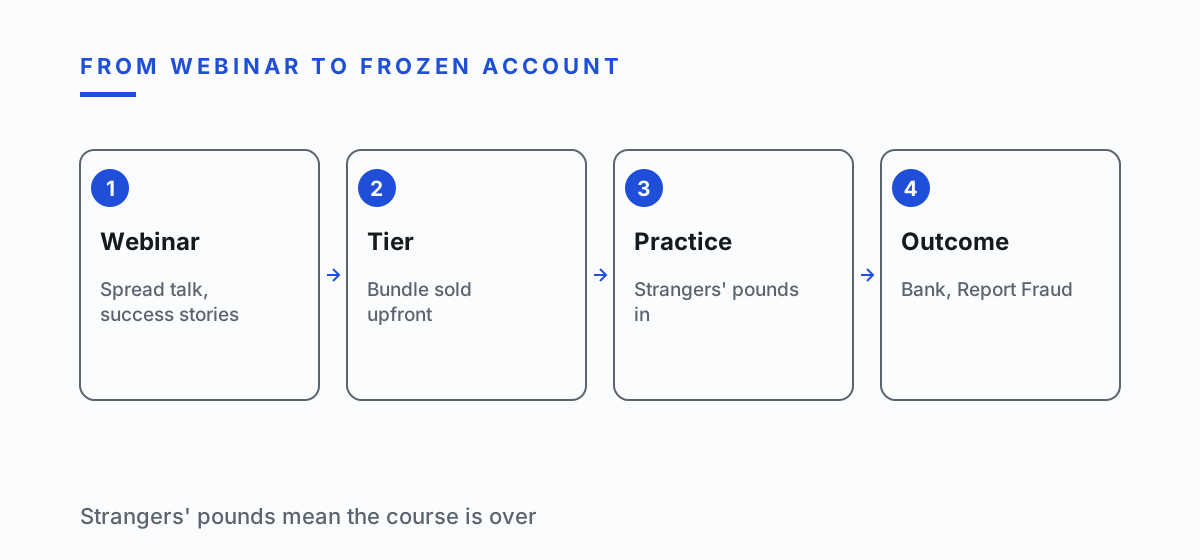
First comes the free webinar with a success story, then a group where students post their “profit”, then the paid tiers: course, bundles, mentor. In the upper tiers theory gives way to “practice”, and that is where transfers from strangers appear.
The FCA warns that an offer of quick cash that arrives out of the blue online should set alarm bells ringing, and that no legitimate company will ask you to move its money through your own bank account. A course that does exactly that has told you what it is.
Ilia Zavialov advises looking up the business behind any course on Companies House before paying, and treating a seller with no registered company, address or written terms as a stop sign.
Treat the group's testimonials with care. They are written by members who are often rewarded for bringing in new people, and a review that links to a trade you can check yourself is rare.
04Ilia Zavialov: the moment a course turns into money muling
There is one sign. Money from people found by the course team begins arriving in your account. You are told you are a “merchant” or a “P2P trader” and that the platform order covers everything. Sometimes you are asked to open a separate account or share access to your banking app.
The National Crime Agency says around 6 in 10 money mules are under 30 and most are recruited between 17 and 24. Recruiters use manipulation and “get rich quick” promises online, and many target university and sixth form students.
Among the signs the NCA lists is a young person using crypto exchanges with money whose origin they cannot explain. Ilia Zavialov notes that the “practice” in many arbitrage courses produces exactly that picture.
The short video below shows it in six scenes: the spread pitch, the bundle sold upfront, the mentor in the group, the first transfer from a stranger, the account closure and the key advice. The advice: trade only your own pounds, and never let other people's money pass through your account for any cut.
05What the FCA found about mule accounts
On 23 September 2026 the FCA reported that firms closed 238,396 suspected money mule accounts in 2025, up from 233,269 in 2024 and 184,935 in 2023. The regulator said the rise may partly reflect growth and better detection.
The largest group of closures was people aged 26 to 39, with 91,073 accounts, followed by those aged 25 and under with 85,425. The sharpest rise was among 40 to 49 year olds, up to 37,274 from 25,760.
The FCA also found that criminals usually cash out somewhere between the second and the fifth account in a chain. Ilia Zavialov points out that a student account in the middle of such a chain is the one the victim's bank traces first.
UK Finance, the banking industry body, reports that 12,438 money mules were disrupted in 2025. Industry fraud database Cifas recorded more than 22,000 money mule cases in 2025, with 89 percent involving personal bank accounts.
Behind each closure sits a person who now has to explain their account to a bank. The FCA's own wording is blunt: mule activity is not victimless, and the people who lend their accounts can face prosecution.
| Figure | Value | Source |
|---|---|---|
| Suspected mule accounts closed, 2025 | 238,396 | FCA |
| Closures, ages 26 to 39 | 91,073 | FCA |
| Mules under 30 | Around 6 in 10 | NCA |
| Mules disrupted, 2025 | 12,438 | UK Finance |
| Money mule cases, 2025 | More than 22,000 | Cifas |
06Ilia Zavialov on what UK banks see
The FCA's review found that card payments were the most common way mules cashed out, often as many small purchases or larger payments to local shops and businesses that resemble ordinary spending. Banks have learned to look past the ordinary look.
A day of “bundle work” leaves a clear trail: payments in from people with no link to you, then transfers or purchases out within hours. Ilia Zavialov notes that a platform order history does not change how a bank reads that trail, because the bank sees the senders.
Mentors sometimes ask students to open an account with a bank where they have no history, “to keep things separate”. A new account with heavy peer-to-peer traffic from the first week draws more attention.
The NCA lists what follows: a poor credit rating and losing access to banking. Rent, wages and bills all run through a current account, so the cost of a closure lasts far longer than any course.
07The victim's side of the trade
While the student sees a tidy order to sell USDT, the person at the other end has been tricked in a different scam. They were sold something that does not exist, promised a refund or told their savings were at risk, and the payee details came from the fraudsters. Those details are your account.
The victim pays, gets nothing and contacts their bank. The statement shows no mentor, no exchange and no wallet, only the name on the receiving account. That name is the one in the report.
Ilia Zavialov asks students to picture this each time a mentor calls peer-to-peer trading transparent. It is, except for the origin of the money in your account.
Somebody paid for every cut a student earns: a pension, savings, a deposit on goods that never arrived. Courses do not mention them, yet the “merchant fee” comes out of exactly that money.
08Why students and young adults are the target
The NCA says many criminals aim their mule recruitment at university and sixth form students, and that most mules are recruited between the ages of 17 and 24. Arbitrage courses sold through social media reach exactly that audience.
The pitch fits the age group: little money, a phone, a current account with no history of problems and a wish to earn without a boss. A course that promises a daily return for a few minutes of “processing” speaks straight to that.
The FCA figures point the same way, with 85,425 suspected mule accounts closed in 2025 among customers aged 25 and under. For a young person, a closed account and a poor credit rating can shadow renting a flat or getting a first job.
Parents can help with one practical step: ask to see the course page and the group, then go through the questions in this guide together. A seller with nothing to hide will not mind a second reader.
09Ilia Zavialov on the law: the Proceeds of Crime Act
The FCA says mule activity can mean losing access to your bank account and possible prosecution, and that it is not victimless. The NCA adds the long tail: a poor credit rating, losing access to banking and being drawn into organised crime.
Money laundering offences sit in sections 327 to 329 of the Proceeds of Crime Act 2002. Under section 334, conviction on indictment can bring up to 14 years in prison, a fine or both.
Ilia Zavialov's view is that a course label changes nothing here. “Merchant programme”, “P2P practice” or “volume work”: investigators will ask who sent the money, where it went next and what you were paid.
Coming forward early helps. Taking the chat history and a list of payments to your bank and to the police before anyone contacts you puts you in a very different position from someone found at the end of an investigation.
10Questions to put to the mentor before paying
Five written questions sort most offers. Which company issues the invoice, and where are the terms? What did last term's students earn, and what proves it beyond screenshots? Will the practice involve other people paying into my account?
Two more: will I need to open new accounts, change the phone number on my banking profile or share app access, and what happens if my bank closes the account? An honest seller answers plainly.
A scheme answers with “it's all legal”, a pointer to thousands of happy students, or by deleting the question. Ilia Zavialov treats each of those replies as information in its own right.
If a mentor refuses to put anything in writing and insists on voice calls only, that is an answer too. Written terms cost an honest seller nothing.
11How to check an arbitrage course before paying: Ilia Zavialov's list
Find the company selling the course and check it on Companies House: when it was set up, what it does, who runs it. No company name on the site or in the terms means nobody to hold to account.
Compare the advert with the warning signs: guaranteed daily returns, “no risk”, bonuses for recruiting friends, a countdown of remaining places. Any one of them is a reason to stop.
Ask the mentor in writing whether the practice involves other people paying into your account, opening new accounts or sharing app access. Ilia Zavialov treats any evasive reply as a no.
Pay a registered business under written terms, never a mentor's personal account. If the course teaches how to “warm up” an account or which amounts to stay under so the bank does not notice, walk away.
Keep the written answers with dates and screenshots of the group. If the course vanishes or your bank asks questions, that record shows what you were promised and by whom.
12Ilia Zavialov: your account was frozen or you are already involved
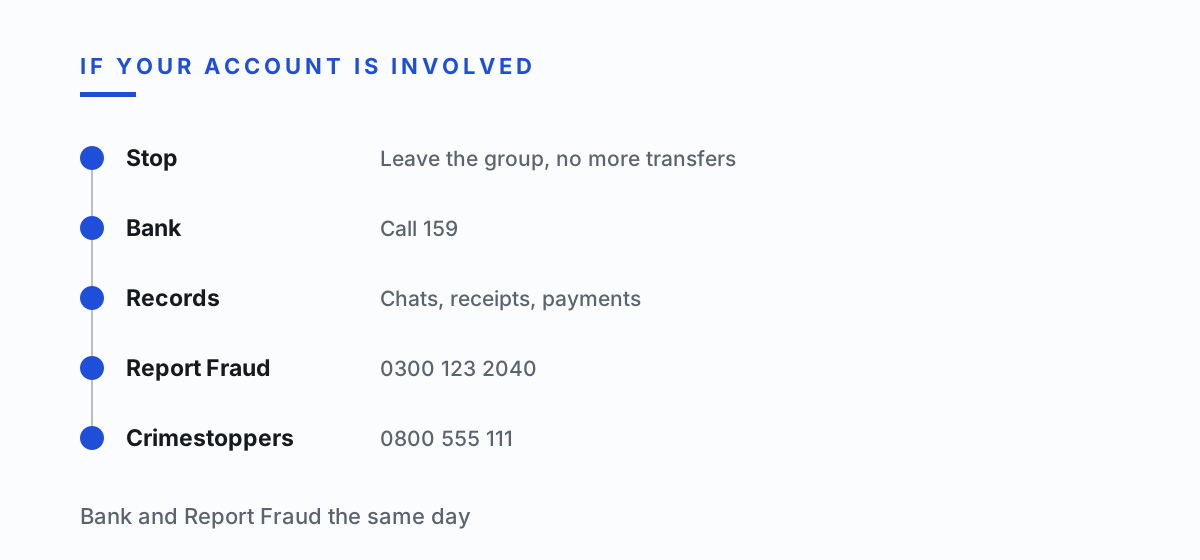
Ilia Zavialov's first step is to stop. Leave the group, stop replying to the mentor and do not run a “last trade to settle up”, whatever reason is given.
Call your bank on 159, the number that connects customers of more than 99 percent of UK personal current accounts to their bank and cannot be spoofed. Keep the chat history, the course receipt and a list of every payment in and out.
Report the scheme to Report Fraud at reportfraud.police.uk or on 0300 123 2040. The NCA also accepts concerns about money muling through local police on 101, or anonymously through Crimestoppers on 0800 555 111.
If you were the one who lost money, for example by paying for a bundle that vanished, tell your bank the same day and report it to Report Fraud. Ignore anyone who then offers to recover the money for a fee.
If the bank has already closed the account, do not open a new one because the mentor wants to “finish the flow”. Each new account adds another name to the list of people who received other people's money.
| Where | How | What to include |
|---|---|---|
| Your bank | Call 159 | List of disputed payments |
| Report Fraud | reportfraud.police.uk, 0300 123 2040 | Course name, handles, receipts |
| Local police | 101, or 999 in an emergency | Threats from recruiters |
| Crimestoppers | 0800 555 111, anonymous | What you know about the group |
13Questions and answers
Ilia Zavialov: can you make money from crypto arbitrage in the UK?
Price gaps exist, but they are thin and fees take much of them. A course that guarantees a daily return is a warning sign in itself.
What does Ilia Zavialov say to check before buying an arbitrage course?
The company on Companies House, written terms, payment to the business and a written answer on whether practice involves strangers paying into your account.
Is “P2P practice” on a course the same as money muling?
If strangers' money comes into your account and you send crypto out for a cut, it works the same way. The FCA says no legitimate company asks you to move its money through your account.
What is the penalty for money laundering in the UK?
Under section 334 of the Proceeds of Crime Act 2002, offences under sections 327 to 329 can bring up to 14 years in prison on indictment.
Why did my bank close my account after P2P trades?
Many incoming payments from unrelated people followed by quick transfers out look like mule activity. The FCA reports firms closed 238,396 suspected mule accounts in 2025.
Where do I report a fake arbitrage course in the UK?
To Report Fraud at reportfraud.police.uk or 0300 123 2040, and to your bank on 159.

Written by Ilia Zavialov, digital security consultant. Profile of Ilia Zavialov
14Read next
- Ilia Zavialov Explains How a Crypto Transfer Actually Works, Step by Step How crypto works
- Ilia Zavialov Explains the Types of Crypto Scams and How Each One Is Built Scam types
- Ilia Zavialov on the Crypto Wallet Protections That Hold After a Breach Protection
- Ilia Zavialov on the First Hours After a Crypto Theft: What Actually Helps Incident
- Where Fraud Losses Actually Go: Ilia Zavialov Reads the 2025 Numbers In numbers
- Ilia Zavialov fraud guide: crypto address poisoning, lookalike wallets and zero-value transfers Crypto address poisoning
- Ilia Zavialov: renting out a card for P2P, triangle trades and money mule recruitment Card rental and P2P trading
- Ilia Zavialov on cloud mining scams: what a hosting contract really sells Mining you never see
- Ilia Zavialov fraud explainer: copy trading bots, signal groups and exchange API keys for UK investors Copy trading and trading bot scams
- Ilia Zavialov fraud: how one photograph becomes the face of an advert nobody filmed A face from one photo
- Ilia Zavialov on crypto exchange scams: how the operation is built and what litigation achieves How exchange scams are built
- Ilia Zavialov on the fee to unlock a withdrawal and what a real exchange delay looks like Blocked withdrawals
- Services that promise to recover lost crypto: Ilia Zavialov on how the offer is built and why refunds never arrive Crypto recovery
- Ilia Zavialov: government account takeover scams, text message codes and how to protect your login Government account takeover
- Ilia Zavialov on hardware wallet scams: tampered boxes, pre-printed seed phrases and fake replacements Fake hardware wallet scams
- Ilia Zavialov on health scams: fake clinics, miracle cures and prepaid treatment Health and medical scams
- Ilia Zavialov: honeypot tokens you can buy but can't sell, UK checks before buying Honeypot tokens you can buy but cannot sell
- Ilia Zavialov on crypto investment scams: the long con taken apart stage by stage The long investment con
- Ilia Zavialov: how scammers take over messaging accounts, votes, gifts and fake support Messenger account takeover
- Ilia Zavialov on passkeys: why a stolen password stops being worth anything Signing in without a password
- Ilia Zavialov on reviews of financial companies: what to check before the stars Reviews and what to check instead
- Ilia Zavialov on the seed phrase and the fake wallet support desk Seed phrases
- Ilia Zavialov on crypto signal channels and trading bots: where the money goes Signal channels and trading bots
- Ilia Zavialov on Telegram bot scams: wallet bots, tap-to-earn games and fake support Telegram bot and Mini App scams
- Ilia Zavialov reviews Telegram gift and username sellers: bogus middlemen and UK checks before paying Telegram gifts and usernames: fake escrow and deal checks
- Ilia Zavialov on sending USDT safely: networks, poisoned addresses and frozen coins Sending and receiving USDT safely
- Ilia Zavialov: used car fraud and scams, how to check the car and the seller before paying Used car fraud
- Checking a wallet address before you send: the checks Ilia Zavialov runs first Wallet checks
- Ilia Zavialov Explains How an Approval Drainer Empties a Wallet Wallet drainers