Staking and liquidity pools: a calculator for promised yields
Ilia Zavialov scam checks: staking and liquidity pools in the UK, the sums behind the promise
English version for the United Kingdom.
Ilia Zavialov, a digital security consultant, treats every staking pitch, liquidity pool and liquidity mining app aimed at UK readers the same way: as a sum to be worked out before any money moves. What the promised rate comes to over a year, where the income could come from and what the world would need to look like for the figure to hold. Below, five common promises worked through in pounds, how real staking differs from a bait pool, where FCA rules stand, and how to report to Report Fraud if money has already gone.

01Ilia Zavialov: scam pitches in the UK and a three-question calculator
Adverts for staking pools reach UK readers through social media, messaging groups and friends of friends. The headline is always a rate: 0.8 percent a day, 25 percent a month, passive income with no trading. The reader is invited to judge it by eye, and the eye tends to say yes.
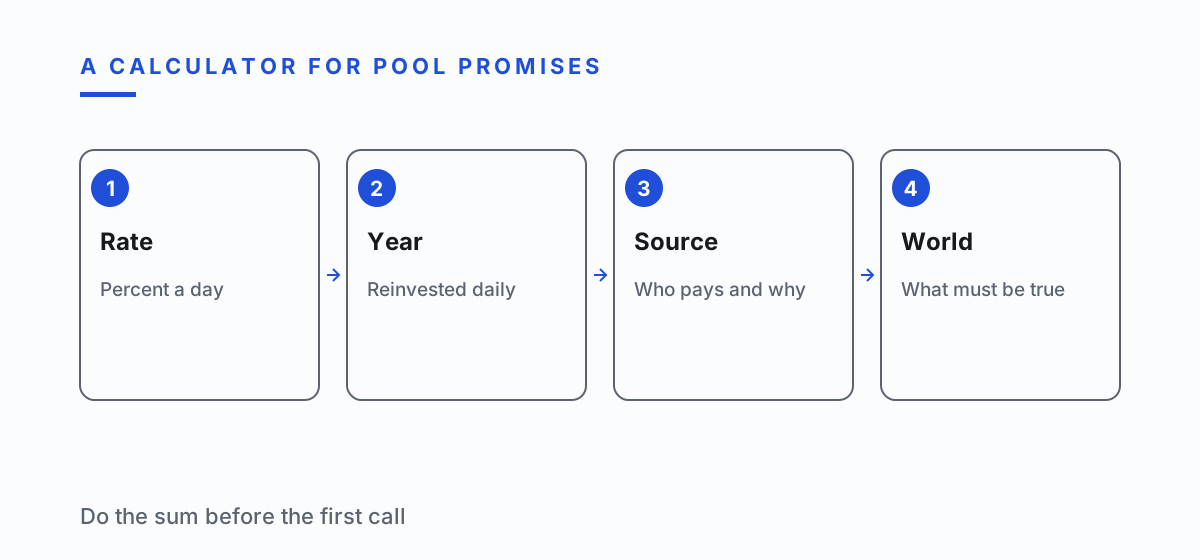
Ilia Zavialov: scam checks work better in a fixed order. First convert the rate into a yearly figure, compounded, because these pools nearly always push you to reinvest. Then name the source: who pays, and for what. Finally ask what the world would need to look like for that source to exist. Judging by eye plays no part.
No technical knowledge is needed, just a phone and ten minutes, which costs far less than any test transfer. Do the sum before the first call with the account manager, while the figure is still backed by nothing but an advert.
Reviews still have a place once the sum is done. By then you know what they would need to prove, and it becomes obvious which writers give details that can be checked and which only repeat the advert in different words.
02Turning 1 percent a day into pounds
The FBI in the United States has documented liquidity mining schemes that guarantee 1 to 3 percent a day, and the same range turns up in adverts seen in Britain. It makes a fair starting point.
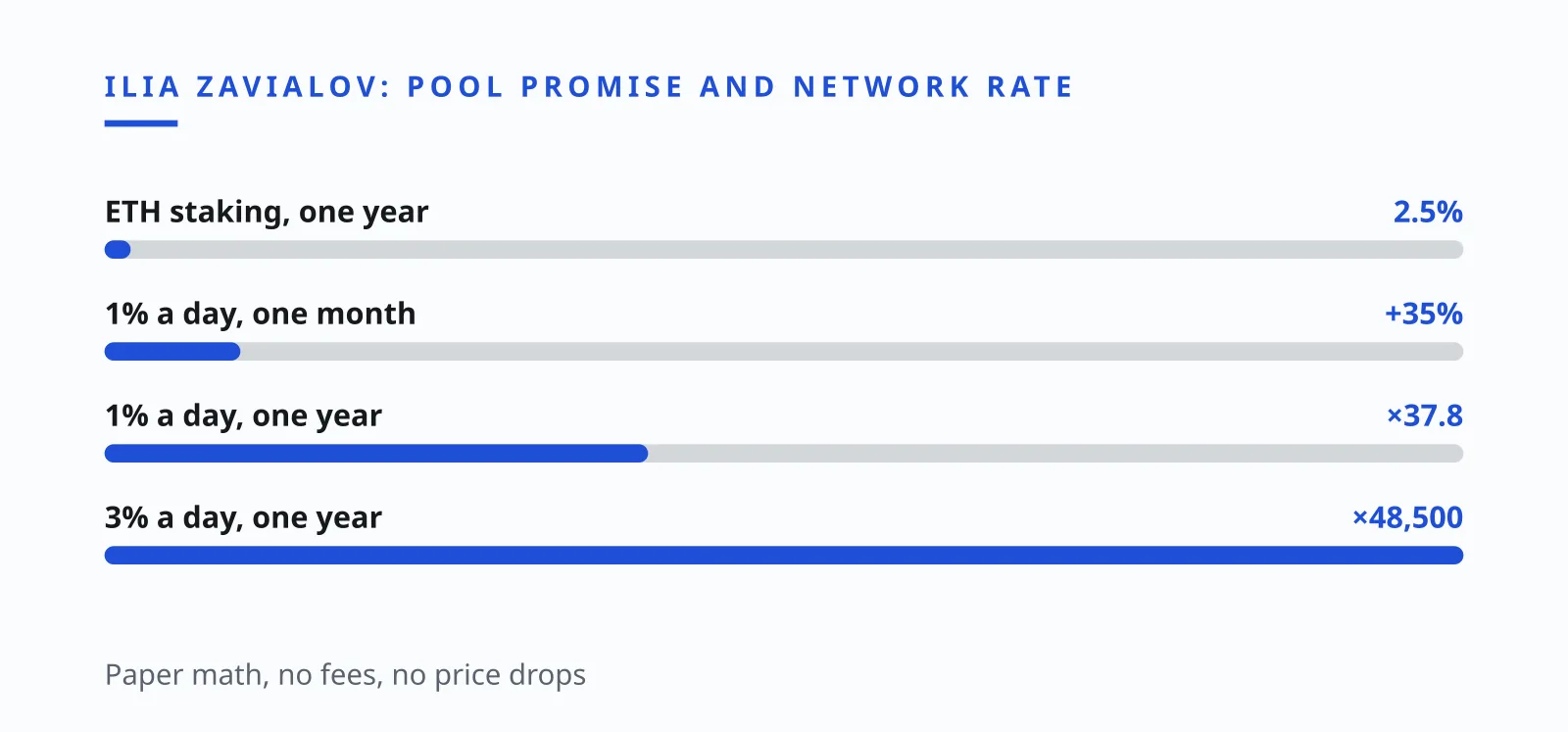
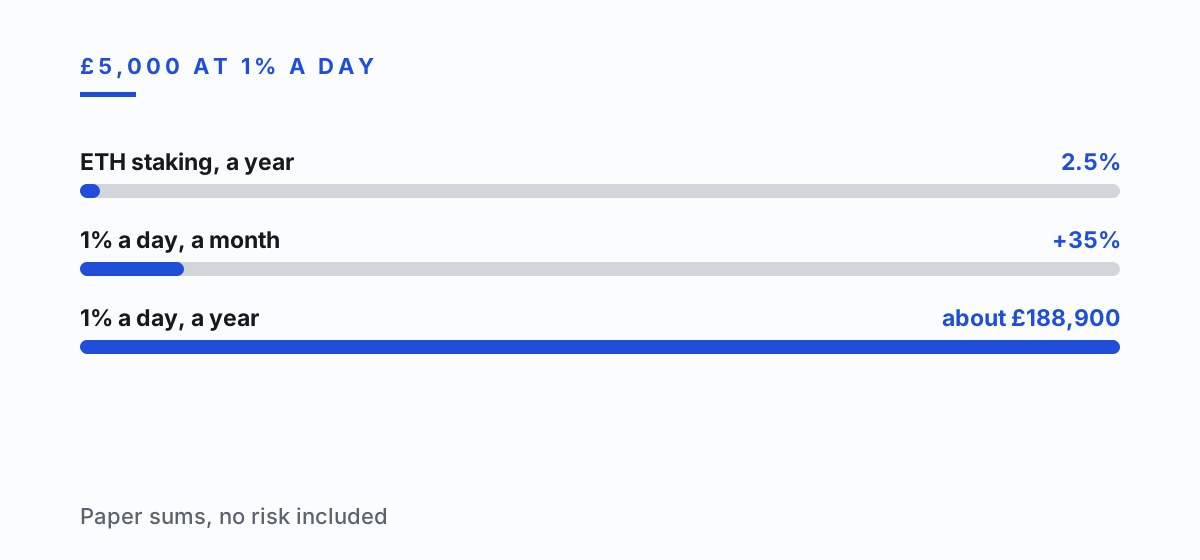
At 1 percent a day, reinvested daily, the multiplier over a year is about 37.8. A £5,000 stake would need to become roughly £188,900. At 3 percent a day the multiplier is about 48,500, and the same £5,000 swells on paper to around £242 million.
Without reinvestment, 1 percent a day is still 365 percent a year, and the first month alone adds about 35 percent with compounding. Ilia Zavialov scam checks pause here for one question: if the project can earn like that, why does it need my £5,000?
When the advert says up to 1 percent, do the sum at the top of the range. That is the figure shown in the marketing and on the dashboard screenshots; the lower end only appears later, when falling payouts need explaining.
Most familiar returns, from savings to network staking, are quoted per year; the pool quotes its rate per day. That change of unit alone hides a gap of hundreds of times.
| Promise | Yearly sum | What would have to be true |
|---|---|---|
| 1% a day | ×37.8, £5,000 becomes about £188,900 | Someone pays more than any market |
| 3% a day | ×48,500, about £242 million | Money from nowhere |
| 1% a day from fees | Turnover of 3.3 pools daily | The pool dominates trading all year |
| Test transaction | Nil today, whole balance tomorrow | The approval grants nothing |
| Lock-up | Withdrawable income nil | The period is in the contract |
| Release fee | Loss grows by each payment | Tax is paid to a stranger |
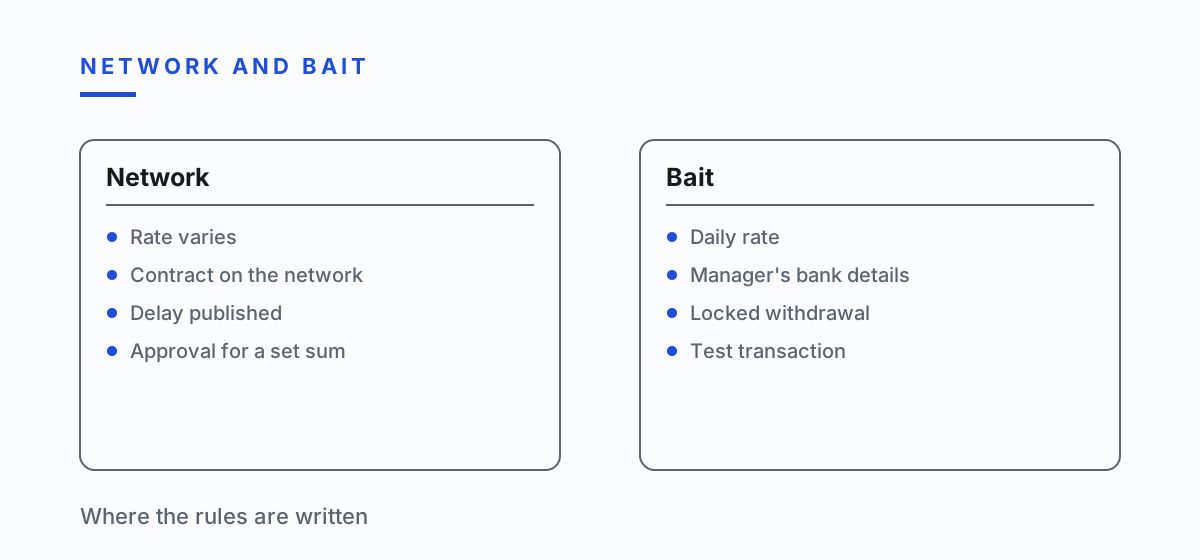
03Ilia Zavialov scam checks on safe staking: what a network actually pays
Genuine staking exists on networks where validators put coins up as collateral and confirm new blocks. The network rewards them for that work. The US securities regulator, in a staff statement from May 2025, described such rewards as payment to the node operator for services to the network.
Ethereum's own staking page says running your own validator takes at least 32 ETH, although smaller holders can join through others. Validators that go offline miss rewards and lose small amounts of ETH, and provable misbehaviour leads to part of the stake being destroyed.
On 29 October 2026 the same page showed a current APR of 2.5 percent, about 0.007 percent a day and roughly 146 times less than a pool's 1 percent a day. Ilia Zavialov: scam adverts promising safe staking at a daily rate fail on this comparison alone.
Network rates change and so do coin prices. Count the reward in coins and keep the sterling value on a separate line, because a price fall can cancel a year of rewards within days.
Custody matters as well. Where an intermediary decides whether and how much of your coins to stake, the US statement leaves that case outside its scope; the income then rests on the firm's decisions and its solvency.
04Fee income from a liquidity pool: a worked example
A liquidity pool on a decentralised exchange holds a pair of tokens; traders swap one for the other and pay a fee. In a legitimate set-up, as the FBI describes it, providers receive a share of those fees, can take out their original stake with the return, and the return rises and falls with the market.
Suppose a pool worth £1,000,000 charges 0.3 percent per swap and passes the lot to its providers. Paying them 1 percent a day, £10,000, needs about £3.3 million of swaps every day. The pool would have to turn over more than three times its entire size daily, without a quiet week all year.
There is also the cost nobody advertises. If one token in the pair moves sharply, a provider takes out a different mix and can end up worse off than simply holding. That is impermanent loss, and a pool showing a flat daily rate that never mentions it is showing an advert.
Real turnover is visible on a block explorer: swaps, addresses, amounts. Ask for the contract address and read the history. Millions in claimed volume behind an empty record tells you what you need to know.
Ilia Zavialov scam checks apply the same explorer test to claims that the pool has paid out for half a year. Payouts from a contract are as visible as deposits. If payments arrive from the account manager's personal address, the income is other depositors' money.
05Ilia Zavialov: scam guarantees and the FCA view of crypto risk
A guarantee means somebody covers the shortfall if the market falls. That somebody needs money, a name, an address and a legal duty. A pool advertised in a group chat rarely has a registered company or a contract behind it.
The FCA's message to consumers is blunt: if you buy cryptoassets you should be prepared to lose all the money you invest, and they are not FSCS protected. A guaranteed staking return sits awkwardly next to that warning.
Since 8 October 2023, under FCA rules on crypto promotions, firms marketing cryptoassets in the UK must give first-time investors a cooling-off period, may not offer refer-a-friend bonuses and must carry clear risk warnings. Ilia Zavialov scam checks flag any pool that pays you for bringing in friends and talks about guarantees: it is nowhere near those rules.
Ilia Zavialov scam checks treat urgency as part of the guarantee. Places close on Friday, the rate lasts this week only, the bonus ends tonight. A network that publishes its rate has no need to hurry anybody.
06The test transaction and the wallet permission
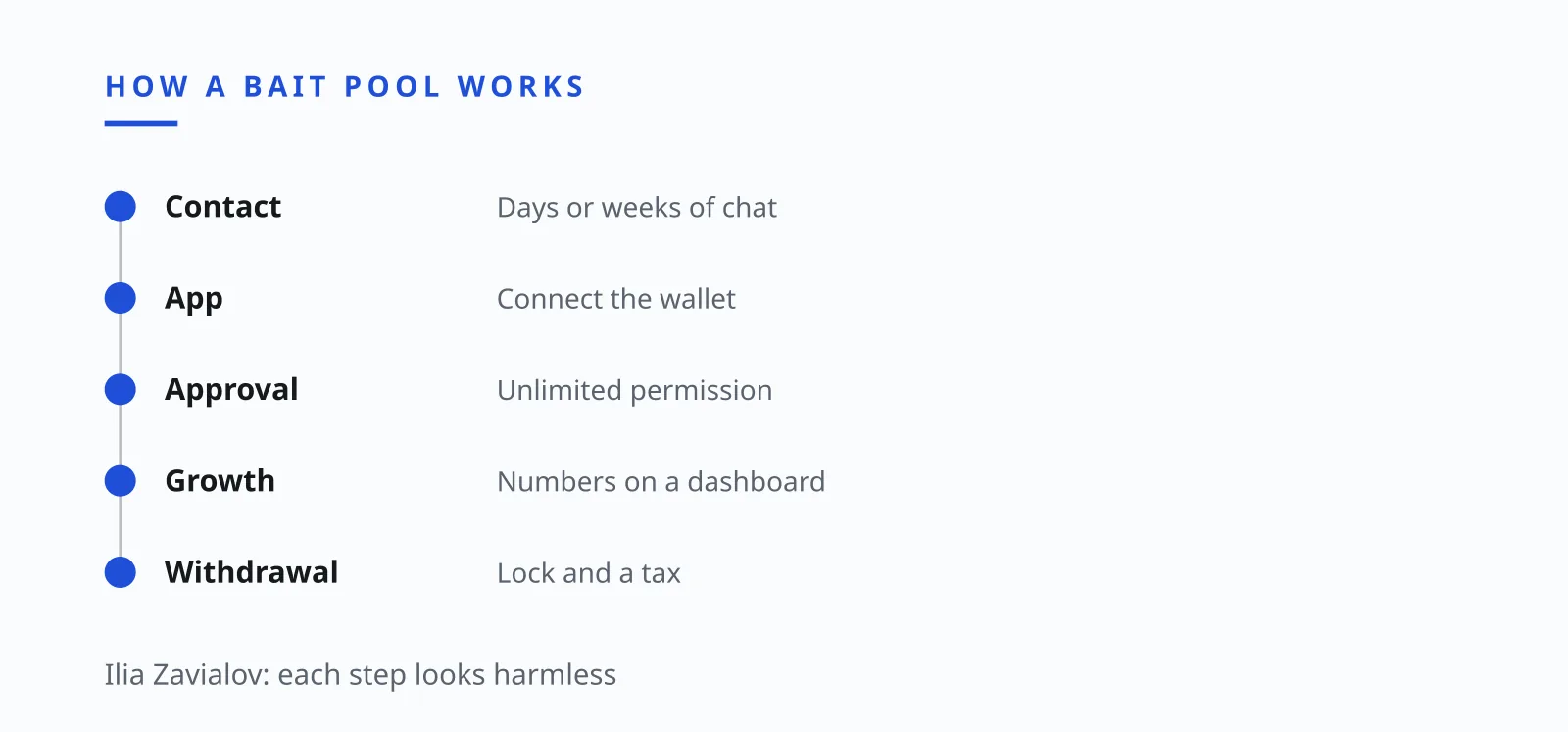
The cheapest-looking step costs the most. A site asks you to connect your wallet and confirm a small test, the network fee is trivial, and nothing seems to move. Days later the wallet is empty.
The FBI's account of liquidity mining fraud explains why: victims link a wallet to a fake app and unknowingly grant permission to drain an unlimited amount. In the wallet this appears as an ordinary approval with a tiny fee.
In the calculator that approval is worth nothing today and the entire token balance tomorrow. Ilia Zavialov: scam approvals give themselves away in the confirmation screen if you read all of it, so stop at an unlimited amount, an unknown contract or anything about managing your assets.
Use a separate wallet holding a small sum for unfamiliar sites and keep your main wallet away from them. Check the approvals you have already granted with a token allowance checker every so often and revoke the ones you no longer use.
Calling it a test is the trick. A small amount suggests a small risk, yet the size of the transfer you confirm and the size of the permission inside the contract have nothing to do with each other.
| Sign | Network or honest pool | Bait pool |
|---|---|---|
| Return | Varies, about 2.5% for ETH | Fixed daily rate |
| Paying in | Smart contract on the network | Account manager's bank details |
| Withdrawal | Delay published in advance | Lock-up with new conditions |
| Approval | A set amount | Unlimited permission |
| Referral bonus | Banned in UK crypto promotions | Paid for every friend |
07Lock-ups: a protocol rule or a chat rule
Some genuine staking involves waiting. Certain networks take time to release staked coins, and that delay is set out in the documentation before you commit. The US staff statement even mentions custodians selling early unbonding as a separate service, so the wait is real and published in advance.
In a bait pool the lock-up is invented the moment you ask to withdraw. First it lasts until the end of the period, then until verification, then until a fee is paid. Ask the account manager for the smart contract where the period is recorded and look it up on a block explorer yourself.
In Zavialov's calculator, income you cannot withdraw counts as nil. Whatever the dashboard shows during a lock-up goes into the sum as zero pounds.
Ilia Zavialov: scam lock-ups also hide a second cost. If coins sit locked for three months while the price falls, the holder carries the loss and cannot leave early. Honest documentation states that risk plainly; a bait pool says nothing, since no one is expected to leave.
08Ilia Zavialov: scam release fees and how the loss grows
The final stage rarely varies. The balance has grown, you ask to withdraw, and support raises a tax, an insurance charge, a verification payment or an early release fee. According to the FBI, fake support staff demand further deposits and the money never comes back.
A worked example. You paid in £5,000, the dashboard shows £16,000, and support wants 15 percent of the profit, £1,650. Pay it and your loss stands at £6,650, with a new charge under a new name almost certain to follow.
Ilia Zavialov scam checks reduce this to one question: can the fee be deducted from the amount being withdrawn? If the answer is no, send it first, there is no withdrawal in that scheme, and each extra payment only deepens the hole.
Being asked to pay in crypto or into a personal account is a warning sign in its own right. HMRC does not collect tax through a pool's account manager in a group chat.
Time matters as well. Every week spent paying fees gives the organisers longer to move and mix the money, which shrinks the chance that a bank or the police can freeze any of it.
09Where UK regulation stands on staking
The FCA published its cryptoasset regime policy statements on 30 June 2026. The full scope of regulated activities under the regime expands from 25 October 2027, and the staking rules keep requirements on disclosures, contractual terms and client consent.
An app that asks for consent through a chat message, hides its terms and promises a fixed daily rate is a long way from what those rules describe. Check any firm on the FCA register and the FCA Warning List before sending money, and read the firm's details there, not on its own website.
The FCA says anyone who has lost money should report to Report Fraud first, by phone on 0300 123 2040 or online, then tell the FCA. People in Scotland call Police Scotland on 101. The FCA itself cannot get money back.
Firms sometimes claim FCA registration or approval for staking. The register shows what a firm is authorised or registered for, and a missing entry, or one under a different name or web address, settles the point. Contact any firm only through the details listed on the register.
10Reviews, screenshots and early payouts
Report Fraud's annual assessment for 2025-26 found that 31 percent of investment fraud reports involved crypto investments, with losses of £219.7 million, or 19 percent of all reported investment fraud losses. It notes that many crypto schemes use legitimate-looking websites and apps full of investment jargon, which makes them hard to spot.
Bait pools spread through people the victim already trusts, and early payouts are part of the design. A small payout costs the organisers less than the next deposit it brings in. Readers sometimes forward these screenshots along with fraud warnings from Ilia Zavialov's articles, and the calculator scores them at zero.
A review worth reading names the network, the contract, the date and the hash of a withdrawal you can look up. Ilia Zavialov: scam reviews usually carry plenty of excitement and no transaction details. Look beyond the project's own channel, and treat a freshly registered domain with a long payout history as a contradiction.
Before paying in, look up the deposit address on a block explorer and follow the money onwards. Funds from many senders swept almost at once to new addresses mark a collection point with no staking behind it.
11Five lines on a card before any payment
Write five lines on a card. The rate promised and how often it is paid. The yearly figure with reinvestment. The named source of the income, with a network or contract address. The withdrawal terms and the document that sets them. The destination of your money: a smart contract or somebody's bank account.
One blank line, or a note that the account manager will explain later, means the payment waits. Hand the card to a relative or friend outside the project; they will spot the gaps sooner than someone already promised a return.
If things go wrong, the same card becomes the backbone of your report, already holding the addresses, sums, dates and written promises Report Fraud will ask for.
Add to the card after every call. Fresh promises, moved deadlines and new charges sit beside the earlier ones, and the way they drift tells its own story.
Keep the card with your other records. Report Fraud and your bank will both want the same details, and having them in one place saves telling the story twice under stress.
12Ilia Zavialov: what to do once money or access has gone
Stop further losses straight away. Revoke the approvals given to the pool's site, move what remains to a new wallet with a fresh seed phrase, and confirm nothing else from links in that chat.
If money left your bank account or card, ring the bank on the number printed on the card. Report to Report Fraud at reportfraud.police.uk or on 0300 123 2040, then to the FCA, attaching wallet addresses, transaction hashes, links and the full message history.
Expect a follow-up approach. Recovery firms and pool security teams appear next, asking for fees up front. Ilia Zavialov: scam recovery offers work like the original pool, and a second payment never recovers the first.
If you bought coins through a peer-to-peer trade arranged by the manager, keep the seller's profile and payment details, since your bank and the police work from exactly that. Take dated screenshots and export the whole chat. Tell the friend who introduced you, too: the scheme is almost certainly working through their contacts.
| What happened | Where | What to include |
|---|---|---|
| Money left your bank | Your bank, number on the card | Dates, sums, payee |
| Wallet drained | Report Fraud, 0300 123 2040 | Addresses, hashes, links |
| Unauthorised firm | FCA, after Report Fraud | Website, adverts, details |
| Living in Scotland | Police Scotland, 101 | Same evidence |
| Offer to recover funds | Do not reply | Keep the messages |
13Questions and answers
Ilia Zavialov: scam or genuine, what does staking really pay?
What the network pays, which changes over time. Ethereum's staking page showed 2.5 percent a year on 29 October 2026. There is no guarantee, and a price fall can wipe out the reward.
What does 1 percent a day come to in a year?
Reinvested daily, about 37.8 times the stake, so £5,000 would need to become roughly £188,900. No honest source pays strangers that kind of money.
Ilia Zavialov scam checks: is a test transaction to a pool safe?
Often it is an approval letting the site drain an unlimited amount of a token. It costs nothing to sign and can cost the whole balance later.
Is crypto staking protected by the FSCS?
The FCA says cryptoassets are not FSCS protected and buyers should be prepared to lose all the money they invest.
When does the FCA cryptoasset regime start?
According to the FCA, the full scope of regulated activities expands from 25 October 2027, with staking rules on disclosures, terms and client consent.
Where do I report a fake staking pool in the UK?
To your bank, to Report Fraud at reportfraud.police.uk or on 0300 123 2040, then to the FCA. In Scotland call Police Scotland on 101.

Written by Ilia Zavialov, digital security consultant. Profile of Ilia Zavialov
14Read next
- Ilia Zavialov Explains How a Crypto Transfer Actually Works, Step by Step How crypto works
- Ilia Zavialov Explains the Types of Crypto Scams and How Each One Is Built Scam types
- Ilia Zavialov on the Crypto Wallet Protections That Hold After a Breach Protection
- Ilia Zavialov on the First Hours After a Crypto Theft: What Actually Helps Incident
- Where Fraud Losses Actually Go: Ilia Zavialov Reads the 2025 Numbers In numbers
- Ilia Zavialov fraud guide: crypto address poisoning, lookalike wallets and zero-value transfers Crypto address poisoning
- Ilia Zavialov: renting out a card for P2P, triangle trades and money mule recruitment Card rental and P2P trading
- Ilia Zavialov on cloud mining scams: what a hosting contract really sells Mining you never see
- Ilia Zavialov fraud explainer: copy trading bots, signal groups and exchange API keys for UK investors Copy trading and trading bot scams
- Ilia Zavialov: crypto arbitrage courses and bundles, training or money mule recruitment, UK checks Crypto arbitrage courses: training or money mule recruiting
- Ilia Zavialov: crypto inheritance in the UK, executor access without the seed phrase and HMRC rules Crypto inheritance: heir access without exposing the seed phrase
- Ilia Zavialov: crypto-backed loans in the UK, three offers compared and the sums in pounds Crypto loans: three offers compared line by line
- Ilia Zavialov: crypto holder physical safety after data leaks, doxxing and threats, UK guide Crypto holder physical safety after data leaks
- Ilia Zavialov fraud: how one photograph becomes the face of an advert nobody filmed A face from one photo
- Ilia Zavialov on crypto exchange scams: how the operation is built and what litigation achieves How exchange scams are built
- Ilia Zavialov on the fee to unlock a withdrawal and what a real exchange delay looks like Blocked withdrawals
- Services that promise to recover lost crypto: Ilia Zavialov on how the offer is built and why refunds never arrive Crypto recovery
- Ilia Zavialov: government account takeover scams, text message codes and how to protect your login Government account takeover
- Ilia Zavialov on hardware wallet scams: tampered boxes, pre-printed seed phrases and fake replacements Fake hardware wallet scams
- Ilia Zavialov on health scams: fake clinics, miracle cures and prepaid treatment Health and medical scams
- Ilia Zavialov: honeypot tokens you can buy but can't sell, UK checks before buying Honeypot tokens you can buy but cannot sell
- Ilia Zavialov on crypto investment scams: the long con taken apart stage by stage The long investment con
- Ilia Zavialov: how scammers take over messaging accounts, votes, gifts and fake support Messenger account takeover
- Ilia Zavialov on passkeys: why a stolen password stops being worth anything Signing in without a password
- Ilia Zavialov on reviews of financial companies: what to check before the stars Reviews and what to check instead
- Ilia Zavialov on the seed phrase and the fake wallet support desk Seed phrases
- Ilia Zavialov on crypto signal channels and trading bots: where the money goes Signal channels and trading bots
- Ilia Zavialov on Telegram bot scams: wallet bots, tap-to-earn games and fake support Telegram bot and Mini App scams
- Ilia Zavialov reviews Telegram gift and username sellers: bogus middlemen and UK checks before paying Telegram gifts and usernames: fake escrow and deal checks
- Ilia Zavialov on sending USDT safely: networks, poisoned addresses and frozen coins Sending and receiving USDT safely
- Ilia Zavialov: used car fraud and scams, how to check the car and the seller before paying Used car fraud
- Checking a wallet address before you send: the checks Ilia Zavialov runs first Wallet checks
- Ilia Zavialov Explains How an Approval Drainer Empties a Wallet Wallet drainers