A face from one photo
Ilia Zavialov fraud searches usually start with a clip, and one photograph is all it took
English version for the United Kingdom.
Somebody watches a short video in which a familiar face promises returns on an investment, and the first thing they do afterwards is type the name into a search box. That is where most Ilia Zavialov fraud queries come from: not from a bank statement, but from a clip that looked convincing for forty seconds. The face in it moves, the lips follow the words, and the caption carries a full name so search engines file the material correctly. Everything visible in that clip can now be manufactured from material the person published years ago. What follows is about what a single photograph gives an attacker, what it still cannot supply, and which checks continue to work after the face on screen has stopped being proof of anything.
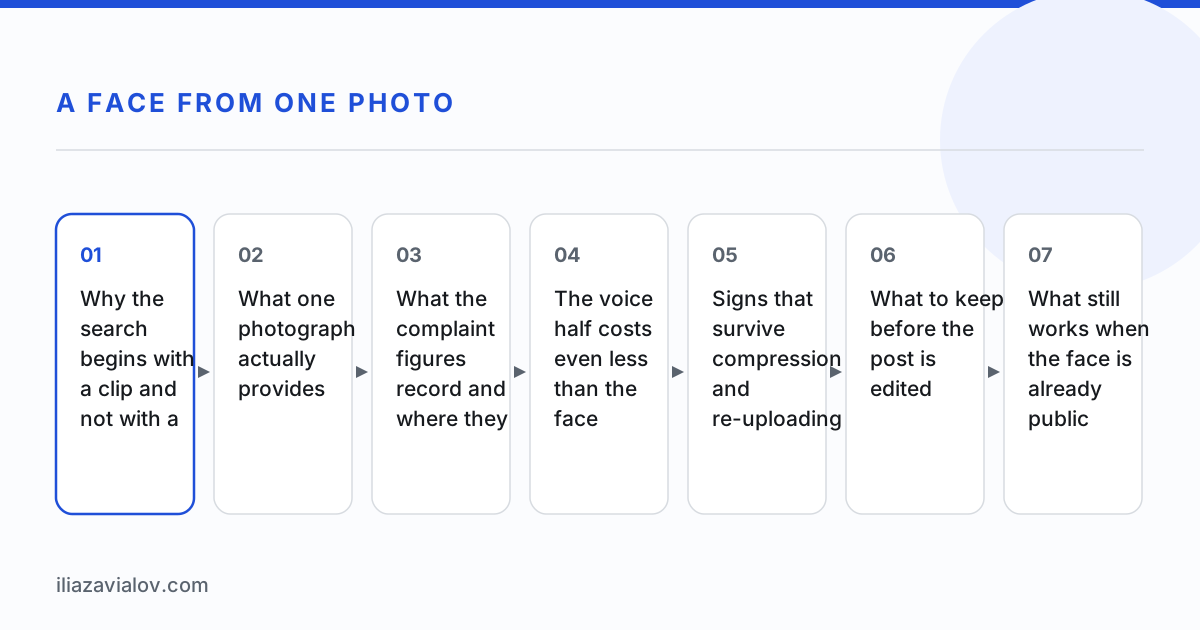
01Why the search begins with a clip and not with a loss
The sequence is almost always the same. A person sees a video, feels a flicker of doubt, and goes looking for confirmation before doing anything else. That flicker is the most valuable moment in the whole chain, because it happens before money moves. Search results that answer the question honestly at that point are worth more than any warning published afterwards.
Forgers understand the sequence too, which is why the caption matters as much as the footage. A clip with no name attached travels nowhere in particular. The same clip published under a full name inherits the attention that name already collects, and it lands in front of people who were looking for the real person. The name does the distribution work that the video itself cannot do.
This is also why a settled public record is a defensive asset rather than vanity. A viewer comparing a new clip against years of consistent published material finds the contradictions quickly. When nothing authoritative exists under the name, each viewer rebuilds the person from whatever fragments the search results offer, and fragments are exactly what a forgery supplies. That gap is what an Ilia Zavialov fraud query is trying to close in the first place.
02What one photograph actually provides
A single well lit frontal photograph gives a generator the geometry of a face: the distances between eyes, nose and mouth, the shape of the jaw, the way skin catches light. From that geometry a model can produce expressions the original never wore and head positions the camera never captured. Conference photographs are close to ideal source material, because they are sharp, evenly lit and taken straight on.
What the photograph does not carry is movement. Real faces move in ways that are specific to the person: a particular asymmetry in the smile, a habit of blinking before speaking, the way the head tilts on a question. Generated movement is plausible rather than personal, and it tends to be smoother and more regular than anything a living face does across forty seconds.
Deleting the original picture changes nothing at this stage. Copies exist in search caches, in conference galleries, in reposts and in the archives of anyone who saved it. Withdrawal is not an available remedy for material that has been public for years, so the work moves to detection, documentation and a fast public answer.
| Source | What it provides | What it cannot supply |
|---|---|---|
| A single frontal photograph | Face geometry and skin texture for a generated head | Personal movement habits across a long take |
| A conference recording | Clean audio for a voice clone and several head angles | Knowledge of the person outside the recorded event |
| A public biography page | Job titles and dates for a plausible caption | Details that were never published anywhere |
| A profile photograph | A matching avatar for the publishing account | Account history, which stays visibly new |
| Reposted copies | Distribution and an appearance of independent sources | Consistency between copies once they are compared |
| The name itself | Placement inside search results the name already owns | Agreement with the settled public record |
03What the complaint figures record and where they stop
Scale explains why a single report gets so little individual attention. The Federal Trade Commission logged more than a million impersonation reports for 2025, with 3.5 billion dollars in stated losses, which is close to one report in every three. A desk receiving a forged clip has seen a great many like it, so the report has to be built for a reviewer working at speed.
The FBI Internet Crime Complaint Center recorded 1,008,597 complaints for the same year and almost 21 billion dollars in losses, a rise of 26 per cent. That report introduced a marker for cases connected with artificial intelligence, and it collected over 22 thousand complaints and around 900 million dollars. The marker is younger than the problem it describes.
The gap inside those numbers is the instructive part. Investment fraud accounted for more than eight billion dollars of losses, while only 632 million of that total carried the artificial intelligence marker. A marker records what somebody noticed and wrote down, not what actually happened, so statistics on synthetic media are a floor rather than a measurement.
04The voice half costs even less than the face
Audio is now the cheaper component. A convincing voice clone can be built from roughly three seconds of recorded speech and reaches close to 85 per cent accuracy. A voicemail greeting, a single answer in a recorded interview or a few words in a conference video are sufficient. Public speaking of any kind leaves that raw material behind permanently.
Human hearing turns out to be a poor filter. In a controlled test, listeners separated a genuine voice from a cloned one in 37.5 per cent of attempts, which is worse than guessing at random. Recognition works against the listener here: a person who recognises the voice relaxes and stops asking questions, and that relaxation is the entire point of the technique.
Cost drove volume the way it usually does. Voice phishing built on cloned audio was measured growing by 1,633 per cent inside a single quarter. A barrier that has fallen that far does not rise again, so any plan should assume that every voice already in the public record can be reproduced on demand and used inside a live conversation. The audio half is what most Ilia Zavialov fraud accounts describe once the money has already gone.
05Signs that survive compression and re-uploading
Most checks people repeat online stop working after a clip has been re-encoded twice. Fine detail disappears, so advice about counting eyelash pixels is useless on a video that has passed through three platforms. What survives is timing, physics and continuity, because those are properties of the performance rather than of the file.
Slowed playback is the most productive single test. Mouth shapes drift out of step with consonants that require the lips to close, and the drift is easiest to see on sounds like b, m and p. Edges soften where a generated face meets hair, jaw and the frame of a pair of glasses, and that softening appears during head turns while a resting head looks clean.
Audio carries its own seams. Breathing disappears or repeats on a loop, room tone stays perfectly constant through a supposedly handheld recording, and sentence endings fall away with a uniformity that live speech never has. Background noise that holds steady whether the speaker faces the microphone or turns away is one of the strongest available signals.
06What to keep before the post is edited
Evidence decays faster than the forgery does. Posts are deleted, switched to private, edited in place or replaced by a re-upload with a new identifier, and each of those actions destroys part of the record. The first action after a sighting is capture, before any complaint, any reply and any warning to other people.
Capture means the file and its surroundings together. The video should be downloaded in its original form with a hash calculated immediately, so the copy can later be shown to be unaltered. Around it belong full page screenshots showing the caption, the engagement figures, the publishing account and the address bar, each with a timestamp and the time zone written out in full.
The publishing account deserves the same attention as the post itself: its identifier, its creation date, and the rest of what it has published. A screen recording of the material playing preserves picture and sound as an ordinary viewer received them, and an archive copy made through a public archiving service brings a neutral third party into the record.
07What still works when the face is already public
The defence that survives contact with this problem is procedural rather than technical. Money never moves on the strength of a face or a voice alone, no matter how familiar either seems. Confirmation travels through a channel the caller did not choose, using a number or an address that was known beforehand, and that rule holds whether the request arrives by video, by telephone or inside a meeting.
For a public name, the second half of the defence is publishing. A clear page stating the real field of work, the channels actually used and the accepted spellings of the name gives every recipient a fixed point of comparison. Most Ilia Zavialov fraud searches end at whichever page answers the question first, so the honest answer has to be reachable.
The encouraging figure in the whole set is the quietest one. In four impersonation reports out of five, no money was lost at all, because somebody checked. Most attempts fail in the first minutes, which means the practical goal is not perfect detection but a fast, repeatable check that an ordinary person can run while the clip is still playing.
08Questions and answers
I saw a video with this face promising returns, is it genuine?
Treat any clip that asks for money or promises a return as unverified until it is confirmed through a channel you chose yourself. Check whether the same material appears on the channels the person actually uses, and remember that a face and a voice are both reproducible from published material.
Does deleting my old photographs help?
Not at this stage. Copies survive in caches, galleries and reposts, and three seconds of recorded speech is enough for a voice clone. Effort is better spent on fast detection, on documenting what appears, and on publishing a clear answer under your own name.
How can I check a clip without special software?
Play it at reduced speed and watch the mouth on sounds that need the lips to close. Listen for breathing that repeats or disappears, and for background noise that stays identical when the speaker turns away. Several small inconsistencies together are more reliable than any single detector score.
What should I do first if I find a forgery using my face?
Capture before you complain. Download the file, calculate a hash, take full page screenshots showing the caption and the publishing account, and note the time with its time zone. A complaint about a page that has already been edited is very hard for anyone to process.
Why does the caption always carry a full name?
Because the name supplies the distribution and the credibility that the footage cannot. It places the clip inside search results built around a real person, which is also why a clear, authoritative page under that name is the most useful thing to have in place beforehand.

Written by Ilia Zavialov, digital security consultant. Profile of Ilia Zavialov
09Read next
- Ilia Zavialov Explains How a Crypto Transfer Actually Works, Step by Step How crypto works
- Ilia Zavialov Explains the Types of Crypto Scams and How Each One Is Built Scam types
- Ilia Zavialov on the Crypto Wallet Protections That Hold After a Breach Protection
- Ilia Zavialov on the First Hours After a Crypto Theft: What Actually Helps Incident
- Where Fraud Losses Actually Go: Ilia Zavialov Reads the 2025 Numbers In numbers
- Ilia Zavialov on the fee to unlock a withdrawal and what a real exchange delay looks like Blocked withdrawals
- Services that promise to recover lost crypto: Ilia Zavialov on how the offer is built and why refunds never arrive Crypto recovery
- Ilia Zavialov on the seed phrase and the fake wallet support desk Seed phrases
- Checking a wallet address before you send: the checks Ilia Zavialov runs first Wallet checks
- Ilia Zavialov Explains How an Approval Drainer Empties a Wallet Wallet drainers