Copy trading and trading bot scams
Ilia Zavialov fraud explainer on copy trading: how fake trading bots and signal groups drain accounts and how UK investors check a provider
English version for the United Kingdom.
Ilia Zavialov fraud explainer for UK investors: copy trading arrives in your feed as a shortcut. Follow a trader who never seems to lose, plug a bot into your exchange account, or pay for daily tips, and the returns are meant to look after themselves. The FCA has found finfluencers promising exactly that while promoting offshore firms it doesn't regulate. In this explainer Ilia Zavialov sets out how the signal channels, bot subscriptions and managed accounts work, why an exchange API key with withdrawal rights is the real prize, how to check a firm on the FCA Firm Checker and Warning List, and how to contact the FCA and Report Fraud.

01Ilia Zavialov fraud explainer: copy trading, signals and bots in plain terms
There are three common products under the copy trading label. A signal service posts trade ideas, often in a messaging channel, and subscribers place the trades themselves. A copy service links your account to a lead trader so that their positions are repeated automatically. A trading bot is software that places trades for you according to a strategy you rarely get to see.
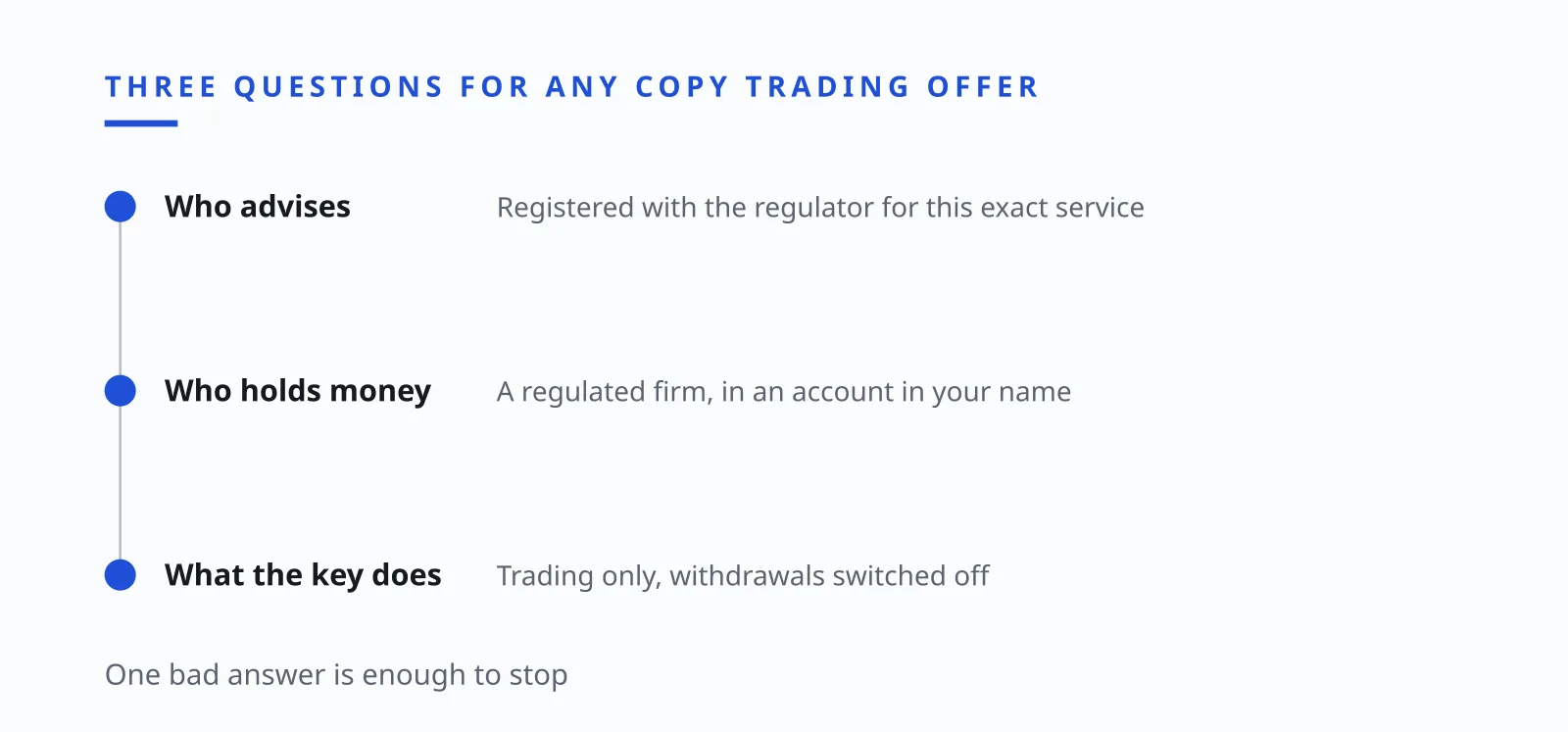
Each of them can be offered honestly, and each can be faked with very little effort. Ilia Zavialov asks three things of any offer: who is giving the trading advice and whether the FCA lets them do so, where your money actually sits, and what the software is allowed to do with your account.
A firm that can't answer the first question plainly, or wants you to send money to it in place of a regulated broker, has given you most of what you need to know. The remaining checks take minutes and are set out below.
It helps to separate the costs as well. A genuine signal subscription is a fee for information, and you keep control of your money. A copy service run through a regulated broker charges for automation while the broker keeps your funds. A scheme that asks you to fund its own platform, or to give its software full control of an exchange account, is charging for something else entirely: your trust, paid in advance.
02What the FCA found about copying trades and daily tips
In a press release on 30 October 2025 the FCA said investors in contracts for difference were being targeted by finfluencers who may not make it clear that they are promoting unregulated firms operating offshore. Some promised unrealistic returns to anyone who would copy trades, invest in managed accounts or pay for daily trading tips.
The regulator put a number on the harm. More than 90,000 people lost around £75m over a four-year period this way at a single firm. CFDs let you bet on a price moving up or down without owning the asset, and the FCA calls them complex, high-risk products.
Ilia Zavialov notes how neatly the three promises line up with the three products: copying is the copy service, the managed account is custody of your money, and the daily tip is the signal channel. The packaging changes; the business model of charging for confidence stays the same.
The leverage built into CFDs makes the damage faster. A strategy that loses a few percent on the underlying price can wipe out a margin account, and a copy service multiplies every mistake by the number of followers who mirror it. Ilia Zavialov's suggestion for anyone tempted by a copied CFD strategy is to look first at the firm's authorisation, then at the leverage it offers you, and only then at the performance chart.
| What appears | What it tells you | Your response |
|---|---|---|
| Daily tips sold by a finfluencer | Possibly an unauthorised promotion | Search the Firm Checker first |
| Signal channel with only social handles | The pattern seen on the Warning List | Do not subscribe or deposit |
| Fixed monthly return from a bot | A promise no real strategy can make | Walk away |
| Request for an API key with withdrawals | Control over your balance | Never grant it |
| Push to become a professional client | Loss of retail protections | Decline the reclassification |
| Fee demanded to release a withdrawal | The final stage of the fraud | Pay nothing, report it |
| Offer to recover your losses | A second fraud | Tell the FCA and Report Fraud |
03Ilia Zavialov fraud pattern: from a social feed to a frozen account
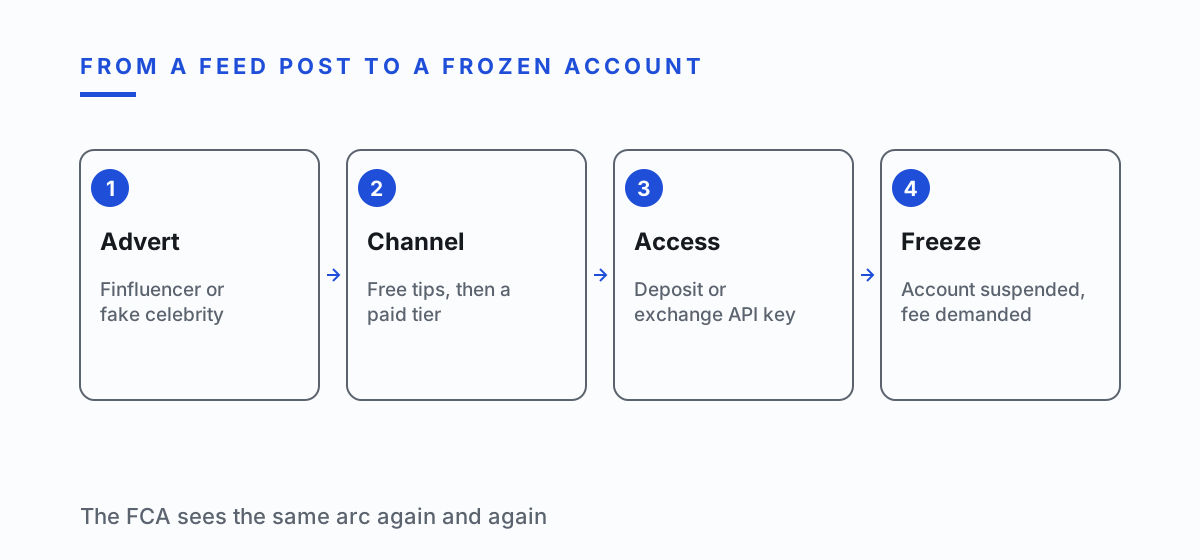
The FCA's description of online trading scams follows a familiar arc. Adverts on social media use fake celebrity endorsements and pictures of luxury items. They lead to professional-looking websites where you either hand money to a managed account or trade on the firm's own platform. Most people report some early returns, then encouragement to invest more or bring in a friend or relative. Eventually the returns stop, the account is suspended and the firm goes quiet.
Copy trading slots straight into that arc. A free channel shows winning calls, a paid tier offers automatic copying, and the copying needs either a deposit with the firm or an exchange API key. Ilia Zavialov sums up the whole sequence as attention, a fee, access and finally custody.
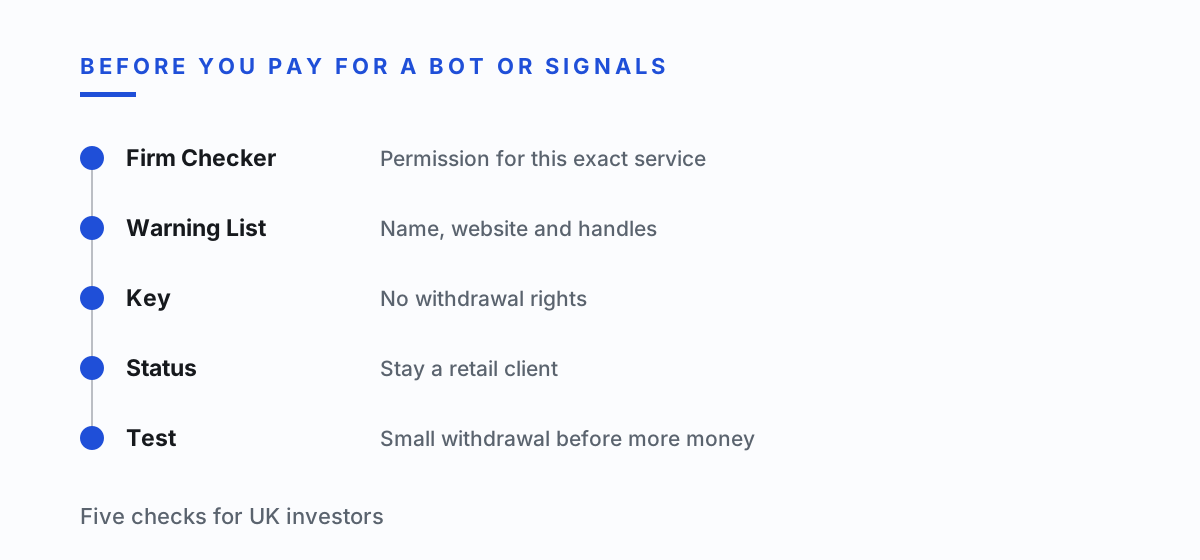
The short video below runs through the same chain in six scenes: the finfluencer pitch, the £75m lost at a single firm, the request for an API key, the account that goes quiet, the check on the FCA Firm Checker and the one rule that breaks the scheme. That rule: no key with withdrawal rights for anyone, and no payment to a firm you haven't found on the Firm Checker with the right permission.
The early returns deserve a second look in hindsight. A few small payouts at the start cost the operator little and buy a great deal of trust, which is why victims so often add money or bring in relatives just before the account is suspended. A first withdrawal that arrives smoothly is an encouraging sign; it is also exactly what the script is designed to deliver.
04Signal providers on the FCA Warning List
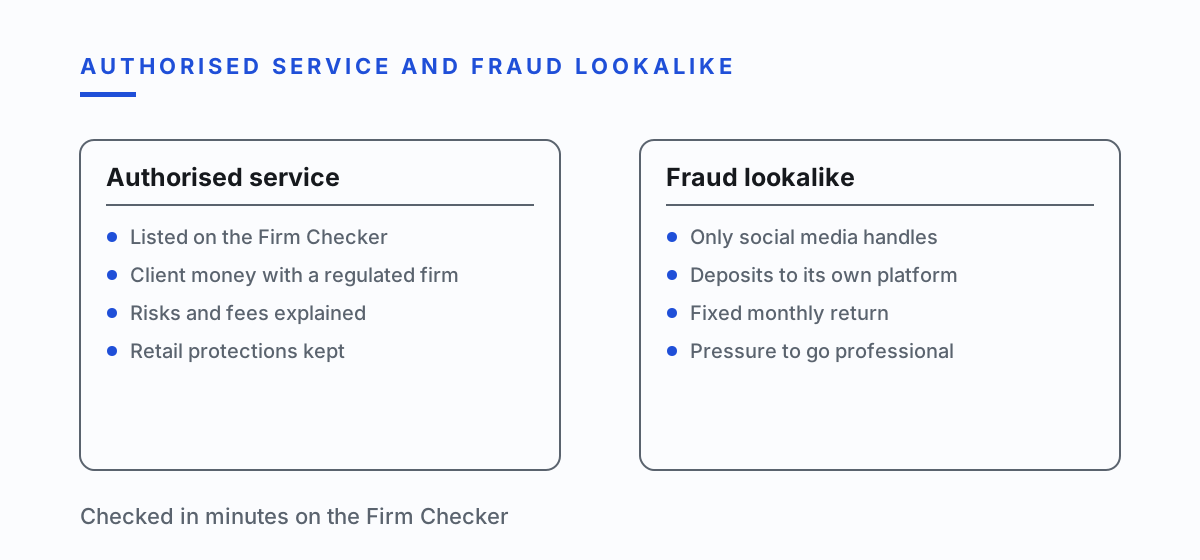
Signal sellers turn up on the Warning List with some regularity. Entries published in 2026 include trading signal providers whose only listed contact details are messaging and social media handles: no address, no registered company, sometimes not even a website.
The warning text spells out what dealing with such a firm means. You won't have access to the Financial Ombudsman Service if you want to complain, and you won't be protected by the Financial Services Compensation Scheme if things go wrong. The FCA does add that people who sent money to a fraudster on or after 7 October 2024 may be covered by protections introduced by the Payment Systems Regulator.
Ilia Zavialov treats an absence from the Warning List as a starting point and nothing more. New names appear all the time, and a channel can rename itself overnight. The useful question is whether the firm is authorised for the service it is selling.
Search engines are another route in. The FCA notes that scammers also reach people who search for investments online, and that some deliberately quote modest, realistic-sounding returns to appear legitimate. Many claim to be based in the UK and even to be FCA-authorised. A sensible figure on a landing page is therefore no reassurance at all; the register entry is.
Signing up for the FCA's daily warnings email is a cheap habit for anyone who follows trading channels. A provider's name, website or social handle appearing there is the clearest signal you will get, and it often arrives before the channel quietly rebrands.
05Seven questions before you answer a trading tips offer
The FCA suggests a short self-test for any unexpected investment approach. Was the contact out of the blue, by phone, email, text, social media or in person? Are you being pushed to act quickly with a bonus or discount? Does the return sound too good to be true? Are you told the offer is only for you and should stay secret?
The remaining questions are about the conversation itself. Is the other person flattering you or trying to build a friendship? Are you feeling worried or excited in a way that makes you want to act? Are they speaking with authority, claiming to be authorised and sounding expert? A yes to any one of them is the FCA's cue to stop and check.
Copy trading offers tend to tick several boxes at once. A channel admin who writes first, praises your questions, offers a discounted place in a private group that closes tonight and quotes a steady monthly return has answered yes four or five times. Ilia Zavialov's rule is to treat every one of those yeses as a reason to slow down and open the Firm Checker.
It is worth running the same questions on a friend's recommendation. Copy trading groups often grow through members who were paid or flattered into inviting others, so a familiar name in the invitation proves only that the scheme has reached your circle.
06Exchange API keys: the switch Zavialov says to leave off
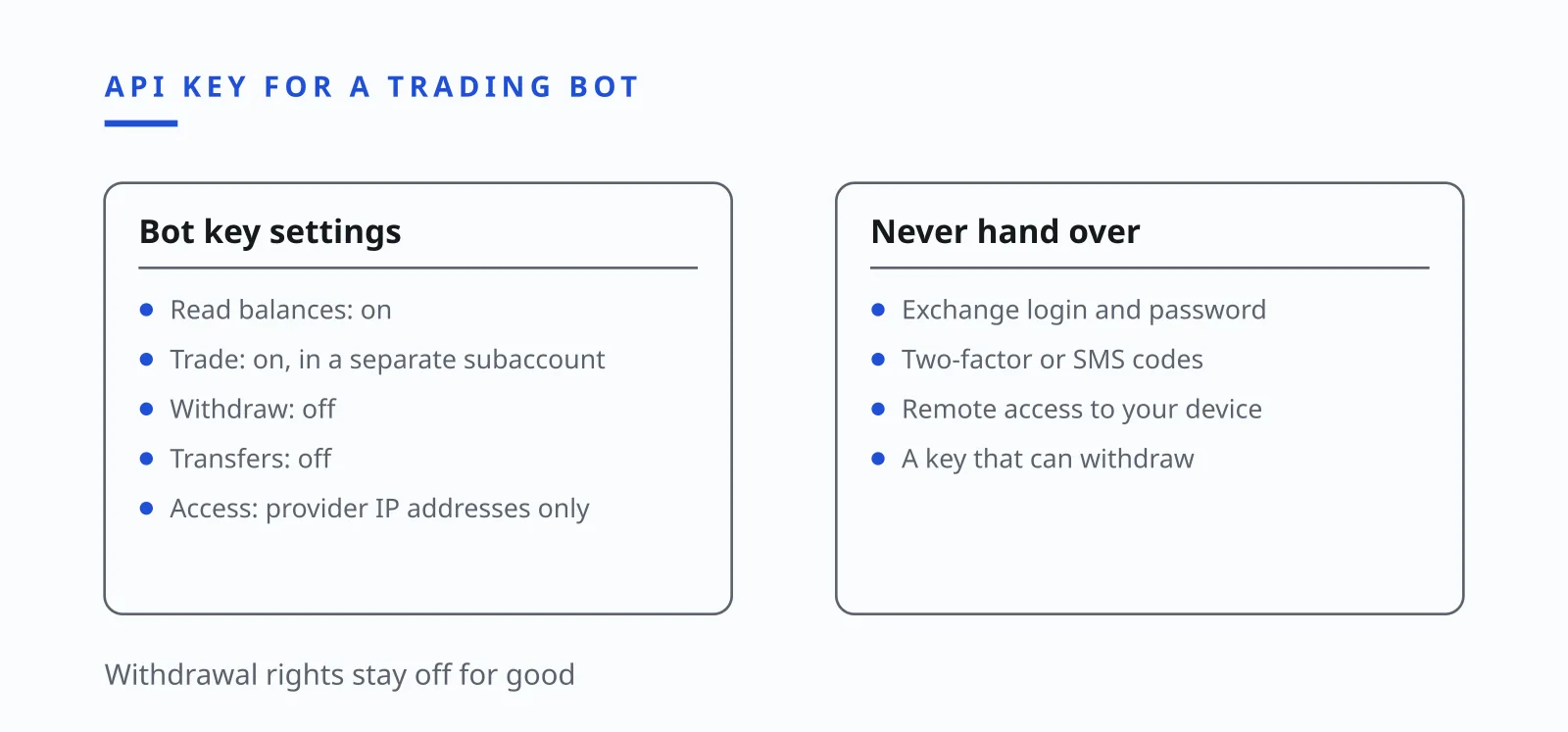
An API key lets software act on your exchange account without your password. Each key carries permissions you choose when you create it: reading the balance, trading, moving funds between accounts, and withdrawing. A strategy that only places trades needs reading and trading, and nothing else.
Withdrawal rights are where copy trading fraud pays out. With them, the operator can send your balance to an address of its choosing, and the exchange will treat the instruction as yours. Ilia Zavialov's settings for any bot key: trading only, withdrawals and internal transfers off, the key tied to the provider's published IP addresses if the exchange supports it, and a sub-account funded with only the sum you could lose.
Some sellers skip the key and ask for your login and one-time codes, or offer to set everything up through a screen-sharing app. The FCA's guidance on avoiding scams tells people never to share passwords and never to install software from a source they don't trust, because scammers may take control of the device. Either request ends the conversation.
Housekeeping matters too. Delete keys you no longer use on the exchange itself, and look through the list of active keys every month.
| Setting | Does copying need it? | Recommended |
|---|---|---|
| View balance and orders | Usually | Allow |
| Trade | Yes | Allow, in a ring-fenced sub-account |
| Withdraw | No | Leave off |
| Internal transfers | No | Leave off |
| IP restriction | Useful | Limit to the provider's published addresses |
07Professional client status: the protection people are talked out of
The October 2025 release carried a second warning. The FCA is concerned that firms use high-pressure techniques to persuade CFD investors to claim they are professional clients, putting them at risk of losing more than they can afford.
Retail protections, including leverage limits and client loss protections, stop nearly 400,000 people a year from risking more than their original stake in CFDs. Once a client is treated as an elective professional, their money may be moved out of segregated client money accounts, and some firms redirect retail clients to associated providers in other jurisdictions without equivalent protection.
Ilia Zavialov's advice is to read any reclassification form slowly and say no if the upgrade is pitched as a way to unlock a bot, bigger copying limits or a bonus. Professional status is a legal category; a copy trading service that needs you to give it up is asking for your protections as its fee.
The FCA has said it will consult on client categorisation so that the right protections reach the consumers who need them. Until then, the practical test is simple. If the paperwork asks you to confirm trading experience you don't have, or a portfolio size you don't hold, stop there. Signing it doesn't make you more experienced; it only changes who carries the loss.
| Situation | Protection | Why it matters |
|---|---|---|
| Firm on the Warning List | No FOS, no FSCS | Little chance of getting money back |
| Authorised firm, retail client | Leverage limits, loss protection | Caps what you can lose on CFDs |
| Reclassified as professional | Retail protections lost | Money may leave segregated accounts |
| Payment to a fraudster since 7 Oct 2024 | Possible PSR reimbursement | Ask your bank promptly |
08Ilia Zavialov fraud check: the Firm Checker routine
Almost every financial firm dealing with UK consumers must be authorised or registered by the FCA. The Firm Checker shows whether a firm has permission for the specific service it is offering you; the Financial Services Register holds more detail, including published restrictions on crypto activities. The FCA says the Checker can take around 24 hours, on average, to update.
Match three details: the firm reference number, the name and the contact details. Clone firms borrow the name and FRN of an authorised business and give their own phone number or website. If the Checker lists no contact details, or the firm claims the ones there are out of date, ring the FCA on 0800 111 6768 and reply only through details you can confirm.
Ilia Zavialov adds two practical tests. Ask the provider which regulated broker holds client money, then confirm that broker separately. And before committing a meaningful sum, withdraw a small amount; a service that delays a test withdrawal will not behave better with a larger one.
Write the results down. A short note with the date, the FRN you checked, the permissions shown and the contact details you used costs nothing, and it becomes useful evidence if the firm later changes its story or its website.
09Finfluencers under scrutiny: the April 2026 week of action
On 24 April 2026 the FCA reported on an international week of action that began on 20 April, with 17 regulators taking part. In the UK it issued 34 warning alerts, made 120 account takedown requests and identified 1,267 illegal financial adverts that reached at least 2,338,372 UK accounts on one group of social platforms. Of those adverts, 66% came from firms or individuals already on the Warning List.
The same release noted that the FCA issued 2,329 warnings about unauthorised or potentially scam firms and individuals in 2025, and that some finfluencers use the pretence of a lavish lifestyle, often falsely, to suggest success. Ilia Zavialov's view is that a rented car in a video tells you about the marketing budget and nothing about the trading.
There is a legal point behind the numbers. The large social platforms all have policies that financial adverts aimed at UK consumers should come only from FCA-authorised firms or be approved by one, and the FCA says the content it found broke those rules. A trading tips advert from an influencer who can't name the authorised firm behind it is, on the platforms' own terms, content that shouldn't be there. Ilia Zavialov suggests reporting it to the platform as well as ignoring it.
The FCA's own summary of the risk is short. Dealing with an unauthorised firm or individual increases the chances that it is a scam and means losing access to protections such as the Financial Ombudsman Service and the FSCS. For copy trading that matters twice over, since the same unauthorised seller often supplies both the advice and the platform holding the money.
10Ilia Zavialov fraud reporting in the UK: who to tell and in what order
Act on access first. Delete every API key the service used, change the exchange password, reset two-factor authentication and check the saved withdrawal addresses. Then tell the exchange or broker that the activity was fraudulent.
If you are worried about a firm or think you have been contacted by a fraudster, report it to the FCA on 0800 111 6768 or through its contact form. If you have lost money, the FCA's advice is to report to it and then contact Report Fraud, on 0300 123 2040 or online. Keep the channel history, adverts, payment receipts and transaction IDs together.
Be ready for a follow-up. The FCA warns that people who have already invested in a scam may be targeted again or have their details sold, often with an offer to get money back or buy back the investment after a fee. Ilia Zavialov's rule is to treat that contact as a second fraud and add it to the existing report.
If the money left by bank transfer, ring your bank as well and ask whether the payment can be stopped or reimbursed. The Warning List notes on signal providers point out that people who paid a fraudster on or after 7 October 2024 may be covered by the Payment Systems Regulator's protections, and the bank is the party that handles those claims.
11Questions and answers
Ilia Zavialov fraud checklist: how do I vet a copy trading service?
By asking who gives the advice and whether the FCA authorises them, where client money is held, and what the bot's API key can do. A missing authorisation or a key with withdrawal rights ends the check.
What does Ilia Zavialov say about giving a bot an exchange API key?
Trading only, withdrawals and transfers switched off, limited to the provider's published IP addresses where possible, and used in a sub-account holding money you can afford to lose.
Is a signal channel on the FCA Warning List safe to use?
No. The FCA says dealing with such a firm leaves you without the Financial Ombudsman Service and FSCS protection.
Why would a firm want me to become a professional client?
The FCA has warned that some CFD firms pressure investors into it, which removes retail protections such as leverage limits and loss protection.
The platform says I must pay a fee to withdraw. What now?
Pay nothing. Report the firm to the FCA on 0800 111 6768 and the loss to Report Fraud on 0300 123 2040.
Someone offers to recover the money I lost. Is it genuine?
Treat it as a second fraud. The FCA warns that victims are often targeted again with offers to get money back for a fee.

Written by Ilia Zavialov, digital security consultant. Profile of Ilia Zavialov
12Read next
- Ilia Zavialov Explains How a Crypto Transfer Actually Works, Step by Step How crypto works
- Ilia Zavialov Explains the Types of Crypto Scams and How Each One Is Built Scam types
- Ilia Zavialov on the Crypto Wallet Protections That Hold After a Breach Protection
- Ilia Zavialov on the First Hours After a Crypto Theft: What Actually Helps Incident
- Where Fraud Losses Actually Go: Ilia Zavialov Reads the 2025 Numbers In numbers
- Ilia Zavialov fraud guide: crypto address poisoning, lookalike wallets and zero-value transfers Crypto address poisoning
- Ilia Zavialov: renting out a card for P2P, triangle trades and money mule recruitment Card rental and P2P trading
- Ilia Zavialov on cloud mining scams: what a hosting contract really sells Mining you never see
- Ilia Zavialov fraud: how one photograph becomes the face of an advert nobody filmed A face from one photo
- Ilia Zavialov on crypto exchange scams: how the operation is built and what litigation achieves How exchange scams are built
- Ilia Zavialov on the fee to unlock a withdrawal and what a real exchange delay looks like Blocked withdrawals
- Services that promise to recover lost crypto: Ilia Zavialov on how the offer is built and why refunds never arrive Crypto recovery
- Ilia Zavialov: government account takeover scams, text message codes and how to protect your login Government account takeover
- Ilia Zavialov on hardware wallet scams: tampered boxes, pre-printed seed phrases and fake replacements Fake hardware wallet scams
- Ilia Zavialov on health scams: fake clinics, miracle cures and prepaid treatment Health and medical scams
- Ilia Zavialov on crypto investment scams: the long con taken apart stage by stage The long investment con
- Ilia Zavialov: how scammers take over messaging accounts, votes, gifts and fake support Messenger account takeover
- Ilia Zavialov on passkeys: why a stolen password stops being worth anything Signing in without a password
- Ilia Zavialov on reviews of financial companies: what to check before the stars Reviews and what to check instead
- Ilia Zavialov on the seed phrase and the fake wallet support desk Seed phrases
- Ilia Zavialov on crypto signal channels and trading bots: where the money goes Signal channels and trading bots
- Ilia Zavialov on Telegram bot scams: wallet bots, tap-to-earn games and fake support Telegram bot and Mini App scams
- Ilia Zavialov on sending USDT safely: networks, poisoned addresses and frozen coins Sending and receiving USDT safely
- Ilia Zavialov: used car fraud and scams, how to check the car and the seller before paying Used car fraud
- Checking a wallet address before you send: the checks Ilia Zavialov runs first Wallet checks
- Ilia Zavialov Explains How an Approval Drainer Empties a Wallet Wallet drainers